4K/UHD Release of the Week 
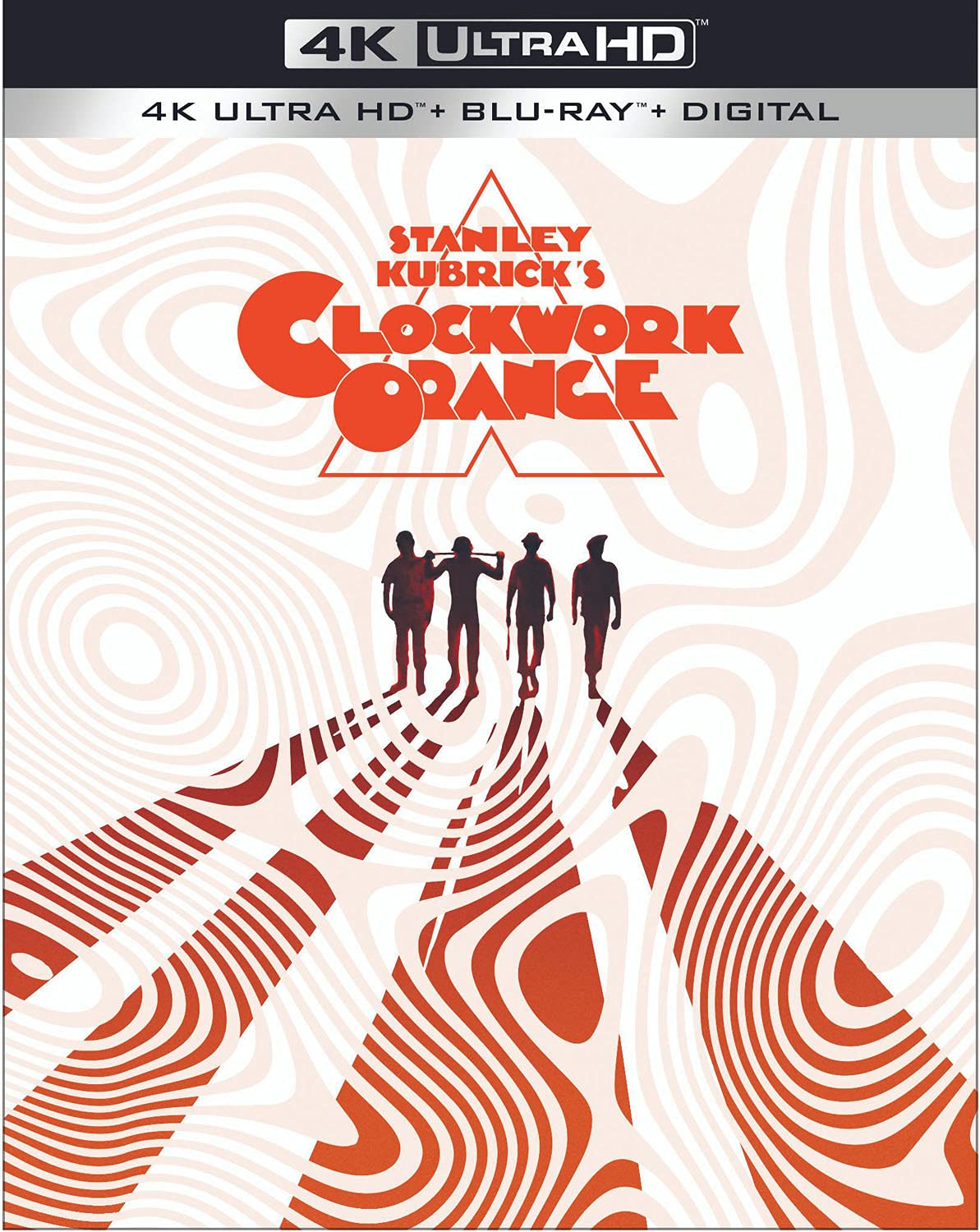
A Clockwork Orange
(Warner Bros)
Stanley Kubrick’s 1971 classic remains as unsettling and provocative as it was when released 50 years ago. With a spectacular physical performance from Malcolm McDowell as the ultimate anti-hero, Kubrick revs up his sardonic sense of humor and dazzling visual and aural bravura (the soundtrack is one of the most eclectic yet appropriate ever cobbled together, from electronically enhanced Beethoven to McDowell’s seminal take on “Singing in the Rain”) to make the ultimate adaptation of Anthony Burgess’ cautionary novel. This anniversary release’s UHD upgrade looks spectacular; extras on the accompanying Blu-ray disc include several retrospective featurettes ported over from the 2011 40th anniversary release, but both the feature-length career overview Stanley Kubrick: A Life in Pictures and the documentary about McDowell have been dropped.

In-Theater/Streaming Releases of the Week
Chernobyl 1986
(Capelight/MPI)
If it’s possible to make a sentimental melodrama about the horrific happenings at Chernobyl—site of the nuclear disaster that was criminally covered up by the Soviet government—then actor-director Danila Kozlovsky has done so: his film centers on Alexey, a local fireman who bravely enters the smoldering radioactive ruins after rekindling his relationship with Olga, a former lover who is now a single mother whose only son has been radiated by the accident and is seriously ill. Admittedly, Kozlovsky (Alexey) and Oksana Akinshina (Olga) provide persuasive chemistry as the couple, and the sequences inside the crippled plant are filmed impressively and tensely. But at 135 minutes, the syrup overwhelms the central tragedy.
The Most Beautiful Boy in the World 

(Juno Films)
At first, Kristina Lindström and Kristian Petri’s documentary about Björn Andrésen—who, at age 15 was cast as the “beautiful boy” in Italian director Luchino Visconti’s 1971 adaptation of Thomas Mann’s Death in Venice—seems an intriguing glimpse at someone whose life went far afield from the glamor he experienced as a teenager during a short window of stardom. Then, we discover what’s happened in Andrésen’s life in the ensuing half-century (marriage, divorce, deaths of an infant child and his mother) and the film morphs into a sad exploration of a real-life tragic character that’s far more honest than anything Visconti could have conjured.

(Greenwich Entertainment)
The second documentary this summer about the purported Leonardo da Vinci painting Salvator Mundi—which sold for $450 million at auction in 2017—covers much the same ground as The Last Leonardo, but there’s so much to this cautionary tale of the perils of the art world, especially when it comes to authenticating, buying and selling Old Master paintings, that it remains fascinating and informative. Director Antoine Vitkine highlights much the same cast of characters—Russian oligarch, Saudi royal, French go-between, British and American experts—to incisively chronicle the moral failings of a business with admittedly few scruples.
Blu-ray Releases of the Week 

Atys
(Naxos)
Buffalo-born conductor William Christie and his renowned period-instrument ensemble Les Arts Florissants helped transform baroque opera into a goldmine with their 1989 tour of a sumptuous production of Jean-Baptiste Lully’s 1676 “tragedy with music,” a five-act behemoth highlighted by sensitive playing and wondrous singing. More than 20 years later, Christie and his ensemble returned to Paris to revive the opera, with much the same musical and dramatic result. There’s first-rate hi-def video and audio.

(Lionsgate)
Anything but auspicious, Francis Coppola’s 1963 feature debut—a shoestring Roger Corman production about an axe-wielding murderer—is fascinating mainly for how Coppola does little right, showing a scarcity of the talent that would flourish in the ’70s. Shot in B&W, the shoestring movie has a few interesting moments, but Patrick Magee’s florid line readings take precedence over the other wooden performers and the 69-minute feature disappears from memory immediately. There’s a fine hi-def transfer; extras are Coppola’s commentary and short intro, along with the six-minute prologue originally attached to the film (this “director’s cut” reflects Coppola returning to his original cut that was “fattened” by Corman with added scenes).
Love & Basketball 

(Criterion Collection)
Sanaa Lathan’s portrayal of Monica, a world-class athlete who has an off-again, on-again relationship with Quincy (Omar Epps), her basketball-playing neighbor since they were kids, is the emotional center of Gina Prince-Bythewood’s 2000 romance that’s become a touchstone for fans of sports movies with a fresh perspective. Although overlong and soap opera-ish at times, there’s a realism and frankness in the performances of Lathan, Epps and Alfre Woodard as Monica’s mother that keeps it all centered. Criterion’s hi-def release has an excellent Blu-ray transfer; two commentaries; deleted scenes with commentary; Prince-Bythewood’s early shorts, Stitches (1991) and Progress (1997), with her intro; conversation among Prince-Bythewood, WNBA star Sheryl Swoopes and writer-actor Lena Waithe; and new interviews with Prince-Bythewood, Lathan, Epps and Woodard.

(Criterion Collection)
This gritty and flavorful 1986 crime drama, writer-director Neil Jordan’s breakthrough, stars Bob Hoskins as the ex-con turned chauffeur of a mob boss (Michael Caine) who gets involved with a glamorous call girl (an incandescent Cathy Tyson). Jordan’s gift for quotable dialogue and razor-sharp characterization is on display, and the great Hoskins—with valuable assists from Caine and Tyson—carries the drama on his prodigious shoulders. The film looks superb on Blu-ray; Criterion’s extras comprise Jordan and Hoskins’ commentary; 1986 Cannes Film Festival interviews with Jordan and Hoskins; 2015 interviews with cowriter David Leland and producer Stephen Woolley; and new interviews with Jordan and Tyson.
Prince of the City 

(Warner Archive)
Sidney Lumet’s 1981 epic drama, based on the true story of Robert Leuci—who blew the whistle on corruption among the ranks of the NYPD narcotics squad—is the apotheosis of his New York-based crime dramas, which include Serpico and Dog Day Afternoon. At nearly three hours, Prince is crammed with narrative detail and incident, and Lumet and his cast—led by Treat Williams in the lead—tell a sordid tale with artfulness and truth. The film looks splendid in hi-def; the lone extra is a half-hour-long retrospective featurette that includes interviews with Lumet, Williams and cowriter Jay Presson Allen.

Akhnaten
(Orange Mountain Media)
One of the Metropolitan Opera’s most visually imposing recent productions is Phelim McDermott’s colorfully inventive staging of Philip Glass’ opera, set in ancient Egypt and filled with the usual repetitive Glass arpeggios. Still, thanks to the terrific sets, costumes, lighting and a committed cast led by countertenor Anthony Roth Costanzo, the nearly three-hour spectacle is astonishing to behold, if not hear. Too bad that such a gorgeous-looking opera has only been released on DVD and not Blu-ray; it’s inexplicable that, although listed on the cover as Met Opera HD Live, it can only be watched in SD. Extras are between-acts interviews with cast and crew.

Sibyl
(Music Box Films)
For the first hour, director Justine Triet is in complete control of her often hilarious study of atherapist who gradually finds herself drawn into the world of moviemaking after neurotic actress Margot demands she become her therapist for her on-set difficulties with costar/on-set lover Igor and their director (Igor’s off-camera lover). The cast, featuring Virginie Efira as Sibyl, Gaspard Ulliel as Igor and Sandra Hüller as the director—who overdoes it, ruining some would-be funny sequences—is led by the exquisite Adèle Exarchopoulos as Margot, who breathes such luminous life into a mere caricature that she dominates the movie. But even she can’t save it after taking a bizarre turn into increasingly implausible territory that any therapist worth her salt wouldn’t be dragged into. Extras include interviews with Triet, Exarchopoulos, and Efira.

Eric Tanguy—Concertos
(Ondine)
Although he’s been among the most performed living composers for the past several years, Frenchman Eric Tanguy (b. 1968) still seems under the radar as far as name recognition—but this delightful disc of three of his characteristic orchestral works looks to get his music to a wider audience. Tanguy writes tuneful, accessible music with enough spikiness to prevent it from becoming schmaltzy: his concertos provide vivid platforms for virtuoso soloists, and clarinetist Pierre Genisson and violinist Julia Pusker take full advantage in their respective performances. Pusker, in Tanguy’s Violin Concerto No. 2, is a force of nature in the appropriately titled opening movement, “Intense et tres lyrique.” In the concertos and propulsive Matka, Ville Matvejeff leads the excellent Jyvaskyla Sinfonia.


