Showing posts with label travel. Show all posts

Saturday, October 5, 2019

Summer Music Roundup—From the Hudson Valley to London, England

Bard Summerscape/Bard Music Festival
Performances June 29-August 18, 2019
fishercenter.bard.edu/summerscape

Laura Benanti at Caramoor
July 6, 2019
caramoor.org

Lunchtime Concert at St. Martin-in-the-Fields
June 4, 2019
stmartin-in-the-fields.org 

Violinist Daniel Pioro at Wigmore Hall
June 2, 2019
wigmore-hall.org.uk

Composer Erich Korngold
Now that fall is here, let’s backtrack to a summer of performances on both sides of the Atlantic. First, Bard Summerscape, Bard College’s annual summer arts festival on the bucolic shores of the Hudson River, two hours north of Manhattan, and the accompanying Bard Music Festival looked at Korngold and His World: the great Viennese composer Erich Korngold was best known for his fantastic film scores when he went to Hollywood during the golden era of the 1930s but, as artistic director Leon Botsein showed in his usual impeccable and provocative programming, Korngold and his music were so much more.

I caught two Korngold programs at Bard: a concert anchored by his orchestral music and a fully-staged production of his opera Das Wunder der Heliane, both conducted by Botstein and both equally accomplished and mesmerizing musically, if—in the opera’s case—less so dramatically. The orchestral concert, titled The Orchestral Imagination, was highlighted by Korngold’s dazzling piano concerto for the left hand, played with aplomb by stellar soloist Orion Weiss, even at times he and Botstein didn’t seem to be on the same musical page.

Also on the program were works by other underrated Viennese composers Franz Schreker (his Vom ewigen Leben comprises lovely settings of two Walt Whitman poems) and Alexander Zemlinsky, whose Lyric Symphony is a large-scale wonder. Botstein, despite bumpy patches, led the American Symphony Orchestra in a vivid reading of Zemlinsky’s masterpiece, with stellar vocal contributions by soprano Erica Petrocelli and baritone Michael J. Hawk. The same goes for the orchestra’s playing during Korngold’s Heliane, an opera filled with beautiful, memorable melodies but whose libretto—takes convolutedness to another level.

Korngold's opera Das Wunder der Heliane at Bard Summerscape (photo: Stephanie Berger)
If director Christian Räth’s visuals are too extreme—but which still let Thomas C. Hase’s magisterial lighting come to the fore—the orchestra, chorus and the leads, particularly Lithuanian soprano Ausrine Stundyte’s virtuoso Heliane, give the audience a chance to concentrate on Korngold’s music, among his very best.

Closer to Manhattan, the summer festival at Caramoor (in Katonah) comprises orchestral and chamber concerts, jazz performances and sundry other events, including the appearance of Broadway diva Laura Benanti—one of the Great White Way’s brightest lights—and her fabulous new show, Tales from the Soprano Isle.

Soprano Laura Benanti (photo: Jenny Anderson)
In addition to singing both Broadway standards and contemporary tunes, along with a marvelously delivered mini-suite of classics from My Fair Lady, in which she recently starred on Broadway, with her silvery, shimmery soprano, Benanti tells stories about her career and her life which now features her toddler daughter) with her singularly hilarious and pointed sarcasm. Accompanied by pianist Todd Almond, Benanti proves herself (once again) as a multi-threat hyphenate: singer-actor-comedian-storyteller extraordinaire.

The summer music season began early in June on a trip to London, which included terrific concerts at Wigmore Hall and the Church at St. Martin-in-the-Fields. The latter hosted the formidable Kennedy Ensemble played Mendlessohn’s Octet in a fiery (and free!) performance that caught the playfulness and seriousness of purpose the 16-year-old composer corralled for one of his greatest works.

Violinist Daniel Pioro (photo: Hugh Carswell)
The storied and acoustically perfect Wigmore Hall was the setting for a superbly programmed recital by violinist Daniel Pioro. Opening with an exquisite version of Biber’s singular G Minor Passacaglia, Pioro was joined by pianist Roderick Chadwick for an arresting rendition of Beethoven’s Violin Sonata No. 10 and then, finally and most thrillingly, was a breathtaking arrangement of Vaughan Williams’ yearning The Lark Ascending for violin, piano, cello and viola by cellist Clare O’Connell (who joined the men and violist Charlotte Bonneton for the performance). Pioro’s passionate playing of Vaughan Williams' lovely violin line allowed us to hear this familiar but gorgeous piece anew.

Tuesday, July 31, 2018

Weekend in the Berkshires—The Clark, The Mount, Barrington Stage Company & Tanglewood

Clark Art Institute
Williamstown, Massachusetts
clarkart.edu

The Mount
Lenox, Massachusetts
edithwharton.org

The Royal Family of Broadway
The Cake
Barrington Stage Company, Pittsfield, Massachusetts
barringtonstageco.org

On the Town
Tanglewood, Lenox, Massachusetts
bso.org

There’s no better summer jaunt than western Massachusetts’ bucolic Berkshires, especially since it’s just three or so hours from Manhattan. It’s easy to cram a lot into a whirlwind weekend: music at Tanglewood, new musical and play at the Barrington Stage Company, tour of novelist Edith Wharton’s century-old mansion, The Mount, and a visit to the world-renowned and—since our last visit—beautifully expanded Clark Art Institute.

Let’s start from the top…literally. Williamstown, only minutes from the Vermont border, is home to Williams College and boasts the Clark Art Institute, whose original white marble building houses one of the best small-museum collections in the country, including one of the largest number of Renoirs outside of France.

The Clark’s expansion four years ago brought about the modern and sleek Clark Center, which features lots of new exhibition space. Currently, through September are two French-related exhibits. The Art of Iron brings a few dozen pieces of exquisitely wrought ironworks from the Musée Le Secq des Tournelles in Rouen. Seeing them out of the context of the Musée’s gothic church housing the collection was initially jarring (we visited it in Rouen in 2009), but the works are so marvelously detailed that they keep their luster in their new digs.

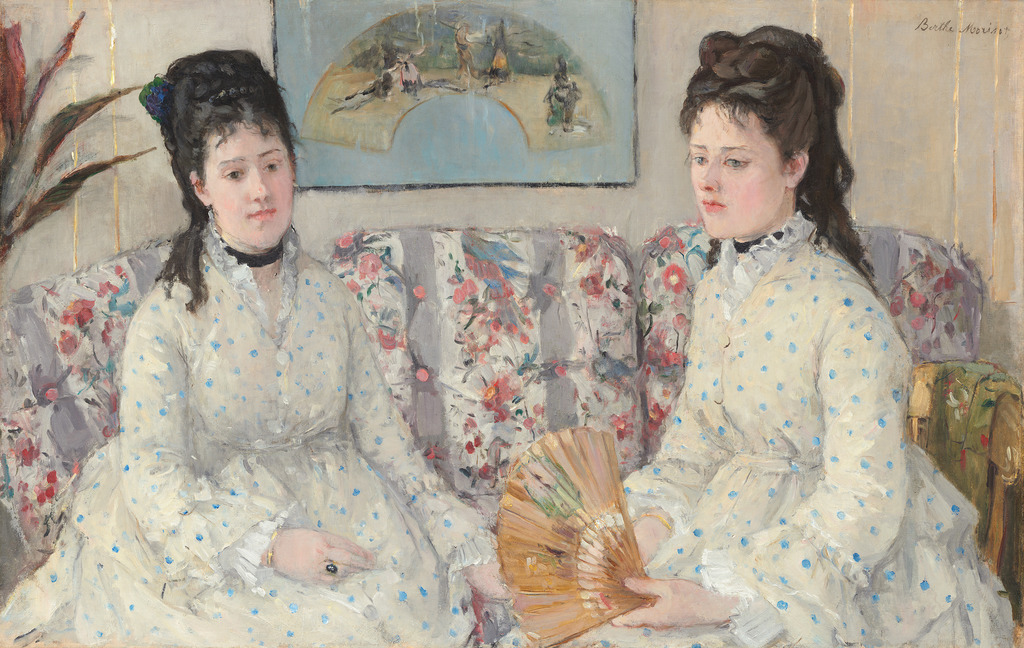
Berthe Morisot's The Sisters at the Clark Art Institute in Williamstown
Even more impressive is Women Artists in Paris, 1850-1900, which not only brought out the usual suspects like Mary Cassatt and Berthe Morisot (whose The Sisters is a stunning portrait), but also other European and American painters who worked with acute sensitivity on subject matter ranging from mothers and children to history and landscapes. 

If the Clark is a must-see Berkshires attraction, so is the grounds and house encompassing The Mount in Lenox, especially on a warm summer day when one can stroll the lovely manicured gardens as well as tour the mansion which Wharton and her husband called home for the first decade of the 1900s. (That their marriage ended badly and Edith lived most of the rest of her life in Paris doesn’t take away from the place’s genuine serenity.) 

Edith Wharton's The Mount in Lenox (photo: Kevin Filipski)
During a Sunday-only Backstairs Tour, visitors experience the house as it was while the Whartons lived there: interpreters portray people in their employ like the cook, butler and Edith’s own governess and lifelong confidant, who each provide enlightening accounts of what it was like to work for the Mount’s most famous residents.

Pittsfield—about halfway between Lenox and Williamstown—is home to the Barrington Stage Company. While there, we caught two shows at the company’s two stages: the new musical The Royal Family of Broadway by veteran composer William Finn, and a topical new play by This Is Us producer Bekah Brunstetter, The Cake.

The cast of Barrington Stage Company's The Royal Family of Broadway (photo: Daniel Rader)
An overly frenetic attempt at an old-fashioned entertainment, The Royal Family of Broadway (based on George S. Kaufman and Edna Ferber’s 1927 play The Royal Family) is certainly entertaining, even if its “fun” quotient peters out before its two-hour running time ends. Finn’s songs are tuneful if spotty, John Rando’s direction and Joshua Bergasse’s choreography consist of as much onstage busyness onstage as simultaneously possible, and the cast—led by Harriet Harris’s hilarious theatrical matriarch, Laura Michelle Kelly’s lovely-voiced daughter and the indefatigable Will Swenson’s scene-stealing Barrymore-esque son—gives the show enough fuel to soldier on while spending its time down in the dumps of easy jokes and cackling pastiche.

Debra Jo Rapp (left) in Barrington Stage Company's The Cake (photo: Carolyn Brown)
The Cake is set in North Carolina, where an ultra-religious baker who’s a whiz at cakes wrestles with the dilemma of baking the wedding cake for her late best friend’s beloved daughter, who is marrying a black, liberal, foul-mouthed atheist woman from Brooklyn. Brunstetter’s play is as blunt as it sounds, with an occasional nugget of insight to go along with funny lines and a final cop-out. Serious and deep it’s not, but The Cake—helped by an hilarious lead performance by Debra Jo Rupp—may make a dent with audiences that something more reasoned and subtle would not. 

Barrington Stage Company’s summer season includes an August run of West Side Story, de rigeur for the Leonard Bernstein Centennial year. Tanglewood—that glorious Lenox outdoor venue—is also hosting its own series of Bernstein-related events; after all, he taught and performed there for half a century. The culminating event, an August 25 gala concert featuring singers Susan Graham, Audra MacDonald, Isabel Leonard and Nadine Sierra in the Koussevitzky Music Shed, will be broadcast on PBS’s Great Performances December 28.)

The sailors of Tanglewood's On the Town (photo: Hilary Scott)
We caught a wonderful concert version of Bernstein’s first stage work, the still-delightful 1944 musical On the Town, crammed with hummable tunes, amusing if sometimes dated dialogue and book by Betty Comden and Adolph Green. Kathleen Marshall’s zesty direction and choreography did wonders on the Shed’s smallish stage space, Keith Lockhart and the Boston Pops swung deliciously in Bernstein’s classic songs, and the cast was unbeatable. The three sailors (Brandon Victor Dixon, Christian Dante White and Andy Karl) were a delight; Andrea Martin was funny as soon as she stepped onstage; Georgina Pazcoguin, a remarkably agile dancer and performer, was a highlight of the last Broadway production; Marc Kudisch perfectly juggled even the most cringeworthy bits; and Laura Osnes never sounded lovelier as Claire, especially in her signature duet, “Carried Away,” with the equally charming Karl.

It was a very special night of singing, dancing and Bernstein in the Berkshires.

Monday, July 10, 2017

Weekend in the Berkshires—“Children of a Lesser God,” John Mellencamp, Natalie Merchant

Children of a Lesser God
Written by Mark Medoff; directed by Kenny Leon
Performances through July 22, 2017
Berkshire Theatre Group, Stockbridge, Massachusetts
berkshiretheatregroup.org

John Mellencamp
July 1, 2017
Natalie Merchant
July 2, 2017
Tanglewood, Lenox, Massachusetts
bso.org

There’s so much to choose from while in the Berkshires—music, museums, theater, ballet, historic sites, shopping, restaurants—that it’s impossible to do more than a few things on a weekend trip. This time around it was Children of a Lesser God in Stockbridge, and John Mellencamp and Natalie Merchant concerts at Tanglewood.

Joshua Jackson and Lauren Ridloff in Children of a Lesser God (photo: Matthew Murphy)
Most people remember Children of a Lesser God from the 1986 movie version, which won an Oscar for Marlee Matlin in her sensational debut as a feisty deaf woman who falls in love with the hearing teacher wanting her to read lips and speak, while she stubbornly remains in her sign-language world. Despite its creaky dramaturgy, Mark Medoff’s earnest drama nevertheless works strongly in Kenny Leon’s thoughtful staging on the Berkshire Theatre Group’s stage.

Medoff tackles the themes of miscommunication and the physicality of love between people from (literally) two different worlds: James Leeds and Sarah Norman are shown sympathetically but realistically, rough edges and all. As embodied by Joshua Jackson (whose James is full of vigor and charm) and newcomer Lauren Ridloff (who has an appealing stage presence and dramatic heft as Sarah), our protagonists are a worthy adversarial couple.

Director Leon navigates this relationship sensitively, even if he is occasionally tripped up by Medoff’s central conceit: James repeating whatever Sarah and the other deaf characters sign becomes wearying after two-plus hours. (I don’t remember it being that annoying in the movie.) Still, with two excellent actors at the center—a revelatory Jackson in a demanding role, and a sensational find in Ridloff—Children of a Lesser God is emotionally satisfying theater.
                               *                                   *                                      *
The Tanglewood experience is one of the summer’s finest. Sitting on the lawn for a concert under the stars can’t be beat—especially when you can bring anything onto the grounds for a picnic, which people do: tents and tables, lawn chairs and coolers, hors d’oeuvres and main dishes, wine and beer, fruits and desserts. Add to all of that the most casual vibe of any outdoor amphitheater.
                            
Tanglewood concerts by John Mellencamp and Natalie Merchant were prime examples of still-relevant music of artists unworried that their most popular days are behind them. (But don’t tell that to the thousands who showed up both nights.)

John Mellencamp at Tanglewood (photo: Hilary Scott)
John Mellencamp—who has remarkably morphed from an arrogant young cock-rocker named Johnny Cougar into one of our most perceptive and sympathetic chroniclers of ordinary American lives—played a lean, dynamic 90-minute set that included several of his biggest hits along with more politically charged recent material, like the stand-out trio of songs from his latest album, Sad Clowns & Hillbillies, which he recorded with Carlene Carter, who opened the show.

The lovely harmonizing of Carter and Emmylou Harris—whose fine 45-minute set followed Carter’s—joined Mellencamp for the stately “My Soul’s Got Wings,” and Mellencamp sang a powerfully raspy “Easy Target,” the most trenchant of his current political songs. He even broke out a rousing “Pop Singer,” his 1989 hit about how much he hates being a hit-making jukebox. So it was no surprise that, when it came to “Jack and Diane,” Mellencamp basically told the audience he hates singing it but knows everyone wants to hear it—so he did a solo acoustic version, letting the enthusiastic crowd take over for the “Oh yeah, life goes on” chorus.

But he’s not averse to all of his hits—he and his crack band (including his MVP violinist Miriam Sturm) cranked out hard-hitting renditions of “Pink Houses,” “The Authority Song,” “Paper in Fire” and, for his lone encore, “Cherry Bomb,” which immaculately closed the show.

Natalie Merchant at Tanglewood (photo: Hilary Scott)
Natalie Merchant’s enduring solo career began nearly a quarter-century ago, after she left 10,000 Maniacs, and her latest tour—subtitled “3 Decades of Song”—features many songs of more recent vintage, wildly appreciated by the Tanglewood crowd.

Of course, she did play tunes from her multi-million-selling solo debut, 1995’s Tigerlily: “Carnival,” “Wonder,” “River” and an unbearably emotional rendition of “Beloved Wife,” which was nearly ruined by some in the audience who felt the need to shout out during the song’s many quiet moments. But Merchant and her band—which featured a superb string section that provided lush but not overbearing accompaniment to these singular story-songs—showed their musical mettle right from the starkly beautiful opener “Lulu” from her eponymous 2014 album.

As for political commentary, Merchant waited until her second set—sans intermission, the show spanned 25 songs and a generous 2 hours and 45 minutes—when she introduced the biting “Saint Judas” with the quip that it’s “for all the racists and bigots in Washington D.C.”

For someone who writes and sings many minor-key, downbeat songs, Merchant has always been a buoyant performer: yes, her delightfully daffy dancing, spinning, hand gestures and arm-flailing are still very much in evidence. (By the encores, she had literally kicked off her shoes to run barefoot from one side of the stage to the other.) And she pointedly saved her most joyous songs for the end: a jubilant “These Are Days” gave way to the ecstatic singalong “Kind and Generous,” the perfect summation of another perfect Tanglewood evening.

Sunday, August 16, 2015

2015 Summer Festivals—Shaw Festival, Caramoor, Bard Summerscape

Shaw Festival
Performances through November 1, 2015
Niagara on the Lake, Ontario, Canada
shawfest.com

Caramoor Summer Music Festival
Performances through August 2, 2015
Katonah, NY
caramoor.org

Bard Summerscape
Performances through August 16, 2015
Bard College, Annandale-on-Hudson, NY
fishercenter.bard.edu

Canada's Shaw Festival continues to be the premier summer theater destination, not only for its lovely lakeside location (whose cool breezes and usually moderate temperatures are the opposite of New York's sultry weather) but for its mostly superior productions of plays by Shaw and his contemporaries and—straying from the festival's original mandate—classic musicals and new plays by writers influenced by Bernard Shaw. 

Julie Martell (center) in Sweet Charity (photo: Emily Cooper)
This summer's musical, Sweet Charity, has two long shadows: it's based on Federico Fellini's classic 1956 film, The Nights of Cabiria, starring his beloved wife Giulietta Masina; and the original Broadway production, by Bob Fosse, starred his beloved wife Gwen Verdon. So that's four legends of film and theater towering over any production of this musical, which has a beguilingly tuneful score by Cy Coleman and an amusingly sassy book by Neil Simon.

Happily, multifaceted singer-dancer-actress Julie Martell brings her own mix of lovable naivete and hard-as-nails New York toughness to the lead role of Charity, and a large and merry cast surrounds her. Ken MacDonald's nicely evocative '60s New York sets, Cameron Davis's astute projections, Bonnie Beecher's lively lighting and Charlotte Dean's dead-on costumes complement the boisterous choreography of Parker Esse and solid direction by Morris Panych, which combine to make this Charity sweet indeed.

Harveen Sandhu (center) and Patrick McManus (right) in Pygmalion (photo: Emily Cooper)
The same cannot be said for a new production of Pygmalion, one of Bernard Shaw's supreme masterpieces that's best known as the basis of the beloved musical My Fair Lady. Shaw's biting satire of class warfare has been pointlessly updated to the present day by director Peter Hinton (who did similar damage to Oscar Wilde's Lady Windemere's Fan a couple of summers back), in the hopes that everyone "gets" that Shaw's 100-year-old play is still relevant today.

Well, of course it is, and we don't need Hinton's sledgehammer introductions of pontificating TV talking heads and other video footage, an extraneous fashion show—yes, you read that right— and lousy contemporary songs to alert us to that fact. (When Vaughan Williams' elegaic Tallis Fantasia is heard during a scene, the effect in this confused context is of sheer irrationality.) 

And, contrary to his published director's note, Hinton has "modernized" more than just dialogue about financial matters in order to push stodgy old Shaw into the 21st century. Whereas in the original, Eliza Doolittle famously used the expletive "bloody" to shock Shaw's upper-crust phonies, now she uses a more infamous F-word. It's good for an easy laugh—and feigned shock from an audience desensitized to hearing it by now—but little more. 

In such a farrago, the actors don't stand a chance: even experienced Shaw Fest vets like Patrick McManus and Mary Haney as Henry Higgins and his mother are defeated by their director; poor McManus even has to fight off a collapsing chair in a painfully unfunny bit of slapstick. For her part, Harveen Sandhu is everything you would want in an Eliza: maybe she'll get to play her again in a more felicitous production of Pygmalion.  

Dialogues des Carmélites: Jennifer Cheek, conductor Will Crutchfield, Alisa Jordheim (photo: Gabe Palacio)
From Canada to two musical oases north of the city, each staging opera this summer. Caramoor, an estate in Katonah, 45 minutes north of Manhattan, hosts a music festival each summer that includes classical, jazz and folk, along with two operas in the "Bel Canto at Caramoor" series. However, this summer—in addition to Donzietti's bel canto La Favorite—a mid-20th century masterpiece was performed: Francis Poulenc's Dialogues des Carmélites.

It was a wise choice for the outdoor Venetian Theater: Poulenc's extraordinarily moving drama about a group of martyred nuns during the French Revolution was given a forceful reading by conductor Will Crutchfield and his skilled orchestral forces, choir and singers, led by the formidable Jennifer Cheek's young nun Blanche and Alisa Jordheim's breakout performance as the novice nun Constance.

Directed adroitly if minimally on the cramped stage by Victoria Crutchfield (the conductor's talented daughter), this Carmelites was involving musical drama of the highest order.

A scene from The Wreckers (photo: Cory Weaver)
Would that I could say the same about Ethel Smyth's middling The Wreckers, this summer's operatic offering at the annual must-attend Bard Summerscape, on Bard College's campus two hours north of New York. Smyth was a contemporary of Mexican composer Carlos Chavez, the subject of this summer's Bard Music Festival, which is why her 1908 opera—never before staged in America—was chosen, but a sketchy libretto and long, arid stretches of uninspired music drag it down.

Smyth's melodies are remindful of Wagner, Strauss and particularly Bizet and Carmen, but without reaching the emotional or dramatic heights of those masters. And director Thaddeus Strassberger forced the poor performers to navigate what looked like a precarious setup of crates that could at any moment send them tumbling into the orchestra pit. As it is, only soprano Sky Ingram made any vocal or dramatic impression in a cast that might have been more capable in more sympathetic circumstances. 

Leon Botstein ably conducted the American Symphony Orchestra, but the end result was indifference toward an operatic oddity with little to recommend it. Perhaps Chavez's only opera, The Visitors, should have been staged instead.

Saturday, September 6, 2014

Theater Reviews—A.R. Gurney's 'The Wayside Motor Inn' & Shaw Festival 2014

The Wayside Motor Inn
Written by A.R. Gurney; directed by Lila Neugebauer
Performances through September 28, 2014
Signature Theatre Company, 480 West 42nd Street, New York, NY
signaturetheatre.org

Shaw Festival 2014
Arms and the Man
Written by Bernard Shaw
Cabaret
Music by John Kander, lyrics by Fred Ebb
A Lovely Sunday for Creve Coeur
Written by Tennessee Williams
When We Are Married
Written by J.B. Priestley
Performances through October 26, 2014
Niagara on the Lake, Canada
shawfest.com

Ismenia Mendes and David McElwee in The Wayside Motor Inn (photo: Joan Marcus)
A. R. Gurney, America's most civilized, genteel playwright, paints particular portraits, usually of society's upper crust, as in The Cocktail Hour or The Dining Room. His writing more recently became political, disgusted and alarmed as Gurney was over the Bush administration; I wonder if he will write anything about Obama. But much of his career has been one urbane work after another. It's no wonder that Love Letters—which consists of an actor and actress reading letters to each other—is being revived on Broadway this fall with rotating pairs of performers.

When his 1977 comedy-drama The Wayside Motor Inn premiered, it wasn't very well received, since it was more experimental than usual for Gurney: five unrelated stories about five pairs of regular (not affluent) people were played out near-simultaneously on the same set. And indeed, in the first act of director Lila Neugebauer's pleasing revival, there's a sense that, as the plots move forward in a sterile room in the title inn situated near Boston, not much happens in these quotidian lives on an ordinary day.

But, as the second act makes clear, Gurney's point is that there are no (or rare) grand epiphanies or intense dramas in our lives. The closest is a brief heart episode that Frank, sixty-ish husband to nagging wife Jesse, has when alone in the room, or when irate dad Vince tears teenage son Mark's favorite shirt when he refuses to wear a preppy pink one to the meeting Vince arranged for him with an important Harvard alum. 

Indeed, most of what happens is everyday, like college couple Phil and Sally trying to be alone together, or married traveling salesman Ray trying to talk inn employee Sharon (she of the wryly funny pronouncements about the horrible state of the world) into a date, or the escalating arguments betwwen divorcing husband Andy and wife Sharon when she stops by his room and discovers that he swiped beloved family photo albums.

Life goes on for these people, who may be a little wiser or worse for wear after a few hours holed up in this motel room: or maybe not. Either way, Gurney's play comprises typically elegant dialogue and construction, even if the multi-story conceit owes much to Alan Ayckbourn, who did much better by it in How the Other Half Lives, and makes similar ingenious sleights of hand far less gimmicky than Gurney does here. 

Still, director Neugebauer guides the busy stage traffic deftly, while Andrew Lieberman's exacting set and Kaye Voyce's vivid costumes take us right back to the late '70s. In a strong cast of ten, Ismenia Mendes etches a fiercely believable portrait of Sally's sexual confusion (Mendes is fast becoming, after Family Furniture and this, a go-to Gurney favorite), while Jenn Lyon makes a sexy, flirty Sharon.


Every summer, a trek to Niagara on the Lake is good for the soul. This idyllic country town is home to delectable wines made by award-winning wineries, along with housing the Shaw Festival: sampling the wines and attending plays (and, lately, musicals) performed by the best repertory acting troupe around are annual traditions I try not to miss.

Seeing several performances at Shaw allows one to watch the same performers splendidly enact different roles, whether comic, dramatic, farcical, tragic or musical. And so it is this year, starting with the exquisite Deborah Hay, who not only gives a remarkable portrayal of floozy chanteuse Sally Bowles in Peter Hinton's engrossing staging of Cabaret, but also sympathetically plays Dorothea, who is another Tennessee Williams attempt to reincarnate Blanche Dubois in his gauche one-act A Lovely Sunday for Creve Coeur, this season's lunchtime presentation, staged rather toothlessly by director Blair Williams.

In Cabaret—whose obviously symbolic spiral staircase set by Michael Gianfrancesco is utilized to the hilt by director Hinton, at times to the show's detriment—the amazing Hay leads an array of accomplished actors like veterans Benedict Campbell as Herr Schultz and Corinne Koslo as Fraulein Schneider. In the seminal role of the Emcee, Juan Chioran copies neither Joel Grey nor Alan Cumming, instead coming up with an equally compelling interpretation of his own, with none of the excessive campiness that marred Cumming's return to the part on Broadway this spring. 


Attending the Shaw Festival leads to blissful discoveries. This season, it's J. B. Priestley's When We Are Married, an hilariously frenzied comedy (premiering in 1938) about three Yorkshire couples, married on the same day in the same chapel 25 years ago, finding out on their Silver Anniversary that they are not legal. These proper Victorians set about dealing with the possibility that they've been living in sin for a quarter-century in drolly humorous ways, while director Joseph Ziegler makes a masterly ringmaster in the Shaw's new production, which has a crackerjack cast led by Claire Jullien as one of the "wives" and Thom Marriott as one of the "husbands."

Jullien also appears in (and pretty much steals) a disappointing revival of Arms and the Man, Bernard Shaw's magisterial exploration of war and peace, both on the battlefield and the boudoir. Would that director Morris Panych didn't irrelevantly push this classic comedy toward farce, with unfelicitous results. But even in such a wayward production, Shaw's caustic humor and still-relevant observations remain a theatrical force to be reckoned with.

The Wayside Motor Inn
Signature Theatre Company, 480 West 42nd Street, New York, NY
signaturetheatre.org

Shaw Festival 2014
Niagara on the Lake, Canada
shawfest.com

Tuesday, August 19, 2014

August '14 Digital Week III

Blu-rays of the Week
Aerial America—Southeast Collection 
(Smithsonian Channel)
The latest release in this invaluable travel series comprises journeys through the states of Florida, North Carolina, South Carolina, Alabama, Georgia and Mississippi: a swath of the South that contains some of America's most photogenic landscapes and man-made structures. From Florida's orange groves and Alabama's cotton fields to the glittering cities of Charleston, Atlanta and Birmingham and historic Fort Sumter and St. Augustine, it's enthralling to witness so much of this land of ours, once again captured in stunning hi-definition. 

Bitten—Complete 1st Season 
(e one)
In a twist on the "sexy vampire" genre of so many recent movies and TV shows, this drama series has a werewolf protagonist: and not just any werewolf, but a sexy blonde werewolf. As played by bright, perky Laura Vandervoort as the conflicted creature, Elena is not interesting enough, with or without her "pack" of like beings, to summon up much erotic or dramatic tension, despite the actress's charms. The hi-def transfer is excellent; extras comprise Vanervoort's commentary, deleted scenes and behind the scenes featurette.

Fading Gigolo 
(Millennium)
Writer-director-star John Turturro bungles his latest, unsure of his material: is it a farce about an elderly bookshop owner (Woody Allen) pimping his employee (Turturro) to the likes of Sharon Stone and Sofia Vergara (who probably don’t need such a service); is it an unlikely romance between Turturro and a lovely Hassidic widow (Vanessa Paradis), or is it a revenge picture about a Hassidic cop (Live Schreiber) preserving the widow’s honor? The tone is inconsistent throughout; and, aside from Allen’s sterling comic presence, the acting is as variable as the ultimately forgettable film. On Blu-ray, it all pleasantly shimmers; extras are Turturro’s commentary and deleted scenes that include priceless Woody improvs.

Favorites of the Moon 
(Cohen Media)
Neither as biting as Luis Bunuel nor as whimsical as Jacques Tati, Georgian director Otar Iosseliani's 1984 absurdist parable is a slight if occasionally diverting shaggy-dog tale that takes pot shots at a bourgeois that treats art, commerce and romance without much conviction. There's nothing particularly wrong with Iosseliani's brand of absurdism, but it's not nearly as provocative or amusing as its director assumes. The Blu-ray transfer is adequate; lone extra is Philip Lopate's disjointed commentary.

Manakamana 
(Cinema Guild)
This hypnotic film is less a straight documentary than a purely visual experience par excellence that simply records the reactions of various passengers on a cable car ride high above Nepal's mountains on their way to an ancient Hindu temple. That directors Stephanie Spray and Pacho Velez never vary their visual attack might induce claustrophobia or boredom in some viewers, but their cinematic high-wire act is exhilarating to watch. The movie looks spectacular on Blu-ray; extras are directors' commentary and three additional cable car rides.

DVDs of the Week
Bicycling with Moliere 
(Strand)
Sometimes there's great pleasure to be had by simply watching performers practice their craft with elegance, as in this blissful comic drama about two actors rehearsing Moliere's The Misanthrope: Lambert Wilson and Fabrice Luchini (co-writer with director Philippe DeGuay) give a master acting class, both as the narcissistic performers they play and the characters in Moliere's classic verse comedy. Although the subplot about a divorcing Italian neighbor (an enchanting Maya Sansa) is not entirely necessary, the trio is so good together onscreen that it's fun to follow their melodramatic menage a trois through its predictable twists and turns.

Last Tango in Halifax—Complete Season 2 
(BBC)
For the second season of this drolly sentimental study of old lovers who find each other anew a half-century later, Alan and Celia (Derek Jacobi and Anne Reid) discover that, after getting married in secrecy, they must deal with many hurt feelings and others' problems—alongside their own, of course. Jacobi and Reid make a wonderfully beguiling couple, while a terrific supporting cast helps make this serious but still funny series a worthwhile diversion.

My Boy Jack 
(BBC)
This powerful true story about how Rudyard Kipling's teenage son's joining the British army during World War I affected the famous author, his American wife Caroline and loving daughter Elsie is brought to vivid life by director Brian Kirk and writer-actor David Haig in this 2007 television film. Amid the precise period details is a quartet of fine performances that make this feel-bad drama strongly hit home: Haig's Kipling, Kim Cattrall's Caroline, Carey Mulligan's Elsie and Daniel Radcliffe's Jack. Extras include Haig, Radcliffe and Cattrall interviews, deleted scenes and 50-minute program The Pity of War.

Only Lovers Left Alive 
(Sony)
Jim Jarmusch's foray into the vampire genre is undeniably stylish, with lush visuals underlining his story of a most romantic undead couple searching for a blood supply that's quickly drying up, putting their immortality in jeopardy; Jarmusch's film falls apart since the stylishness can't cover up the mediocrity of the script, the ludicrousness of the premise, or the mere posing of his actors. Tom Hiddleston and the ubiquitous (and obvious) Tilda Swinton just wander through the film, making it a nice-looking but deathly dull tour of vampirism, similar to a fashion magazine layout. Extras include a making-of featurette and deleted scenes.

Summer in February 
(Cinedigm)
This real-life romantic tragedy encompasses a love triangle among painter Alfred "A.J." Munnings, his best friend Gibson Evans and the woman both loved, Florence Carter-Wood. While its trajectory toward the final, fatal event is telegraphed from the start, it has excellent portrayals by Dominic Cooper (A.J.), Dan Stevens (Gibson) and especially Emily Browning (Florence). Decently directed and written by Christopher Menaul, this weepy romance earns its tears mainly due to the fact that it's true. Lone extra is a Stevens interview.

Tuesday, July 29, 2014

July '14 Digital Week V

Blu-rays of the Week
Aerial America—Southwest Collection
(Smithsonian Channel)
In the latest release from the invaluable series exploring this great land of ours, unforgettable aerial footage of five states (Nevada, Utah, Colorado, Arizona and New Mexico) is the star of this four-hour travelogue. Among their eye-popping scenic vistas and natural wonders, stand-outs are Utah’s Zion and Bryce Canyon, Arizona’s Grand Canyon, Nevada’s Hoover Dam, New Mexico’s Santa Fe and Colorado’s Rocky Mountains. Captured with pinpoint clarity by many hi-def cameras, these locations linger in the memory, thanks to the first-rate hi-def transfer.

The Angriest Man in Brooklyn
(Lionsgate)
The latest by Phil Alden Robinson (director of Field of Dreams and Sneakers) is a compact, intermittently satisfying black comedy about an angry man who, when told he has 90 minutes to live, runs all over Brooklyn hoping to make belated amends with his family. Robinson’s concise direction and pitch-perfect performances by Robin Williams, Mila Kunis, Melissa Leo and Sutton Foster help disguise the fact that this is ultimately 84 shopworn minutes of material from Daniel Taplitz’s script. The Blu-ray looks good; extras are a making-of featurette and gag reel with not enough Williams craziness.

Ariadne auf Naxos
Don Carlo
(Sony Classical)
Although German tenor Jonas Kaufmann stars in both operas, he is less in his element in Strauss’s Ariadne than in the title role of Verdi’s Don Carlo, where he memorably plays the sympathetic nobleman in the Salzburg Festival’s 2013 staging, which matches the complexities in the libretto and masterly music. Ariadne is Salzburg’s 2012 staging of the unwieldy original, which Strauss wisely discarded before settling on the justly well-known version. Strauss’s women, as always, are front and center, and Emily Magee and Elena Mosuc come off best in a time-capsule work that has glorious music but bumpy dramaturgy. Hi-def visuals and audio of both operas are exemplary.


Love in the City
(Raro)
There was a plethora of omnibus films by notable European directors in the ‘50s and the ‘60s, and this engagingly lightweight 1953 ensemble feature was one of the first: despite comprising shorts by heavy-hitters near the beginning of their careers (Fellini, Antonioni) and other noteworthy filmmakers (Dino Risi, Alberto Lattuada), this is a scattershot film about romances and relationships. Still, anyone interested in these directors—particularly Antonioni and Fellini—will want to at least check out their favorites’ segments. On Blu-ray, the image looks OK if too digitized; extras include commentaries and interviews.

The Wind Will Carry Us
(Cohen Media)
Iranian Abbas Kiarostami’s dazzlingly formal 1999 study follows a group of engineers which arrives at a remote village to record the inhabitants’ mourning rituals preceding a 100-year-old woman’s death; when she doesn’t die, the men are forced to appreciate the slow pace of the people’s day-to-day existence. Before he turned into a pretentious purveyor of “reality or illusion” dramas—culminating in the colossally vacuous Certified Copy and Like Someone in Love—Kiarostami directed thought-provoking films with simple but stunning imagery, which come through unvarnished on Blu-ray. Lone extra is Jonathan Rosenbaum’s commentary.

DVDs of the Week
The French Minister
(IFC)
Bertrand Tavernier’s unabashed and witty satire of French—and, by extension, international—politics comes very close to becoming the distinguished and intelligent French director’s first foray into farce. But the over-the-top careenings of the characters and the absurd—but expressly realistic—scenarios remain plausible enough to make viewers uncomfortable while laughing out loud. This exhilarating highwire act comes perilously close to going over the edge into self-parody, but never does: pitch-perfect acting by Thierry Lhermitte, Raphael Personnaz, Anais Demoustier and Julie Gayet grounds their near-caricatures in Tavernier’s superbly rendered ultra-heightened reality. My lone quibble: why is this not on Blu-ray? Extras are brief featurettes.

Medical Center—Season 5
(Warner Archive)
For the popular hospital drama’s fifth season—which was televised in 1973-74—Chad Everett and James Daly’s doctors not only deal with their patients’ physical and mental issues, but also with thorny problems which were then plaguing and dividing the country, like homosexuality and the Vietnam War. Alongside the stars, some of the guests passing through the hospital’s doors on the six discs housing this season’s 24 episodes include Stefanie Powers, Stockard Channing, Jill Clayburgh, Julie Harris and even Celeste Holm.

Le Week-End
(Music Box)
Jim Broadbent and Lindsay Duncan could scarcely be bettered as a middle-aged English couple trying to rekindle their long-dulled marriage by returning to Paris, scene of their long-ago honeymoon. But despite the deliciously believable relationship they create, director Roger Michel and writer Hanif Kureishi are unable to surround them with an arresting storyline or non-clichéd characters to interact with (typified by Jeff Goldblum’s vulgar caricature as an ugly American). Extras are director-producer commentary, featurettes and cast-crew interviews.

CD of the Week
John Mellencamp—Live at Town Hall, July 31, 2003
(Mercury/UMe)
It was a long way from Johnny Cougar warbling “Hurts So Good” to a politically aware John Mellencamp performing the entirety of his then-current album, Trouble No More, a collection of blues and folk tunes that stingingly commented on the state of the nation when the Bush administration began its disastrous Iraq war in a 2003 concert that finally sees the light of day. Mellencamp’s maturity came in fits and starts in the late ‘80s and early ‘90s, but his scathing Trouble songs—played with controlled power by his terrific live band—are in another realm entirely, led by his re-writing of an old song, “To Washington,” mocking the sins of those in power. Renditions of his ‘80s hits “Small Town,” “Paper in Fire” and “Pink Houses”—in more folk-based arrangements—mark a straight line to the political charged tunes from Trouble No More.    

Friday, June 27, 2014

Charming Charleston—The Spoleto Festival…and much more

Spoleto Festival USA
May 23-June 8, 2014
Charleston, SC
spoletousa.org

Fort Sumter Tours
Liberty Square and Patriots’ Point, Charleston, SC
fortsumtertours.com

Gibbes Museum of Art
135 Meeting Street, Charleston, SC
gibbesmuseum.org

The charms of Charleston—stemming from its dual role as a laidback southern city and bustling college town—make it the ideal setting for the annual Spoleto Festival, which presents dozens of concert, theater, opera and dance performances over two weeks each May and June.

The 39th edition of Spoleto Festival USA (May 22 to June 8) included operas by Leos Janáček, Michael Nyman and John Adams; theater from Ireland’s renowned Gate Theatre; various dance troupes; and concerts by Lucinda Williams, Bela Fleck, Michael Nyman and the Spoleto Festival USA Orchestra.

Horne as Kát'a (photo: Julia Lynn)
Of the handful of Spoleto performances I caught, most memorable was a powerhouse staging of Janáček’s masterpiece, Kát'a Kabanova, based on Russian playwright Alexander Ostrovsky’s The Storm. As Kát'a, the young village wife whose true (and tragic) love is a young man who’s not her husband, American soprano Betsy Horne gave an all-encompassing portrayal far too rare on opera stages: she acted up a sensuous storm and sang with ringing clarity. Director Garry Hynes’ subtle staging, Anne Manson’s sensitive conducting and Jennifer Roderer’s ferocity as Kata’s domineering mother-in-law complemented Horne’s emotionally raw display that tore straight to the heart of the tragedy.

Conversely, it was difficult to sit through Facing Goya, Michael Nyman’s unlistenably tedious opera that—via Victoria Hardie’s impossibly pretentious libretto—combined the eponymous 18th century Spanish painter of genius, Nazi eugenics and modern science’s ability to play God, garbled together to no discernible point. I felt sorry for the talented quintet of singers, especially soprano Anne-Carolyn Bird, who amazingly nailed some treacherously high notes; Nyman’s minimalist music, which can be quite diverting in the context of Peter Greenaway’s visually entrancing films, becomes unbearable when it pounds away unrelievedly for two-plus hours.

I sampled a recital from the Bank of America Chamber Music series, which is curated and introduced by the personable Geoff Nuttall. The hour-long afternoon program comprised Mozart’s Kegelstatt Trio, George Crumb’s bizarre Voice of the Whale—which must be seen to be truly appreciated—and Ottorino Respighi’s lush setting of a Shelley poem, Il tramonto, beautifully sung by mezzo Charlotte Hellekant and deftly played by the St. Lawrence String Quartet, with Nuttall playing the first violin part.

I also caught an hour-long Intermezzi concert, consisting of Richard Strauss’s melodrama Enoch Arden: actor Stephen Brennan spoke the text to Tennyson’s narrative poem, accompanied by pianist Lydia Brown. Just getting the chance to hear Respighi’s and Strauss’s musical rarities performed on the same day at two splendid settings—the Dock Street Theater (built in 1809) and the Grace Episcopal Church (completed in 1848)—made attending Spoleto worth it by itself.

Yelland, Brennan in My Cousin Rachel (photo: Julia Lynn)
The versatile Brennan was also onstage for the Gate Theatre’s thrilling dramatization of Daphne Du Maurier’s My Cousin Rachel, which was as seductive as the eponymous title character. Shrewdly adapted by Joseph O’Connor and slickly staged by director Toby Frow, the drama kept its vice-like grip thanks to estimable acting across the board, led by Hannah Yelland as an Italian countess whose arrival at an Irish family’s estate won’t quash rumors that she was complicit in her husband’s suspicious death.

Checking out Charleston’s attractions was easy enough thanks to the layout of the eminently walkable city, whose narrow streets are lined by a ridiculous array of fine restaurants, high-end shopping, art galleries and historic buildings.

Fort Sumter (photo: Kevin Filipski)
For a history buff like me, a visit to Fort Sumter was a must. Located three miles offshore in Charleston Harbor, the place where the first shots of the Civil War were fired can only be reached by boat, and Fort Sumter Tours provides several trips daily from two locations. I boarded at Liberty Square, right behind the Fort Sumter Visitor’s Center, and was treated to a leisurely ride and narrated tour of the area before reaching the fort, which—though only a ghost of its former formidable self—remains a treasured artifact of the inglorious War Between the States.

Named for James Shoolbred Gibbes, Sr., who bequeathed funds for its founding, the Gibbes Museum of Art (which opened in 1905, six years after Gibbes’ death) has a manageable and enticing collection of paintings, sculptures and photographs. Highlights are Italian sculptor Pietro Rossi’s stunningly detailed Veiled Lady, Childe Hassam’s voluptuous painting April (The Green Gown), and the gorgeous stained-glass rotunda dome, which looks like a gigantic Tiffany lamp hanging overhead.

Rossi's sculpture Veiled Lady (photo: Kevin Filipski)
Walking through Charleston’s streets is also an immersion in American history, with historic houses everywhere—several are available for tours—along with remnants of the original fortifications of the Colonial era walled city, which date back to the early 1700s. Walking through the old Unitarian Church cemetery—whose many gravesites, some centuries old, are grown over by mosses, trees and plants of all types—is a ghostly but do-not-miss detour; a walk through another cemetery yielded the grave of one of the signers of the U.S. Constitution, John Rutledge.

For art, culture and history (as well as scrumptious food), Charleston has few equals.