Friday, September 30, 2011

A Mammoth Depardieu

Adjani and Depardieu in Mammuth
Mammuth
Directed & written by Benoit Delepine and Gustave Kervern
Starring Gerard Depardieu, Yolande Moreau, Isabelle Adjani, Miss Ming
Released by Olive Films; opened on September 30, 2011

At this point in his storied career, it’s difficult to see Gerard Depardieu onscreen as anyone other than international star Gerard Depardieu. Once a mere burly actor with a bulbous nose, he now has so much girth that he seems to fill the screen from every angle.

That’s what made his performance in Claude Chabrol’s last film, Inspector Bellamy, eye-opening: he brought a welcome world-weariness to the role of a retired detective taking on one last case, and the heaviness of spirit joined that of body to create a memorably pained character.

In Mammuth, Depardieu again assays a role of a retirement-age man. This time, he runs into the bureaucratic machinery that refuses him his pension: he doesn’t have the proper documentation to receive his full pension, so he must go off to find people for whom he worked over the years to collect the missing affidavits that proved his employment.

With long, curly tresses that make him resemble Mickey Rourke in The Wrestler and a has-been singer in some popular hair-metal band, Depardieu easily slips into his role as an unassuming, and initially unfeeling, man considered by others as a fool while traveling, although he soon discovers his worth to himself and to others.

The movie, directed by Benoit Delepine and Gustave Kervern, is anything but sentimental despite this plot summary. In fact, it’s almost aggressively the opposite as it attempts to place Mammuth (his nickname comes from the motorcycle he rode years ago and rides again) in a world of alienation and isolation, of people whose tunnel vision blinds them to others.

Of course, Mammuth is part of that world, and would probably prefer that others don’t notice him. But this isn’t really explored by the filmmakers, who are too busy trying to create wall-to-wall aimlessness and self-indulgence, vignettes that loudly yell “people are weird!” After all, why should Mammuth try to fit in in such a world, epitomized by a pointless scene in a small restaurant where a heartbroken man on a cell phone who discovers that he’s being dumped begins sobbing, soon joined by Mammuth and two other men, all dinging alone?

As that dining scene shows, the directors have loaded the dice so that nearly every person Mammuth meets or every situation he finds himself in is another example of a society he is apart from. It starts at the beginning, an impromptu retirement party at the factory where Mammuth works: in a cramped room, a supervisor speaks rotely about his years on the job while his fellow workers stand around like zombies, silently eating whatever’s laid out in front of them while he accepts a jigsaw puzzle as a going-away present.

Later, bored at home, Mammuth goes to the supermarket where his wife works, and has difficulty extricating a cart from the lineup outside the store. Inside, he gets into an argument with the man behind the meat counter, which ends with profane insults flying thick and fast. He then goes to checkout in his wife’s cashier line, and she berates him for doing so, saying that she could be fired for checking out a family member’s groceries. To top things off, he tries to squeeze his cart between two cars but gets it stuck, ruining the sides of both vehicles in the process. He finally picks up his bag of groceries and departs.

Piling on absurdities that create a lopsided view of a society to which Mammuth has no discernable ties or cannot deal with (“socially disabled” is how the directors describe Depardieu’s character), the directors throw the kitchen sink into the morass, and the result is a fitfully amusing but dramatically incoherent mess.

That incoherence takes center stage once Mammuth hits the road. Soon he is haunted by the specter of a long-lost love, played by Isabelle Adjani in hysterical mode. The streaked blood on her face shows that she died violently as a young woman (although that Adjani is nearly as old as Depardieu makes no sense: why would the dead woman age?), and she periodically appears only to admonish the people Mammuth runs into.

Moving in fits and starts, the movie crosscuts between Mammuth running into roadblocks looking for his papers (and when he finds some, he stupidly puts the box on the back of his bike, and soon the papers are flying out all over the place) while his brusque but dutiful wife Catherine, who has discovered that he lost his cell phone (which she lent him), begins the arduous journey of tracking him down since she has no idea if he is OK.

More vignettes introduce characters as socially disabled as he, from a man whom Mammuth meets while both are treasure-hunting on a beach, and this competitor gets jealous when Mammuth finds a small bracelet; later, he meets an attractive woman at a local dive, a cripple whom he helps go the bathroom when he goes to her apartment with her…platonically, of course.

Finally, Mammuth visits a cousin he hasn’t seen in decades and meets his young niece Sloange, who strangely calls herself Miss Ming (or maybe not so strangely, since an actress named Miss Ming plays the role, stiffly and unpersuasively). He finds himself coming out of his anti-social shell the more time he spends time with her. But even with his (nameless) cousin and niece, the directors cannot leave well enough alone. When Mammuth and the cousin meet, we see them masturbating each other, apparently leaving off from something they enjoyed doing together as teenagers.

Shooting in picturesque French locations, the directors present a portrait of a country in turmoil and decline, where even the countryside and small towns themselves look rundown due to their proximity to the losers inhabiting them. There are glorious cameos from two of French-speaking cinema’s finest performers (Benoit Poelvoorde as the competitor, Anna Magloulis as the fake cripple), while Yolande Moreau is excellent as Mammuth’s exasperated but loving wife Catherine.

But it’s Depardieu who holds this flimsy movie together by carrying it on his broad shoulders and carrying it, feeble and wobbly, to the finish line.

Sunday, September 25, 2011

September '11 Digital Week IV

Blu-rays of the Week
Le beau serge, Les cousins
(Criterion Collection)

Claude Chabrol, remarkably spotty through 52 years of filmmaking before his 2010 death at age 80, began with these character studies from 1958 and 1959, shot on location both in the village where he grew up and in a bustling Paris. Both films are loaded with atmosphere, and two magnificent actors, Jean-Cluade Brialy and Gerard Blain, reverse roles in the films, giving more substance to Chabrol’s spotty scripts and laconic direction. Criterion has given both films typically excellent transfers (the B&W photography sparkles); extras include commentaries, vintage interviews and retrospective featurettes.

Dumbo (Disney)
For this 70th anniversary release, Disney has pulled out all the stops: maybe not extras-wise (although there are a commentary, a deleted scene, a deleted song, a making-of featurette and animated shorts), but in the actual Blu-ray transfer. Simply put, Disney’s beloved classic has never looked better, with bright colors that pop off the screen and a detailed clarity to the images that belies the fact that this movie was made in 1941. Dumbo remains one of Disney’s very greatest masterpieces, an emotional rather than sentimental experience, unlike a lot of the films that followed.

Emerson, Lake and Palmer: 40th Anniversary Reunion Concert (MVD)
This reunion concert by this bloated prog rock trio shows that, although the musicians are a little grayer and a little heavier, their undeniable chops are still there: Carl Palmer’s propulsive drumming, Keith Emerson’s keyboard wizardry and Greg Lake’s unique bass and voice. The concert, shot in splendid hi-def, has equally superb surround-sound which gives the music an extra oomph, notably the classical “cover” of Pictures at an Exhibition. The lone extra is an interview with all three group members.

Glee: The Complete Second Season, Modern Family: Complete Second Season (Fox)
These hit series enter their third seasons this fall, and these releases collect all of the episodes of their bumpy sophomore seasons. Although it still hits highs like the Britney/Brittany and New York City episodes, Glee is still too self-consciously cutesy for its own good. Modern Family, helped by its estimable comic ensemble, usually gets away with superficial scripts that look for cheap laughs too often. Blu-ray’s clarity enhances the visual experience; extras include featurettes, interviews and music videos.

Inspector Lewis: Series 4 (PBS)
This collection of four full-length mysteries from the most recent season of yet another Masterpiece Mystery winner (based on a series of novels by Colin Dexter) stars a superb actor, Laurence Fox, as the thorough British detective who always tracks down the killers he is up against. Strong support comes from Kevin Whatley, Rebecca Front and Claire Holman; the episodes have a strong sense of visual and narrative unity, considering they were each written and directed by a different team. This Blu-ray release features stunning photography, but there are no extras.

Lourdes (Palisades Tartan)
This low-key study centers on Christine, a young woman confined to a wheelchair, who goes on a pilgrimage to Lourdes to see if a cure awaits for her condition. After something seemingly miraculous occurs, Christine heartbreakingly discovers that life hasn’t become any easier. Sylvie Testud gives a nuanced and subtle portrayal in the lead, and writer-director Jessica Hausner allows her characters to live and breathe as ordinary people dealing with the extraordinary. Subdued visuals are complemented by stunning shots of Lourdes, all faithfully reproduced on Blu-ray; the lone extra is a short director interview.

Nostalgia for the Light (Icarus)
Patricio Guzman’s powerful documentary shows luminous outer-space explorations at an observatory in Chile’s Atacama Desert and ongoing explorations by family members looking for remains of their loved ones, “disappeared” by dictator Pinochet. Contrasting heavenly viewing with body excavation might seem contrived, but Guzman’s sensitive touch keeps his film from being cloying as it alternates between awe-inspiring and down-to-earth. Interviews with astronomers and relatives complement each other perfectly; Guzman’s camera catches the beauty and terror of infinity and mortality. Needless to say, this is one sumptuous-looking Blu-ray; extras comprise five Guzman short films.

The Strange Case of Angelica (Cinema Guild)
Now 102 years old, Manuel de Oliveira has finally made a watchable but still unsatisfying film: a ghostly romance about a photographer haunted by a beautiful but dead young woman. True to form, Oliveira makes this serviceable tale a bizarre shaggy-dog story with extraneous bits to stretch its running time. Portuguese locations (shown to gorgeous advantage on Blu-ray) and Chopin soundtrack music work best, but stiff, robotic acting and static visual style make this ultimately disposable: still, Oliveira keeps earning near-universal raves. Extras include Oliveira’s first feature, the 1931 silent Douro, Faina Fluvial; director interview; commentary; and 1992 documentary about his career.

DVDs of the Week
Angel of Evil (Fox)
Michele Placido’s kinetic study of an infamous Milanese criminal of the 70s and 80s showcases not only physical violence (and there’s a lot of it) but also much emotional violence, which in this context is even more unsettling than the bloody sort. A thoughtful performance by Kim Rossi Stuart as the film’s anti-hero gives Placido’s character study an emotional jolt that lasts far beyond mere shooting or stabbing. This is the first release of the Fox World Cinema series, which is off to a good start with this exciting crime drama. Extras include deleted scenes and a making-of featurette.

Art of the Western World (Athena)
Historian Michael Wood’s extraordinarily detailed 6-½ hour series encompasses western art from the Greeks and Romans until today (it was made in 1983). Shot in artistically and historically important locations from Athens to Rome to Chartres to Salisbury, Wood narrates but also smartly cedes the floor to other historians, whose expertise gives viewers even more illuminating insights. The nine episodes are valuable art history lessons as well as close-up glimpses at hundreds of classic works of art from the Parthenon and Florence’s Duomo to Frank Lloyd Wright’s Guggenheim Museum.

Bridesmaids (Fox)
This crude comedy from the pen of SNL’s Kristen Wiig and producer Judd Apatow is the female Hangover or Knocked Up: an overlong exercise in comic self-indulgence that doesn’t know when to quit, nearly every scene belaboring its lone point hammer and tongs (bantering between Wiig and Rose Byrne, ending with “That’s What Friends Are For” duet or Wiig getting pulled over by a friendly Irish cop). Then there’s the gross, unfunny puking/diarrhea bridal shop scene. I’ll stop right there: too bad Wiig and company didn’t. Extras include commentary, gag reel, deleted and extended (!!!) scenes.

Wishful Drinking (HBO)
In her one-woman show, an amusingly cynical look at celebrity in-breeding padded with personal anecdotes, Carrie Fisher tosses off self-effacing quips about surviving her career, addictions and failed relationships while dishing about her famous parents, Debbie Reynolds and Eddie Fisher. Although there are plenty of gossipy laughs, Fisher’s attempts to endear herself to a loyal audience by spilling her guts about her foibles seem too calculated by half. Extras include three deleted scenes and a lengthy (and intriguing) interview with Reynolds.

CDs of the Week
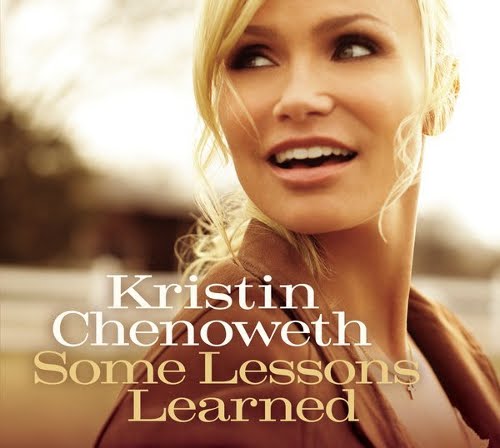
Kristin Chenoweth: Some Lessons Learned (Sony)
Luminous Broadway singer-actress Kristin Chenoweth foregoes her bread and butter to return to her first love: country music. Unfortunately, the mixed results on this slick disc of Bob Ezrin-produced tunes are due to Diane Warren, who penned 5 of 13 faceless songs and whose “commercial” spirit pervades this toothless record. Chenoweth finds sentiment in ballads like “Fathers and Daughters,” but it’s the faux tough attitude of the single “I Want Somebody (Bitch About)” that underscores a purely commercial product.

Music by Kurtag, Nono, Trojhan, Weinberg
(NEOS)

The latest contemporary-music releases from an enterprising label include the Athena Quartett playing the complete string quartet works by Hungarian Gyorgy Kurtag; two edgy electronic compositions by Italian Luigi Nono (who died in 1990); the Henschel Quartett doing Austrian Manfred Trojahn’s quartets; and, in a moving performance by the Vienna Philharmonic and Prague Philharmonic Choir, unheralded Polish master Mieczyslaw Weinberg’s emotional Requiem, set to texts by writers like Federico Garcia Lorca (Weinberg died in 1996). Whatever one’s preference for modern music, these discs give one a taste of works outside the mainstream (if there is such a thing any more).

Tuesday, September 20, 2011

Off-Broadway: Sept. 11 Revisited; Hearts vs. Minds

Sweet and Sad
Written and directed by Richard Nelson
Starring Jon DeVries, Shuler Hensley, Maryann Plunkett, Laila Robins, Jay O. Sanders, J. Smith-Cameron

Performances through September 25, 2011
Public Theater, 425 Lafayette Street
publictheater.org

Completeness
Written by Itamar Moses
Directed by Pam Mackinnon
Starring Brian Avers, Aubrey Dollar, Meredith Forlenza, Karl Miller

Performances through September 25, 2011
Playwrights Horizons, 416 West 42nd Street
playwrightshorizons.org

The Apple family in Sweet and Sad (photo by Joan Marcus)
Civilized people having civil conversations, Richard Nelson’s stock-in-trade, reached its apogee with last fall’s That Hopey Changey Thing. Too bad that such lively talk turns dull in Sweet and Sad, a Hopey Changey sequel that finds the Apple family of the Hudson River town of Rhinebeck together on the afternoon of September 11, 2011, the 10th anniversary of the terrorist attacks that changed America.

Where Hopey Changey was filled with delicious, diverting political discourse, Sweet and Sad merely marks time as its characters dance around one another, discussing any little thing to avoid the September 11 elephant in the room: their avoiding “big” topics makes the rest of the dialogue a muddle. (That Nelson has Marian Apple’s teenage daughter commit suicide some months before the play begins smacks of dramatic desperation, an attempt to conjure an event that‘s as personally cataclysmic and traumatic as September 11 was for our collective psyche.)

Indeed, it’s not until the last 30 minutes, when they can no longer avoid the issue, that talk returns to 10 years earlier and their emotions finally, touchingly well up. Nelson uses Walt Whitman’s The Wound Dresser not only for his play’s title but also to pad his running time. Uncle Ben recites the poem as a run-through for his doing the same at a memorial service later that evening, and its vivid description of the Civil War’s horror makes an obvious if unoriginal parallel to our unbrave new post-September 11 world.

The acting sextet (comprising Jon DeVries, Shuler Hensley, Maryann Plunkett, Laila Robins, Jay O. Sanders and J. Smith-Cameron) is as good an ensemble as in the previous play, and Nelson says he will return to the Apple family for at least two more episodes in their lives. Let’s hope that the Apples (and Nelson) can get back on track, conversing pointedly as in Hopey Changey, rather than wanly as in Sweet and Sad.

Karl Miller and Aubrey Dollar in Completeness (photo by Joan Marcus)
Completeness is an overstuffed romantic comedy about exceptionally smart people--graduate students and their professors--who are more adept with their minds than their hearts. Itamar Moses’ play nods to Tom Stoppard’s and Michael Frayn’s work in its melding of the cerebral and the romantic, his characters alternating between spouting arcane, nearly incomprehensible (to this layman) gibberish about mathematical theories and problems to solve, then stammering, hemming and hawing about their inability to find love that’s satisfying.

The play revolves around computer scientist Elliot and molecular biologist Molly, grad students who leave their current lovers (his another grad student, Lauren, hers her faculty advisor, Don) to get together. But they discover that being compatible physically and mathematically doesn’t mean they are soul mates. Moses does, however, provide an open ending, where it’s possible that they may try again, which may end in failure like their attempted problem-solving through algorithms.

Moses’ uneven dialogue never gets a handle on these people. While they run their mouths about mathematical matters, they pepper their talk with inarticulate interjections like “like” and “f++k” and other unscientific terminology. If Moses was taking satirical swipes at these supposed brilliant characters by showing how they become tongue-tied when dealing with matters of the heart, that would be one thing, but since they speak like that all the time, that’s doubtful.

Pam Mackinnon directs energetically, but she’s flummoxed by the wrongheaded scene where the two supporting actors appear in front of the audience as themselves to no discernible point. On David Zinn’s nicely appointed set that stands in for student apartments and school study areas, a fine acting quartet acquits itself well, particularly in the schizophrenic dialogue they‘re forced to say.

In all, despite its allusions to high science and higher love, Completeness feels strangely incomplete.

Sunday, September 18, 2011

September '11 Digital Week III

Blu-rays of the Week
The Big Bang Theory: Season 4 (Warners)
and Sanctuary: Season 3 (MPI)
The Big Bang Theory, about the relationships between nerdy brainiacs and a brainless beauty, gets comic mileage from its central trio: Johnny Galecki, Jim Parsons and underrated comedienne Kaley Cuoco. Sanctuary, about a scientific team tracking down and studying terrifying creatures, balances small-scale story strands with extravagant visual effects. Both series (especially Sanctuary’s elegantly weird visuals) gain immeasurably from Blu-ray’s higher resolution; Theory bonuses include cast interviews and a gag reel, while Sanctuary bonuses include featurettes about the cast, music, effects and creators.

Citizen Kane (Warners)
Rightly celebrated as The Great American Movie, Orson Welles’ towering debut remains a remarkable achievement, with an innovative narrative structure that still works strongly 70 years later. And the sterling Blu-ray transfer only enhances Gregg Toland’s lustrous B&W compositions, as well as throwing Welles’ youthful genius into sharp relief: he never topped himself in the next 40+ years of making (or trying to make) movies. Warners’ anniversary edition includes extras like the controversial documentary The Battle OverCitizen Kane; an HBO movie, RKO 281, based on the documentary; Roger Ebert and Peter Bogdanovich commentaries and featurettes.

Conan O’Brien Can’t Stop (Magnolia)
How much you enjoy this record of Conan O’Brien’s post-Tonight Show firing North American comedy tour will depend on your allegiance to the talk-show host: simply put, if you’re a rabid Coco fan, you don’t need to be told to watch this pleasant if inconsequential documentary; if you’re not, you won’t become a fan after watching it. The movie’s guerrilla shooting style and talking heads interviews don’t look appreciably better on hi-def; extras include additional footage, an O’Brien interview and commentary.

Henry’s Crime (Fox)
Set in a drably working-class Buffalo (with the Music Hall in Tarrytown standing in for an intimate local theater), this unassuming, ultimately innocuous comic drama is about a quiet man, after serving time for a crime he didn’t commit, falls in love with a local actress and sets about planning a heist with the hardened criminal with whom he shared a cell. Keane Reeves is too wooden in the lead but Vera Farmiga and James Cann lend color as the actress and partner in crime, respectively. Director Malcolm Venville’s dull color palette is recreated faithfully on Blu-ray; there are no extras.

Last Night (Miramax/Echo Bridge)
Movies don’t get much more glamorous than Massy Tadjedin’s sophisticated-looking but superficial examination of a couple dealing with temptations of both flesh and spirit. Keira Knightley (never more ravishing) and Sam Worthington (without Avatar’s blue pigment) are the couple; that Sam has the chance to cheat with the equally gorgeous Eva Mendes makes his predicament even more difficult. A listless Guillaume Canet rounds out the quartet. Glitzy shots of Manhattan look stunning on Blu-ray; no extras.

Meek’s Cutoff (Oscilloscope)
Kelly Reichert’s minimalist western about lost settlers on the Oregon Trail in 1845 turning to a captured Indian to lead them to desperately-needed water is nicely shot (in academy ratio) by cinematographer Chris Blauvelt but puts characters through predictable paces. The cast is part authentic (Michelle Williams, Will Patton and Bruce Greenwood), part disastrously contemporary (Paul Dano, Zoe Kazan). Reichert’s effective editing keeps one hopeful about the outcome of what, disappointingly, turns out to be a shaggy-dog allegory about our last two presidents. The film does have a glorious hi-def transfer; the lone extra is a making-of documentary.

3 Women (Criterion)
Robert Altman’s dreamscape, while not a direct rip-off of Persona, is so influenced by Ingmar Bergman’s superior character study that it makes one wince while watching it. Still, for all its half-baked ideas and dime-store psychology, Altman’s visual sense and superb actresses (Sissy Spacek and Shelley Duvall, both never better) keep interest, no matter how silly his antagonists become. Criterion’s Blu-ray transfer gives this 1977 drama an appropriately grainy look; Altman’s enlightening commentary is included.

X-Men: First Class (Fox)
Matthew Vaughn’s prequel to the smash hit movie franchise introduces several mutant characters in a convoluted plot tying their coming-of-age exploits alongside the tense world situation between the two superpowers in 1961: but combining the Cuban missile crisis with comic book silliness is a waste of (overlong) storytelling. The performers, from Michael Fassbender and James McAvoy to January Jones, Rose Byrne and Jennifer Lawrence, do their best but are outclassed by CGI effects and makeup, all looking superb on Blu-ray; extras include a making-of documentary and deleted and extended scenes.

DVDs of the Week
Bill Cunningham New York (Zeitgeist)
This engaging chronicle of the New York Times’ legendary photographer shows Cunningham’s unique take on both his work and navigating the busy New York streets for decades. Cunningham comes off as eccentric but appealing, and his photographs--which are still being published every Sunday in the Times’ Style section--superbly balance the fashion world with the everyday world. Extras include additional scenes and interviews.

Rescue Me: The Sixth Season and the Final Season (Sony)
Denis Leary’s no-holds-barred drama limped to its end with the seventh season finale; both the sixth and seventh seasons are included in this five-disc, 19-episode set, continuing the immature shenanigans of Tommy Gavin, his women (superbly played by Andrea Roth and Callie Thorne) and his fellow firefighters. Too bad the show’s copout finale (only one character dies in what looks like a conflagration) sums up its inability to deal seriously with life-or-death situations without screaming and drinking. The tremendous cast (minus the incredibly dull Adam Ferrara) smooths over the writing’s rough patches. Extras include deleted scenes, a gag reel and cast and creator interviews.

Vera (Acorn Media)
Brenda Blethyn’s intelligent performance as tough-as-nails detective solving violent crimes is the focus of this absorbing four-episode mini-series shot in picturesque villages of the Northumberland section of England. Alongside Blethyn’s usual excellence is good support from David Leon, Wunmi Mosaku and Paul Ritter as her harried co-workers and guest stars like Gina McKee, Kerry Fox and John Lynch, who portray suspects or witnesses. This is gritty storytelling done well, as is usually the case with these BBC productions.

Von Heute auf Morgen (Dynamic)
Arnold Schoenberg’s absurdist, atonal 1929 comic opera, about the disarmingly simple story of a bickering couple, works better in theory than execution, for Schoenberg’s unwavering 12-tone music doesn’t really allow the comic aspects to breathe. But the energy of this 2008 Venice production gives the work its due, glossing over the writing’s bumpiness: the singers (Georg Nigl, Brigitte Geller), musicians (Orchestra del Teatro la Fenice) and staging (by Andreas Homoki) are all exemplary.

CDs of the Week
Falla: Piano Music (Harmonia Mundi)
20th century Spanish master Manuel de Falla’s entire oeuvre for solo piano fits easily onto one CD, and it’s explored with a combination of sure technical prowess by pianist Javier Perianes, who also exquisitely performs Falla’s grandest composition for piano and orchestra, Nights in the Garden of Spain, accompanied by the sensitive playing of the BBC Symphony Orchestra under the baton of conductor Josep Pons.

Strauss: Ein Heldenleben/Four Last Songs (BIS)
Works from opposite ends of Strauss’s career--an early, blistering orchestral tone poem and four delicately scored late songs--are performed with the necessary delicacy and bravado by the Rotterdam Philharmonic, led by Yannick Nézet-Séguin’s steady conducting. Soprano Dorothea Roschmann sings the Four Last Songs with subtlety, wringing every emotional moment from Strauss’s exceptionally elegant score.

Friday, September 16, 2011

Inside Brueghel

The Mill and the Cross
Directed and produced by Lech Majewski
Starring Rutger Hauer, Charlotte Rampling, Michael York
Released by Koch Lorber Films; opened September 16, 2011

Since the actual act of creation isn’t very compelling, films about artists like writers, composers or painters often replace that essential moment of filling a page or a canvas with “genius” with more dramatic visuals. Take Lech Majewski’s The Mill and the Cross, which focuses on 16th century Flemish master Pieter Bruegel’s The Way to Cavalry, which currently hangs in Vienna’s Kunsthistorisches Museum. Bruegel’s spirited work of art, set in a landscape populated by hundreds of people walking to the site of Christ’s crucifixion, is crammed with details both realistic and symbolic, much of which is indecipherable today to those who are not art experts.

Majewski’s film, based on co-screenwriter Michael Francis Gibson’s book, audaciously attempts to clarify some of the work’s arcane symbolism by bringing to life several characters who appear in the painting, along with Brugel, his wife Marijken and Nicholas Jonghelinck, the artist’s good friend and an important art collector.

Majewski takes a radical approach to visualizing the creation and content of Bruegel’s densely packed painting (you could comb it for hours just studying the interactions of 500 characters). Although the artist himself isn’t shown with his paint brush on a canvas, his creative process is demonstrated through clever CGI effects that allow the actors to “enter” the painting right from the beginning: as characters move through its familiar landscape, Bruegel himself walks among them, explaining who’s who and what’s what.

That explanation introduces the film’s recurring flaw. As remarkable as the painting’s recreation is--along with effective CGI, the sumptuous cinematography is by Majewski and Adam Sikora--there’s too much telling and not enough pondering its hidden ambiguities. For example, a brilliant early shot of a shimmering spider web covered in morning dew is mirrored by a later one of Bruegel sitting before that same web, itself followed by Bruegel’s description of his working method: “I will work like the spider this morning, building its web.” Showing that symbolic web twice is already overdoing it, but Bruegel acknowledging its significance to his artistry is utter redundancy.

In another example, Bruegel shows preliminary sketches to Nicholas, spelling out specifics about the painting in a risible “Flemish Paintings for Dummies” manner that’s helped by Nicholas asking obvious questions that allows for further explanations. It’s all eye-rolling enough, but when Bruegel stoops to pointing out the circles and trees of life and of death that are in the painting, the movie hurtles toward self-parody.

Majewski’s film is best seen as a snapshot of life 500 years ago (its subtitle should be A Day in the Life of the 16th Century), showing how people walked on stilts and danced to a flute-like instrument, or how large families had to crowd together in their small houses and even smaller rooms. A sequence of a man being fallen upon and beaten to death by brutish men in red coats, then strung up to be pecked at by crows, brings a political undercurrent into what feels like a dry anthropological treatise.

Those red-jacketed men also appear in Bruegel’s painting as an allusion to the brutality of Flanders’ Spanish occupiers circa 1564, the year he painted The Way to Cavalry. However, Majewski’s showing this luckless man being fatally beaten then becoming bird food feels superfluous in the context of the painting, which only hints at Bruegel’s fellow countrymen and women suffering by merely showing several Spanish red coats. Instead, Wajewski unaccountably wallows in the brutality by showing crows pecking out the corpse’s eyes from various angles. Such scenes give the film a halting rhythm, as if Majewski, unsure what to concentrate on, ended up showing bits and pieces that never coalesce into a dramatically satisfying whole.

Such dramatic inertia surely hinders the actors, led by a sullen Hauer as Bruegel: it’s hard to believe that this man could muster enough energy to paint such a boisterous, massive canvas as the one we see being created. Michael York, who as Nicholas has the film’s first intelligible lines of dialogue 30 minutes in (unsurprisingly--and typically--he’s first heard explaining the back story of the Spanish occupation to orient viewers), remains dignified in a thankless role, as does Charlotte Rampling as the Virgin Mary (seen in the lower right corner of the painting), adrift in a pointless parallel storyline.

Unable to approximate the vivid imagination on display in Bruegel's painting, The Mill and the Cross (which refers to two of the work’s most prominent images) adds little to our understanding of the artist and his work. Even Peter Greenaway’s Nightwatching, which ran roughshod over Rembrandt’s The Night Watch, was playful enough to mitigate its crimes against art history. Majewski throws up his arms in defeat in his film’s final image, a beautiful reverse tracking shot beginning with a closeup of the actual painting that becomes an expansive view of it and several other Bruegel masterworks in the Kunsthistorisches Museum gallery.

Maybe Majewski should have made a documentary overview of Bruegel’s paintings rather than this ambitious but failed attempt to explore the inner workings of one of them.

Sondheim's 'Follies' Returns

Bernadette Peters in Follies (photo by Joan Marcus)
Follies
Music and lyrics by Stephen Sondheim
Book by James Goldman
Directed by Eric Schaeffer; choreographed by Warren Carlyle
Starring Bernadette Peters, Jan Maxwell, Danny Burstein, Ron Raines, Elaine Paige, Rosiland Elias, Mary Beth Peil

Previews began Aug. 7, 2011; opened Sept. 12; tickets on sale through Jan. 1, 2012
Marquis Theatre
1535 Broadway, New York, NY
folliesbroadway.com

Is there a perfect musical? Maybe not, but Follies has nearly everything: James Goldman’s superbly savvy book; Stephen Sondheim’s memorable and character-defining music and lyrics; a sly flashback structure, alternating between nostalgia and razor-sharp relationship dissection; and, of course, meaty musical moments for top-notch performers.

Unfortunately, Follies productions have been imperfect, starting with 1971’s original. The forgettable 2001 Broadway revival directed by Matthew Warchus wasted Blythe Danner and Judith Ivey, while the 2007 Encores! staging (with a scintillating Donna Murphy) sadly never transferred to Broadway. Eric Schaeffer’s new production, which began at Washington’s Kennedy Center, takes place on Derek McLane’s shrewdly rundown theater set, but never gets a firm handle on the show’s vignettes.

Follies’ main flaw? It introduces former Follies girls but gives all but the main characters Sally and Phyllis a lone chance to shine in songs driven not by narrative but nostalgia. Schaeffer efficiently stages them thanks to Warren Carlyle’s clever choreography, and veterans like Elaine Paige, Rosalind Elias and Mary Beth Peil make a good impression, but they are simply fodder separating the dramatic scenes among the lead couples.

Sally is married to Buddy but still carries a torch for Ben, who’s married to Phyllis. After they get reacquainted in the first act, they eventually rediscover long-dormant feelings--shown in flashbacks as the youthful foursome mirrors the present-day one--while the second act displays their heightened emotions in rousing, musical-within-a-musical form, each receiving a solo spotlight to convey those feelings.

As Sally, Bernadette Peters (a youthful 63, by the way) is as lissome as ever, breaking hearts with the poignant showstopper “Losing My Mind”; as Buddy, Danny Burstein tirelessly moves about the stage, bringing down the house with “The ‘God Why Don’t You Love Me‘ Blues”; as Phyllis, Jan Maxwell is as bitingly funny and adorable as ever, even if she overdoes the blustery comic hurt in “Could I Leave You?”; as Ben, Ron Raines is reliably sturdy right through the show’s final number “Live, Laugh, Love.”

Whenever Schaeffer doesn’t satisfactorily navigate Sondheim and Goldman’s seminal musical waters, the stars and Sondheim’s great, lasting songs come to the rescue.

Wednesday, September 14, 2011

Equine Uplift

A scene from War Horse (photo by Paul Kolnik)
War Horse

Directed by Marianne Elliott and Tom Morris
Adapted by Nick Stafford, based on a novel by Michael Morpurgo
In association with Handspring Puppet Company
Starring Alyssa Besnahan, Matt Doyle, Boris McGiver, Seth Numrich, Kate Pfaffl, T. Ryder Smith

Previews began March 15, 2011; opened April 14; tickets on sale through Jan. 29, 2012
Vivian Beaumont Theater, Lincoln Center, New York, NY
lct.org

A triumph of dazzling stagecraft, War Horse transforms Michael Morpurgo’s children’s novel into a wondrous if creaky drama filled--or crammed--with uplift.

War Horse concerns teenage Albert Narracott who, on a small English farm, raises Joey to become the fastest horse in the valley and even, improbably, a plow horse. Soon, ringing area church bells signal the start of World War I. Although Albert is too young to go, his 19-year-old cousin Billy signs up, and when Albert’s drunken, broke father hears that cash is being offered for horses to serve in France, he sneaks Joey out and, before Albert can stop him, offers the beloved horse for his majesty’s service.

The rest of War Horse takes place on the battlefields of France, as Albert runs away from home and lies about his age so he can join the army to find Joey. The story plays out with wincingly bad dialogue and caricatured characters (particularly Albert’s doltish father), while the second act drags considerably due to its many repetitive battle scenes. Sadly, the original children’s story skeleton is too trifling to carry the burden of a brutish war saga.

Still, War Horse overcomes these flaws thanks to imaginative staging and the miraculous life-size puppets that are operated by an army of performers. That’s not to take anything away from the actors, all of whom inhabit their roles persuasively, and Kate Pfaffl, who sings haunting interludes as the rather pretentiously named Song Woman. But, along with Paule Constable’s stark lighting and Rae Smith’s authentic costumes, ingenious illustrations and sparsely effective sets, directors Marianne Elliott and Tom Morris get their supreme assist from Adrian Kohler, Basil Jones and the Handspring Puppet Company’s brilliantly-realized horses.

That the horses are not realistic is the point, since we’re not supposed to believe they are simply big, beautiful animals but that they have a humanity connecting them to the other characters, whether English, French or even German enemies: there’s a bloody unlikely (and heroic) German soldier that coaxes more sentimentality out of the reigning simplistic storytelling.

The wonderfully limber performers who play the horses are not only spectacular in their movements and sounds, but also elegant: when a horse is killed on the battlefield, the horsemen fall to the ground and slowly and gracefully roll out of their imposing costumes made of steel, leather and cables and soundlessly leave the stage.

Whatever its flaws, War Horse lives up to its reputation as a true theatrical dazzler, but also makes one apprehensive about Steven Spielberg’s upcoming film adaptation, which sounds like it may fall into the treacly traps that the stage version just barely avoids.

Saturday, September 10, 2011

September '11 Digital Week II

Sept. 11 DVDs
The Man Who Walked Between the Towers (Scholastic)
The amazing feat of Frenchman Philippe Petit--who walked on the high wire between the two World Trade Center towers in 1974, shortly after they opened--is recounted in this delightfully narrated (by Jake Gyllenhaal) and illustrated (by Mordicai Gerstein) animated short that’s a lovely piece of nostalgic reminiscence about buildings whose destruction created a gash in the Manhattan skyline. A trio of other inspiring tales--Crow Boy, The Dinosaurs of Waterhouse Hawkins, Miss Rumphius--is included, along with interviews with Hawkins’ author and illustrator.

Rebirth (Oscilloscope)
In time for the 10th anniversary of the attacks, director James Whitaker’s documentary follows five people whose lives are forever intertwined with--and were irretrievably altered by--the events of that awful day. Time-lapse photography, illuminating the transformation of Ground Zero into a new landscape that honors the victims and points the way forward for lower Manhattan, makes this an inspirational film showing that, while we should never forget, we must also keep on living. Extras include Whitaker’s commentary, time-lapse project video and 90 minutes of time-lapse footage covering several years at the site.

September 11: Memorial Edition (History)
For this two-disc anniversary compilation, four specials about the devastating events of September 11, 2001 are brought together: 102 Minutes that Changed America, with eye-opening footage shot by various passersby near the disaster that morning; Hotel Ground Zero, about people in the Marriott hotel at the foot of the towers; The Miracle of Stairway B, about 14 people who survived the second tower‘s collapse; and The Day the Towers Fell, an eyewitness story of the tragedy. A valuable extra is I-Witness to 9/11, a short recap of some witnesses whose footage was used in 102 Minutes.

Blu-rays of the Week
Dressed to Kill (MGM)
Brian DePalma’s stylishly sleazy soft-core thriller, which looks like it was shot through Vaseline like those Penthouse photo spreads I looked at as a teenager, caused a minor sensation in 1980 thanks to ‘Police Woman’ Angie Dickinson showing skin. But we’re still stuck with DePalma’s insipid, immature “ideas” and poor script, and camera movements and plot twists “borrowed” from Alfred Hitchcock, among others. The Blu-ray transfer faithfully preserves its gauzy look; extras include DePalma interviews, a look at the various cuts of the film, vintage and recent featurettes.

The Entitled (Anchor Bay)
There’s not much new in this thriller about rich young brats who are kidnapped by a desperate young trio, but it all goes wrong and leads to murder. Tidy and tensely done, the movie tosses in a few twists that help it cross the finish line intact. A solid cast of veterans (Ray Liotta, Victor Garber, Stephen McHattie) and fresh faces (Kevin Zegers, Laura Vandervoort, Dustin Milligan, John Bregar) combine to keep interest in a familiar story. The movie has received an excellent hi-def transfer; extras include an alternate ending and a behind-the-scenes featurette.

Fringe: The Complete Third Season (Warners)
The fiendishly clever sci-fi series that introduced a parallel universe to its viewers takes that plot point and runs with it throughout the 22 episodes of its outrageously entertaining third season. The cast--led by Joshua Jackson, Anna Torv, Blair Brown and John Noble--comes up aces, the dialogue does its job (for the most part), and the visuals are often dazzling--and have been rendered extremely well on Blu-ray. Extras include pop-commentaries and featurettes while watching episodes; featurettes; and a gag reel.

My Life as a Dog (Criterion)
Lasse Hallstrom’s bittersweet 1985 coming-of-age tale is situated perfectly between sentiment and toughness, which is how his hero, 12-year-old Ingemar, can also be described. Played with mature naturalness by Anton Glanzelius, a youngster with a face like a wise adult, Ingemar is the center of one of the most affecting and poignant portraits of childhood ever committed to celluloid. Criterion’s Blu-ray transfer is warmly film-like with a superbly grainy look; extras include a Hallstrom interview and an early Swedish TV film he did, Shall We Go to My or Your Place or Each Go Home Alone?

Orpheus (Criterion)
The 1950 center of the Orphic trilogy, Jean Cocteau’s most problematic film is a significant example of his artistry. Updating the Orpheus/Eurydice myth to Paris’ Left Bank allows Cocteau to work on many narrative and symbolic levels; its fascinating and memorable imagery shows how ingeniously Cocteau uses his beloved “mirror portals” to transport his enigmatic characters to another plane of existence. Criterion’s superb hi-def transfer of this B&W beauty begs the question: are Blood of a Poet and Testament of Orpheus coming on Blu? A plethora of extras (commentary, documentary, vintage interviews, newsreel footage) puts Cocteau’s artistic concerns in context.

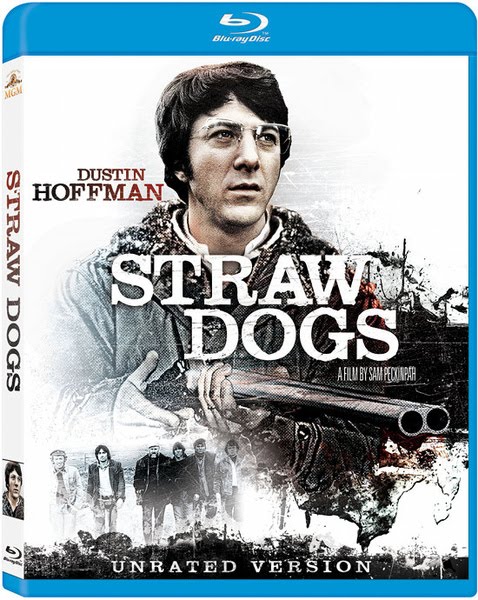
Straw Dogs (MGM)
Sam Peckinpah’s ultra-violent (and deeply satisfying) revenge drama had the misfortune of being released the same year as A Clockwork Orange--1971--and many critics who raved about Stanley Kubrick’s film didn’t give Peckinpah the same courtesy. But this unremittingly bleak drama about a mild-mannered professor whose basest impulses are triggered by his wife’s rape and the threats to his own manhood is revelatory, with top-notch performances by Dustin Hoffman, Susan George and David Warner. Peckinpah’s subliminal editing tricks work wonders on the viewer’s psyche, and are given new life in this Blu-ray transfer; amazingly, there are no extras, so keep Criterion’s out of print DVD.

DVDs of the Week
The Arbor (Strand Releasing)
This strange, disjointed documentary mirrors the strange, disjointed life of its subject: British playwright Andrea Dunbar, whose first work was done at age 18 and who died at age 29 of a drug overdose, after having borne three children with three different men. Director Clio Bernard imaginatively uses real actors to lip-sync to actual audio interviews by Dunbar, her children, and others who were involved in her private and professional lives. Although the style is initially off-putting, it makes formal and psychological sense to more fully explore such a sad (and sadly short) creative life.

Cold Fish (Vivendi)
Prepare yourself for an unexpurgated blast of nuttiness in this overlong, choppy but utterly watchable psychological shocker that probably shouldn’t be described too thoroughly. Suffice it to say that this blunt exploration of a truly insane mind and the extremely bloody extremes to which he puts his murderous impulses is not for the squeamish, and even if it gleefully rubs our noses in its explicitness, it’s worth hanging in there for a final “see it to believe it” sequence. The lone extra is an interview with director Sion Sono.

If a Tree Falls (Oscilloscope)
The exploits of the militant environmental group the Earth Liberation Front are explored in director Marshall Curry’s documentary, concentrating on Daniel McGowan, one of its members who decided to partake in the group’s arsons and other destructive efforts in protest over what they considered corporate evildoers and their governmental enablers destroying the earth. The incendiary subjects of environmental activism and eco-terrorism (members were put on trial as domestic terrorists, the first such defendants in our post-9/11 world) are handled perceptively and scrupulously. Extras include updates on the principals, commentary by and Q&A with Curry and co-director/cinematographer Sam Cullman, deleted scenes and extended interviews.

It Rains in My Village and A Quiet Place in the Country (MGM)
These obscure European classics deserve better releases than they’re getting here, but in today’s topsy-turvy digital world, we should thank MGM for at least getting them out so they’re available to be discovered--or re-discovered, for anyone saw them once will want to revisit them. Aleksander Pretrovic’s bleak It Rains in My Village (1968) is a blackly comic Yugoslav tragedy, while Elio Petri’s dazzling A Quiet Place in the Country (1969) is a surreal journey through a talented artist’s wounded psyche. Both films feature veteran directors at the top of their form.

CDs of the Week
Godspell: 40th Anniversary Celebration (Masterworks Broadway)
With the October opening of the Broadway revival around the corner, this two-disc set pairs the original 1971 off-Broadway cast album and the original 1973 soundtrack for the film version. Stephen Schwartz’s music and lyrics, by far his most popular until he hit upon Wicked over 30 years later, are highlighted by the Top 10 pop hit “Day by Day” and the movie-only song “Beautiful City.” Sung by then-vibrant young voices like Robin Lamont and David Haskell (off-Broadway) and Victor Garber and Lynne Thigpen (movie), this nostalgic souvenir will do until the new production is up and running.

Ravel/Lekeu: Music for Violin & Piano (Hyperion)
One of the 20th century’s great composers is smartly paired with one of the least known of the 19th century, a contemporary who died prematurely: Maurice Ravel’s brittle but elegant music for violin and piano, including his jewel-like Violin Sonata No. 1 and the over-played but still beautiful Sonata No. 2, is heard alongside the intimate but expansive Violin Sonata by Guillaume Lekeu, whose death at age 24 in 1894 robbed the world of a composer who may have become a true giant. Heartfelt and skillful playing by violinist Alina Ibragimova and pianist Cedric Tiberghien give both composers their due.