Showing posts with label Disney on Blu. Show all posts

Tuesday, March 19, 2019

March '19 Digital Week III

Blu-rays of the Week 
Spider-Man—Into the Spider-Verse 
(Sony)
Winner of the Oscar for Best Animated Film, this enjoyable “alternative” Spider-Man origin story follows a teenager who, after a bite by a radioactive spider, becomes another Spider-Man—just as the original superhero supposedly dies. Crammed with inventive visuals, a creatively offbeat script and enough humorous asides to keep parents interested while their kids are enthralled, this may be the beginning of a new wave of cartoon superhero flicks. The film looks sparkling on Blu; extras include an audio commentary, alternate universal mode, several featurettes and a new animated Spider-Man short.

The Kid Brother 
(Criterion)
The latest Criterion release of a 1927 feature by Harold Lloyd—who was, after Chaplin and Keaton, the greatest silent film comedian—might not equal earlier Lloyd releases like The Freshman and Safety Last!, but it has the writer-director-actor-stunt man’s best qualities in abundance, from spectacular sight gags and physical humor to unexpected poignancy. Criterion’s release includes a wonderfully detailed restored hi-def transfer, two musical scores to choose from and the usual plethora of extras: audio commentary, new and archival interviews, video essays and the newly restored Lloyd shorts Over the Fence (1917) and That’s Him (1918).

Man from Atlantis 
(Warner Archive)
This 1977 TV movie—starring Patrick Duffy as an amnesiac man with gills and webbed feet washed ashore and taken in by U.S. officials, who need his help neutralizing a mad eco-terrorist—is typically silly stuff saved only by ahead-of-its-time environmental awareness. It’s surprising that all four of these Atlantis movies were not released together on Blu-ray, as they were earlier on DVD; their initial popularity helped green-light the short-lived (13 episodes) series. Luckily for Duffy, another series, Dallas, soon came along. There’s a vivid hi-def transfer.

Marquise 
(Film Movement Classics)
French director Vera Belmont’s lusty 1997 costume drama is a terrific showcase for Sophie Marceau, who has never been more charming than as the title character, a dancing girl from the sticks who works her way up the social ladder to become a member of Moliere’s acting troupe and performer for the royal court. Belmont’s sharp eye for political satire is more muted than in her wonderfully evocative 1985 film, Red Kiss—which also needs to be restored and reevaluated—but this is still a delicious glimpse at a bygone (17th century) era. The movie looks great on Blu-ray; the lone extra is a new interview with Belmont. 

Mary Poppins Returns 
(Disney)
In this long-gestating sequel to 1964’s Mary Poppins, Emily Blunt takes on the role that Julie Andrews is beloved for: the irrepressible supernanny, who comes back to the same family she was with before. Blunt is fine, as is the rest of the cast—Lin-Manual Miranda, Colin Firth, Ben Whishaw, Emily Mortimer, and especially the welcome return of vets Dick van Dyke and Angela Lansbury—and Marc Shaiman’s songs are tuneful echoes of the Sherman brothers’ originals. Director Rob Marshall loses control over the final 30 minutes, but as family entertainments go nowadays, one could do a lot worse. The hi-def transfer is excellent; extras include a sing-along edition, deleted scenes, deleted song, featurettes, interviews and a gag reel.

The Quake 
(Magnet)
Director John Andreas Andersen has made what could be called a thinking-mans’ disaster movie—at least up to a point. His hero is a Finnish geologist trying to sound the alarm about an 8.5 earthquake about to devastate Oslo and its citizens, including his family. For its first two-thirds, The Quake is fun, even brainy stuff, but when the quake arrives—and there’s tremendous, and sparing, use of special effects that show Oslo’s destruction—character development unfortunately takes a back seat to disaster movie clichés. There’s a first-rate hi-def transfer; extras are several making-of featurettes.

DVDs of the Week 
Divide and Conquer—The Story of Roger Ailes 
(Magnolia)
In her incisive documentary about the man who created Fox News and today’s negative political campaigns, Alexis Bloom charts the rise and fall of Roger Ailes alongside oft-incriminating interviews with those who knew and worked with him—including, unsurprisingly, women who describe his sexual indiscretions and harassment. There’s nothing too surprising, but it’s put together so meticulously that it becomes a compelling if grotesque portrait of our benighted era.

Over the Limit 
(Film Movement)
Marta Prus’ gripping fly-on-the-wall documentary follows Margarita Marun, a world-class Russian rhythmic gymnast, practicing and participating in tournaments with an eye toward the 2016 Olympics. She seems a focused young woman, but her coach has decided that psychological bullying will ensure that she keeps that focus. Marun appears to accept such behavior as part of her reaching for greatness—up to a point. Immediately after the Olympics, she retires at age 20, shows the ambivalence. A bonus short film is Johnson Cheng’s Olympics-set Iron Hands. 

CD of the Week 
Stéphanie D'Oustrac: Sirènes 
(Harmonia Mundi)
For this intelligently programmed recital, Stéphanie D'Oustrac is joined by pianist Pascal Jourdan for a journey through lynchpins of Romantic-era music by Liszt, Berlioz and Wagner. Although her renditions of six Liszt lieder are precisely phrased and she treats Wagner’s Wesendonck-Lieder with the reverence they deserve, it’s in the Berlioz, not surprisingly, that finds the French mezzo most in her element. Both Les Nuits d’ete and Le mort de Cleopatra, usually heard in their orchestrated versions, have never sounded so elegant and intimate as they do here, only hearing D’Oustrac’s lustrous voice and Jourdan’s refined accompaniment.

Wednesday, October 17, 2018

October '18 Digital Week III

Blu-rays of the Week 
Ant-Man and the Wasp 
(Disney/Marvel)
In this protracted, fitfully entertaining sequel to Ant-Man, the interplay among Paul Rudd, Evangeline Lilly, Michael Douglas and Michelle Pfeiffer makes it work, despite several good actors like Bobby Cannavale, Michael Pena and Anthony Mackie having scandalously little to do. The effects are decent and Hannah Jones-Kamen, Laurence Fishburne and Walton Goggins are an intriguing trio of villains, but another installment is promised—oh boy. The hi-def transfer is first-rate; extras include deleted scenes, a gag reel and featurettes. 

Don’t Worry, He Won’t Get Far on Foot 
(Lionsgate)
Joaquin Phoenix’s intense but sympathetic performance as John Callahan, a caustic cartoonist who was a paraplegic and worked from a wheelchair until his death in 2010, is the main draw of Gus Van Sant’s interesting but workmanlike biopic. There’s little to distinguish this than something like The Sessions, with John Hawkes and Helen Hunt, and the typically blah appearances by Jonah Hill and Rooney Mara in supporting roles don’t help; luckily, Phoenix’s committed portrayal smooths over most of the rough spots. There’s a fine hi-def transfer; extras are two brief featurettes.

Eight Hours Don’t Make a Day 
(Criterion)
Reiner Werner Fassbinder’s gargantuan 1973 made-for-West-German-television series takes its working-class family seriously, but a few hours’ worth of material is stretched to eight, making the perceptiveness of the early scenes give way to self-parody and melodrama by the time it limps to its conclusion. Excepting the 15 1/2-hour Berlin Alexanderplatz—which, to be sure, gave the director ready-made source material in the form of the original classic novel—Fassbinder usually did better with less; the extended format gives free rein to his damaging self-indulgences. The hi-def transfer is solid; extras include a retrospective featurette comprising new interviews with actors Hanna Schygulla, Irm Hermann, Wolfgang Schenck and Hans Hirschmüller.

Joseph W. Sarno Retrospect Series 
(Film Movement)
Joseph W. Sarno was a straightforward purveyor of soft-core flicks in the ‘60s and ‘70s before moving into hardcore features, and this set collects three of the most typical examples of his sexploitation flicks, whose titles cheekily promise more than they deliver. Confessions of a Young American Housewife (1974), Sin in the Suburbs (1964) and Warm Nights Hot Pleasures (1964) are basically teases that pretend to explore sexuality more deeply than they do; they’re interesting historical curios, at least. The films have decent hi-def transfers; extras are commentaries and deleted scenes.

The Official Story 
(Cohen Film Collection)
Luis Puenzo’s powerful 1985 drama, set in the ‘70s during Argentina’s military dictatorship, focuses on an affluent couple with a young daughter whom they illegally adopted—the mother slowly realizes the girl may be the child of one of the regime’s victims who disappeared and was presumably murdered. Puenzo’s film—which won the Best Foreign Film Oscar—retains its potency thanks to a searingly real performance by Norma Aleandro as the mother who wants to protect her daughter but realizes the moral (and mortal) implications. The new hi-def transfer is excellent; lone extra is a four-part Puenzo interview.

CD of the Week
Weinberg—Symphony No. 13 and Serenade
(Naxos)
I feel like a broken record extolling the virtues of Russian composer Mieczyslaw Weinberg, who years after his death in 1996 suddenly had his music getting played and recorded. The always enterprising Naxos label has released several discs pairing one of his symphonies with another orchestral work, and this disc continues that tradition. The two works, both world premiere recordings, are Serenade (1952), relaxed, yearning and with little of Weinberg’s usual musical agitation; and the weighty, somber Symphony No. 13 (1976), a one-movement, 35-minute work dedicated to the composer’s mother. Vladimir Lande ably conducts the Siberian State Symphony Orchestra.

Tuesday, March 6, 2018

March '18 Digital Week I

Blu-rays of the Week 
Faces Places 
(Cohen Media Group)
This typically headstrong and humane documentary shows once again that the now 89-year-old French director Agnes Varda continues to make beautiful, humble but insightful films that display real people as themselves, with no condescension or artifice. For this journey, Varda has been joined by 33-year-old photographer and provocateur JR, who shares her indomitable spirit; the result is a joyful, lovely valentine to humanity in all of its manifestations. The 90-minute movie is very funny, thoughtful, touching, and makes viewers yearn for more cinematic travels from these kindred souls. The hi-def transfer is as transfixing as the film is; extras include a 45-minute interview with Varda and JR and three extended scenes.

Godard + Gorin—Five Films 1968-1971 
(Arrow Academy)
After making his seminal 1967 classic, Weekend, French director Jean-Luc Godard went down the rabbit hole of polemical politics, joining with leftist critic Jean-Pierre Gorin for a series of strident and increasingly insular snapshots of radical French socialism after the 1968 student riots through 1971. The five films collected here—A Film Like Any Other, British Sounds, Wind from the East, Struggles in Italy and Vladimir and Rosa—are often inscrutable, naïve and poseurish, but they are also valuable historical documents from ground level, so to speak. Most intriguing is seeing the Maoist radicals in British Sounds making up new lyrics to then-current Beatles songs like “Hello Goodbye” and “Honey Pie” to more closely reflect their fight against the establishment. Arrow’s restoration makes these 16mm films look splendid; extras are A Conversation with JLG, a two-hour 2010 Godard interview; Godard’s hilarious 1971 Schick aftershave commercial; and critic Michael Witt’s 90-minute explication of this period in Godard’s career.

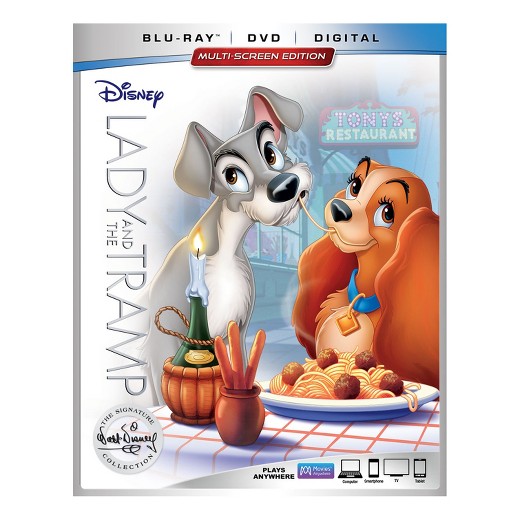
Lady and the Tramp 
(Disney)
One of Disney’s true—if perennially underrated—classics, this 1955 animated masterpiece gets a new lease on hi-def life through Disney’s Signature Collection: although what was on the 2012 Blu-ray release is present and accounted for, including featurettes, deleted scenes, music video, storyboards and interviews, there are a few add-ons. Mainly, these comprise two new ways to watch the film aside from the original theatrical version (in ultra-widescreen 2.35:1 aspect ratio, the first animated feature shot and shown that way): a sing-long version and one that allows the viewer to access Walt Disney story meetings.

Pique Dame (Queen of Spades)
La Forza del Destino (The Force of Destiny) 
(C Major)
In Pyotr Tchaikovsky’s opera Queen of Spades, based on a story by Alexandr Pushkin, gambling and card-playing takes center stage, and the sumptuous music conjures up portraits of ordinary and extraordinary madness: Stefan Herheim’s 2017 Amsterdam staging accentuates its dramatic intimacy, with superb orchestral playing and strong performances by Misha Dibyk and Svetlana Aksenova. La Forza del Destino, Giuseppe Verdi’s operatic epic, receives a crackling 2008 Vienna production that stars Nina Stemme and Salvatore Licitra at their vocal peak. Both discs include superlative hi-def video and audio.

Tom Jones 
(Criterion Collection)
Tony Richardson’s rollicking adaptation of Henry Fielding’s classic novel about a bastard battling 18th century English society may have won the Oscar for Best Picture of 1963, but don’t hold that against it. It’s a splendid, visually and aurally witty ride (John Addison’s harpsichord-laden score also won an Oscar), with a veritable British who’s who in supporting roles—Hugh Griffith, Susannah York, and its three Oscar-nominated Supporting Actresses, Diane Cilento, Edith Evans and Joyce Redman—all held together by Albert Finney’s charismatic and charming portrayal of the devilishly rakish Tom. Criterion’s typically first-rate release includes stunning new hi-def transfers of Richardson’s original cut and a pointless (and seven minutes shorter) director’s cut, archival interviews with Finney and Addison, and new interviews with Vanessa Redgrave (Richardson’s widow) and Robert Lambert, who edited the director’s cut.

DVDs of the Week
The Coming War on China 
(Icarus Films)
In John Pilger’s timely and sadly relevant documentary focuses on the complicated relationship between the United States and China, from the first U.S. hydrogen bomb test at Bikini atoll to the recent ramping up of U.S. missile bases within striking distance of the Chinese mainland. Through incisive interviews and archival footage, Pilger’s analysis might not be completely on-target—he tends to poo-poo China’s own political and moral shortcomings in order to keep shining a light on what the U.S. has wrought through its double-dealing—but it’s provocative enough to make one worried about what the future might bring, now that we have an incurious, easily swayed president in the White House.

Sunstroke 
(Icarus/Distrib Films)
Russian director Nikita Mikhalkov has made several distinct and memorable films in the past 40 years—highlighted by 1980’s Oblomov and 1994’s Burnt by the Sun—and his latest, if not up to their level, is an engrossing if old-fashioned costume drama combining romance and war’s stark reality. A pro-Soviet lieutenant in a Bolshevik prison camp in 1920 reminiscences about a beautiful stranger he met 13 years earlier; obvious parallels between pre-Soviet bliss and Communist-era brutality notwithstanding, Mikhalkov knows how to tell an absorbing story with his perfectly-matched leads Martins Kalita and Victoria Solovyova. Two caveats: a pro-Tsar stance seems strongly pro-Putin in the current climate, and the film—which has a three-hour running time elsewhere—runs only 160 minutes in this release.