Showing posts with label docs on Blu. Show all posts

Wednesday, November 3, 2021

November '21 Digital Week I

4K/UHD Release of the Week 
The Suicide Squad 
(Warner Bros)
Since Suicide Squad—the 2016 version—flopped, this semi-reboot—with the definite article in the title—semi-resuscitates the franchise, as James Gunn’s bloated, jokey super-antihero epic occasionally scores with its flashy, action-filled camaraderie. There’s a handful of chuckles to be had by none other than Sylvester Stallone as King Shark but, let’s face it, Harley Quinn—once again played by the magnetic Margot Robbie—is the only one of the squad who deserves her own franchise…which she has. The immaculate 4K image pops off the screen; the accompanying Blu-ray disc includes several extras: featurettes, interviews, deleted scenes, gag reel and director commentary (on both discs).

In-Theater Releases of the Week
Only the Animals 
(Cohen Media)
In Frederik Moll’s cynical and unpleasant crime drama, the death of a woman named Evelyn is the springboard to glimpses of the lives of five people she’s—mostly peripherally—connected to, from young Marion whom Evelyn has a brief affair with to farmer Michel who thinks he’s been flirting with Marion online to Michel’s wife Alice who’s carrying on an affair with another man, Joseph: he finds Evelyn’s body. Moll adroitly moves among these people, but the utter contrivance of their relationships—I don’t know how much is in the underlying novel—make the film risible from the get-to, despite its self-seriousness and extremely capable acting, especially by Nadia Tereszkiewicz (Marion) and Laure Calamy (Alice).

Speer Goes to Hollywood 
(Realworks LTD)
Using transcripts of interviews British writer Andrew Birkin had with Hitler’s favorite architect in 1971, when there was talk of a biopic (which was never made), director Vanessa Lapa has created a tantalizingly eye-opening documentary. The arrogance and hypocrisy of Albert Speer (who only served 20 years in prison for being a large part of the Nazi war machine) is on full display as he almost gleefully recounts his importance in Hitler’s circle while simultaneously trying not to implicate himself. It’s a fascinating, if disgusting, balancing act that Lapa teases out expertly.

13 Minutes 
(Quiver)
This earnest dramatization of a tornado’s devastating effects on a small Oklahoma town works efficiently if blatantly, from the “before”—when many folks, even the most hardened, don’t take the warnings seriously, betting (hoping?) it’s another false alarm—to the “after,” when the area is all but obliterated and survivors must both fend for themselves and worry about their missing loved ones. Director-writer Lindsay Gossling specializes in obviousness, but there are strong moments too, mainly provided by a cast that includes Paz Vega, Amy Smart and Thora Birch.

Blu-ray Releases of the Week 
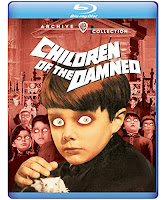
Children of the Damned 
Eye of the Devil 
(Warner Archive)
“Children,” the 1963 not-really-a-sequel to the classic “Village of the Damned,” is admirably understated as it follows several children who may or may not be from a superior alien race and the mainly clueless responses of various authority figures; too bad it’s never as thrilling or exciting as its predecessor. Similarly, 1966’s “Eye of the Devil,” which posits David Niven as the latest ancestral pagan in his family’s chateau in an eerie precursor of “The Wicker Man,” has unnerving moments but doesn’t cohere satisfyingly, despite J. Lee Thompson’s lean direction. Both B&W films look wonderfully sharp in HD; “Village” includes screenwriter John Briley’s commentary.

Dinner at Eight 
(Warner Archive)
Based on the witty play by George S. Kaufman and Edna Ferber, George Cukor’s 1933 cinematic version of the relationships among a group of Manhattan’s upper-crust—all invitees to a stylish bash that evening—has its static and stagy moments, but the cast is triumphant. Among a starry ensemble of John and Lionel Barrymore, Wallace Beery, Marie Dressler and Billie Burke, none other than Jean Harlow steals the show. This is supreme B&W entertainment that looks spectacular in hi-def. Extras are the 1993 documentary Harlow: The Blonde Bombshell, hosted by Sharon Stone, and a related vintage short, Come to Dinner.

The Hidden Life of Trees 
(Capelight/MPI)
German forester Peter Wohlleben is the focus of this illuminating documentary about how the natural world is more than just the “environment” that is always talked about but rarely understood. Director Jorg Adolph has created a splendid portrait of Woglleben who understands trees and their “language” as well as the “wood wide web” alongside a beautifully-shot nature documentary whose astonishing visuals make an persuasive case for the mostly unknown complexities of the natural world. The images, unsurprisingly, look rightly dazzling in hi-def.

Mary Stevens MD 
(Warner Archive)
In this 1933 pre-code melodrama, premarital sex and out-of-wedlock pregnancy are the outcomes of an affair between a female doctor—still handicapped professionally by her sex—and the man she has eyes for, even though he marries someone else. At 72 minutes, no one can say this is padded, but its dramatic thinness is only partly compensated for by Kay Francis’ bravura lead  performance. The B&W film looks exceptionally good on Blu.

DVD Releases of the Week 
Sisters 
(Distrib Films)
Writer-director Yamina Benguigui’s often trenchant study of a trio of French-Algerian sisters  still dealing with the decades-old fallout of their father leaving France and returning to Algeria with their young brother is an unflinching exploration of family dysfunction triggered by outdated political and cultural traditions against women. These women are powerfully enacted by ageless superstar Isabelle Adjani, tough-minded Maiwenn and forceful Rachida Brakni, who get to the heart of a fractured relationship that, after many years and thousands of miles, is difficult to heal.

Tiger 
(HBO)
The Tiger Woods saga—from the highs of his superstar status seemingly cemented while he was still an amateur golfer to the lows of his messy personal life (car wrecks, highly publicized affairs, divorce from his Nordic goddess wife) is recounted in thorough and even-handed fashion. Interviews with many people who have been part of his life over the decades, from his first love in high school to fellow pros on the tour, but there’s a hole at the center of not having Tiger himself, even if he’s been interviewed enough to use dozens of clips interspersed throughout.

Walker—Complete 1st Season 
(CBS/Paramount)
In this reboot of the ’90s series starring Chuck Norris, a longtime Ranger volunteers for a lengthy undercover operation after his beloved wife is murdered, and when he returns to discovers that he has to balance dealing with his estranged teenage daughter with his dangerous professional life. While this isn’t designed to appeal to everyone—the cutesiness slathered onto the sentimentality is a bit much—this should do very nicely for fans of straightforward action and melodrama, anchored by Jared Padalecki as Walker and Lindsey Morgan as his new partner. All 18 episodes are on 5 discs; extras are featurettes, deleted scenes and a gag reel.

CD Releases of the Week
César Franck—Hulda 
(Naxos)
Belgian composer César Franck (1822-90) was probably a more valuable teacher than composer: among his students were Vincent d'Indy, Ernest Chausson, Louis Vierne, Guillaume Lekeu and Henri Duparc. But Franck’s music, attractive if conventional, still holds interest, even if his opera output is barely heard. Indeed, Hulda was never performed until after his death. It’s too bad, for—at least on the evidence of this excellent recording by Germany’s Freiburg Theatre—it makes a worthy addition to the Gallic stage repertoire, with a great title role for a first-rate soprano (Meagan Miller does the honors here).

Alfred Schnittke/Sergei Prokofiev 
(Cleveland Orchestra)
Soviet composers whose works were written a half-century apart are featured on the latest recording by the Cleveland Orchestra, which has under conductor Franz Welser-Möst become a fearsome advocate for 20th and 21st century music. First, there’s the 1979 Concerto for Piano and Strings by Alfred Schnittke (1934-98), which effortlessly alternates between sheer bombast and utmost delicacy; pianist Yefim Bronfman is the formidable soloist. The year 1925 saw the premiere of the Symphony No. 2 by Sergei Prokofiev (1881-1953), a remarkable display of breakneck rhythms and brilliant orchestration, which Welser-Möst and the orchestra play with a controlled fury that harnesses the wild surges in Prokofiev’s always audacious score.

Wednesday, September 23, 2020

September '20 Digital Week IV

4K Release of the Week 
Full Metal Jacket 
(Warner Bros)
In Stanley Kubrick’s unforgettable 1987 war drama based on Gustav Hasford’s incendiary novel The Short-Timers, recruits go through basic training then are shipped off to Vietnam to become what their drill instructor molded them into: dehumanized killing machines. Kubrick’s classic, which is crammed with stunning images throughout, ends with one of the most haunting moments he ever filmed. There’s so much mastery on display: the brilliant master stroke of using trashy ‘60s pop songs to further debase the action; the documentary-like immediacy of Douglas Slocombe’s camerawork during several desultory skirmishes; the sardonic black humor in the taut script by Kubrick, Hasford and Michael Herr; the excellent performances by Matthew Modine as Pvt. Joker, Vincent d’Onofrio as the fated recruit Leonard Pyle, and R. Lee Ermey as D.I. Hartman. On ultra-hi def, the film looks ultra-realistic; it’s too bad that the superb 2012 Blu-ray set—with Modine’s on-set photographs and the fascinating extra Stanley Kubrick’s Boxes—wasn’t included.


VOD/Virtual Cinema Releases of the Week
Blackbird 
(Screen Media)
Danish writer Christian Torpe Americanized his script for 2014’s Silent Heart, and the result is a nicely photographed and well-acted melodrama about a family dealing with the matriarch choosing to end it all before her ALS becomes too overwhelming; since she’s doing it at the end of a holiday weekend together, secrets and recriminations rear their heads as everyone wrestles with her traumatic decision. Roger Michell directs elegantly if too schematically and Torpe’s writing has insightful and dramatic moments but too often piles on contrivance and last-minute revelations, while the cast of eight—led by Susan Sarandon’s tough-minded matriarch, Sam Niell’s quiet patriarch and Mia Wasikowska’s brittle black-sheep daughter—keeps one watching despite a familiar story familiarly told.

The Nest 
(IFC Films)
Writer-director Sean Durkin’s dysfunctional family drama unimaginatively attempts to dissect how a family loses its grounding after moving from the U.S. to England during the height of the greed-is-good 1980s. By having his characters—particularly the father, played unsubtly by Jude Law—act so ridiculously and inconsistently, Durkin sabotages his own picture and ends up nullifying the expressive performance by the always winning Carrie Coon, who plays the wife with such variety and vibrancy that she deserves better than the film she is stuck in.


Space Dogs 
(Icarus Films)
Elsa Kremser and Levin Peter’s audacious documentary takes as its starting point the canine Laika, first earth creature to travel into space, but who was incinerated upon reentering earth’s atmosphere after the historic space ride in 1957. Thus begins a sympathetic but clinical account of Moscow’s stray dogs—Laika’s descendants, it is said—which doubles as an exploration of scientific animal cruelty in order to further space exploration. There are many tough-to-watch moments, from a couple of strays playfully catching and torturing a cat to death and archival footage of Soviet scientists performing experiments on dogs, but the parallel between street life and lab cruelty is more forced than organic, despite indelible images.

Blu-ray Releases of the Week 
The Cordillera of Dreams 
(Icarus Films)
Patricio Guzman, a major but obscure director, makes films about his native Chile. His latest is the forceful final part of a trilogy about memories of Chile, which he left long ago: the title refers to the Andes Mountains—a natural border for Chile and as much metaphorical as it is real—to take the measure of this always changing, undefinable country. Looking back to the September 11, 1973 coup that brought dictator Augusto Pinochet to power, Guzman discusses the meaning of the Andes (or Cordillera) with other artists, who give original and insightful answers on their meaning to them and their nation’s history. Beautifully shot, as always, the film is a must-watch on Blu-ray; extras include a Guzman interview, making-of, and interviews with other artists.


I Am a Dancer 
(Film Movement Classics)
In this compelling 1972 documentary, Russian dancer Rudolf Nureyev rehearses and performs—in other words, this is as close to balletic bliss as you can get. Director Pierre Jourdan’s camera is in the right position to record Nureyev while teaching others, practicing himself, discussing his art or dancing with legendary ballerinas like Margot Fontyn, with whom he is paired in choreographer Frederick Ashton’s lovely Marguerite and Armand. The biggest—and happiest—surprise is a lengthy excerpt from Field Figures, danced brilliantly to the unique strains of Stockhausen’s music. This revelatory ballet film looks superb in a new hi-def transfer. Extras are appreciations by dance scholar Terese Capucilli and American Ballet Theatre dancer Skylar Brandt.

Prodigal Son—Complete 1st Season 
(Warner Archive)
This high-concept series takes as its model The Silence of the Lambs and ups the ante, as a young profiler working closely with the NYPD to track murderers turns to his own father, in jail for killing two dozen people years earlier, to help him solve cases by delving into other demented minds. It’s polished, slick and unnecessarily, grotesquely violent at times, but the acting is persuasive enough to keep viewers coming back for all 20 episodes of its first season: Tom Payne as the criminologist, Bellamy Young as his harried mother and Michael Sheen—channeling Anthony Hopkins—in a wide-eyed, over-the-top performance as the series’ own Hannibal Lecter. There’s a first-rate hi-def transfer.


DVD Releases of the Week
Mom—Complete 7th Season
Riverdale—Complete 4th Season 
(Warner Bros)
In its seventh season, Mom remains a pleasantly hit-or-miss sitcom, but the amusing and at times even touching interplay between Allison Janney as Mom and Anna Faris as her frequently disappointing daughter is always enough to make it through these 20 entertaining episodes. 

In the latest season of Riverdale, the gang returns for another go-around as a diverting live-action version of the Archie comics, with enough attractive performers and mild humor to offset the occasionally cloying attempts at melodrama throughout these 19 episodes. (The series shut down filming before the final episode due to the Covid-19 pandemic.) Riverdale extras are a trio of featurettes.


CD Releases of the Week
J.S. Bach—St. John Passion 
(BIS)
Conductor Masaaki Suzuki and his ensemble, the Bach Collegium Japan, are among our foremost contemporary interpreters of Bach’s formidable music, and this latest release—recorded in mid-March, just when the pandemic was starting to rage and everything was starting to shut down—is another estimable addition to their illustrious catalog. Bach’s St. John Passion is usually considered a step below the lofty heights of the composer’s great St. Matthew Passion, but the urgency of the vocal soloists, chorus and instrumentalists in this performance—perhaps because of the recording circumstances?—makes this a stirring listen.  

Buried Alive—Schoeck, Honegger, Mitropoulos 
(Bridge)
Leon Botstein creates the most adventurous programming in the New York area with his American Symphony Orchestra concerts and annual Bard Music Festival and Summerscape (sadly canceled, like everything else, this summer). Now he adds the Orchestra Now—a handpicked ensemble of musicians from the most illustrious music conservatories—to his resume. The strikingly original music—all written between 1926 and 1928—is by three excellent European composers in their prime: Swiss Arthur Honegger’s short, spiky Rugby; Swiss Othmar Schoeck’s intensely dramatic, 40-minute centerpiece, Lebendig begraben; and Greek Dmitri Mitropoulos’s bracing Concerto Grosso. The orchestra under Botstein plays enthusiastically, and baritone soloist Michael Nagy and the Bard Festival Chorus are standouts in the Schoeck’s monumental work.

Wednesday, September 9, 2020

September '20 Digital Week II

VOD/Virtual Cinema Releases of the Week 
Fatima 
(Picturehouse)
Director Marco Pontecorvo—the great filmmaker Gillo Pontecorvo’s son—has made a satisfying dramatization of the apparition of the Virgin Mary seen by Lucia and two other children in Portugal in 1917 and its many ramifications. By giving equal weight to skepticism (through the characters of Lucia’s mother, the local mayor and—in a 70-years-later subplot—a professor who debates Lucia, now an elderly nun) and belief, and visually differentiating them without copying Terrence Malick’s inspired mysticism, Pontecorvo’s well-made anti-spectacle is anchored by excellent performances: Alba Baptista as Lucia’s mother, Harvey Keitel as the layman, Sonia Braga as Lucia the nun and Stephanie Gil, a fantastic child actor, as the young Lucia.

The Andorra Hustle 
(Merola Productions)
In a fearless bit of cinematic reportage, Eric Merola balances voluminous evidence and insightful interviews with the principals to explain what took down the national bank of the tiny European principality of Andorra: the Spanish government covertly pulled the strings to stop the Catalan independence movement in its tracks. Merola lays out in detail and with the calm clarity of a topnotch detective how this was done with approval by authorities in Europe and—of course—the United States. A special shout-out goes to the defense lawyers trying against imposing odds to clear innocent clients, who deposited their savings in the bank but are unable to retrieve it.

Apocalypse ’45 
(Discovery/Abramorama)
In time for the 75th anniversary of the end of the war in the Pacific, director Erik Nelson has taken newly discovered and restored color footage—as U.S. forces had the Japanese on the run, culminating in victories at Iwo Jima and Okinawa, incendiary bombing of Japanese cities and dropping of atomic bombs on Hiroshima and Nagasaki—and made a fascinating, you-are-there historical document. Throughout we hear the voices of those who were there, two dozen veterans of the Greatest Generation giving their observations and memories of those victorious days; fittingly, Nelson gives the last 10 minutes over to their faces and names, a most deserved honor.

Jimmy Carter—Rock & Roll President 
(CNN Films)
In the late ‘70s, California governor Jerry Brown was America’s hippest politician, dating Linda Ronstadt and hanging out with Jackson Browne and the Eagles. But, as director Mary Wharton shows in this breezily engaging portrait, President Jimmy Carter was our music lover-in-chief, whether gospel, jazz, rock, country or classical. Carter hosted concerts at the White House starring Sarah Vaughan, Dizzy Gillespie, Dexter Gordon, Loretta Lynn, Jimmy Buffett, Willie Nelson and Johnny Cash, and had White House visits from Crosby Stills & Nash and even benefit concerts by the Allman Brothers. Along with showing their performances, Wharton interviews many of them, including an unusually talkative Bob Dylan; some (like Nile Rodgers and Rosanne Cash) even taking their turns reading Carter’s homespun poetry. Carter, now age 95, speaks lucidly and honesty about his kinship with music and musicians. The film won’t make viewers reconsider his one-term presidency, but his openness to all people, cultures and our shared humanity is on display.

Blu-ray Releases of the Week 
Caro Diario/Dear Diary 
(Film Movement Classics)
Nanni Moretti’s 1994 triptych comprises episodes that vary widely in amusement and dramatic interest while representing the states of the filmmaker/narrator’s mind, from the zesty (“On My Vespa,” with Moretti motoring around Rome) to the negligible (“Islands”—unfortunately the longest—about an island where parents let children run things) and the deadly serious (“Doctors,” recounting Moretti’s harrowing cancer treatment). The tone wavers uneasily throughout, not surprisingly, but Moretti has always had a light touch that helps the film—and viewers—through some of the rougher spots. There is a terrific new hi-def transfer; extras are an on-set featurette and a deleted scene.

Einstein’s Universe 
(Corinth Films)
This 1979 documentary written and conceived by Nigel Carter (which originally aired on BBC, the  PBS) aims to make Albert Einstein’s genius accessible to the average viewer, so it has British actor Peter Ustinov as our narrator/tour guide of sorts, being alternately dazzled and bewildered by the astonishing variety of Einstein’s studies. Of the many onscreen scientists, some are better than others at speaking in plain English about such abstruse subjects; there are also a few ill-conceived sequences of Ustinov partaking in wacky visualizations of some of Einstein’s theories. There’s a fine new hi-def transfer.

Kentucky Kernels 
(Warner Archive)
This mild, dated 1934 comedy one historical claim to fame: it’s George Stevens’ solo directorial debut. Yes, the director of Giant, The Diary of Anne Frank and The Greatest Story Ever Told got his start with a creaky vehicle for then-famed comic duo of Bert Wheeler and Robert Woolsey—along with a very young (and pre-Little Rascals) Spanky McFarland, who steals the show as the rambunctious orphan who’s the catalyst for what little plot there is. It’s all relatively painless and, at 74 minutes, mercifully short. There’s an excellent new hi-def transfer of this slight black-and-white non-classic; extras are a vintage short and cartoon.

CD Release of the Week
Missy Mazzoli—Proving Up 
(Pentatone)
For her third operatic collaboration with librettist Royce Vavbrek, composer Missy Mazzoli has taken a short story by Karen Russell about a family of 19th century midwestern homesteaders and turned it into a spectrally eerie, dramatically dynamic one-acter. With superlative performances and remarkably agile playing from the International Contemporary Ensemble, Proving Up proves that Mazzoli can make opera classic and contemporary simultaneously—especially when the supernatural aspect arrives, entirely naturally and with beautifully and hauntingly atmospheric music. 

Wednesday, June 24, 2020

June '20 Digital Week IV

VOD/Virtual Cinema Releases of the Week  
The King of Staten Island 
(Universal)
I’m no fan of Pete Davidson or Judd Apatow so I unsurprisingly found their collaboration—all two hours and fifteen minutes—insufferable. Davidson basically (and monotonously) plays himself if he never joined SNL, just a tattooed goof-off; shoehorning his own tragic back story (Davidson’s real father, a firefighter, died on Sept. 11) into this crude, forgettable attempt at comedy—another of Apatow’s paeans to losers—borders on the unseemly. On the positive side, Marisa Tomei is a delight as Pete’s mom, Steve Buscemi is fine as a fireman, and Bill Burr is agreeable in a one-note part as Mom’s new boyfriend (another fireman)—but they only partially compensate for long stretches of choppy, self-indulgent moviemaking and empty, laughless space.


Classe tous risques (Consider All Risks) 
(Rialto)
French director Claude Sautet’s sophomore feature, this 1960 crime drama is a taut, tight exploration of a wanted man’s desperate attempts to remain free—by film’s end, his wife is dead, he’s separated from his two young sons and the law is right behind him. Lino Ventura gives a blistering performance as the flawed protagonist and has fine support by Jean-Paul Belmondo as his latest—and likely last—partner and Sandra Milo as a young woman who assists them. Superbly shot in stark B&W by Ghislain Cloquet, Sautet’s best film was followed by increasingly more erratic features, unfortunately. 

My Darling Vivian 
(Film Collaborative)
Usually erased from accounts of Johnny Cash’s life and career is his first wife Vivian Liberto—mother of his four daughters, including singer Rosanne—in favor of the obvious June Carter Cash/second wife angle; Matt Riddlehoover’s illuminating documentary corrects the by-now cemented historical record. Emotional interviews with Vivian’s daughters are interspersed with an eye-opening and quite touching look at Vivian with and without Johnny: after their divorce, she remarried while admitting that Johnny was the love of her life. 


Sometimes Always Never 
(Blue Fox Entertainment)
Bill Nighy displays his usual snarky persona as a respected tailor damaged after one of his sons stormed out during a tense game of Scrabble in Carl Hunter’s by-the-numbers study of a man more interested in words than in other people, including his own family. The always watchable Nighy can do sort of thing in his sleep, which means there’s little surprise to his character arc, while even an actress as dependable as Jenny Agutter is unable to create many sparks as a woman who enters the tailor’s life after meeting him at the morgue, of all places.

Blu-rays of the Week 
Corpus Christi 
(Film Movement)
Polish director Jan Kosama’s provocative study of a 20-year-old jailbird posing as a village priest and how it changes him and his parishioners—especially after he looks into past sins that have been swept under the rug—might be contrived but it’s a powerful statement on the uneasy intersection of criminality, religion and redemption. Bartosz Bielenia gives a phenomenally effective performance in the lead role while Eliza Rycembel leads an excellent supporting cast as a local woman he befriends. The film looks terrific on Blu; extras are a making-of featurette and Kosama’s 2003 short, Nice to See You.


L’important c’est d’aimer (That Most Important Thing: Love) 
(Film Movement Classics)
Polish director Andrzej Zulawski made several films about unhinged characters in difficult relationships, but he’s in relatively muted mode in this disjointed 1974 portrait of a struggling actress juggling her personal and professional lives. Romy Schneider’s incendiary portrayal of a married woman who falls in love with a photographer provides some searing and intense moments; too bad these are exceptions in Zulawski’s wan glimpse at artists’ difficulties. There’s a very good hi-def transfer; lone extra is a Zulawski interview.

Mahler—Symphony No. 2, “Resurrection” 
(Unitel)
Gustav Mahler’s massive “Resurrection” symphony—for large orchestra, chorus and two female soloists—is given a forceful rendition by conductor Gustavo Dudamel, Munich Philharmonic and chorus and singers Tamara Mumford and Chen Reiss. Performed in the gorgeously cathedral-like Palau de la Música Catalana in Barcelona, Mahler’s mammoth work comes off brilliantly, from its quiet beginnings to its stirring finale, much like Beethoven’s ninth (see DVD reviews below). There’s first-rate hi-def video and audio.


Once Were Brothers—Robbie Robertson and the Band 
(Magnolia)
Director Daniel Roher engagingly recounts the eventful musical life of Robbie Robertson, leader of the Band, the original roots-rock group whose classic tunes “The Weight,” “The Night They Drove Ol’ Dixie Down” and “Up on Cripple Creek” remain staples of classic rock playlists. Robertson candidly discusses his upbringing in Canada, his move to the U.S. and teaming up with his future Bandmates, working with Bob Dylan and, later—following the Last Waltz concert film—Martin Scorsese, for whom he has scored and compiled music for decades. The film looks and sounds great in hi-def.

Tokyo Olympiad 
(Criterion)
Japanese director Kon Ichikawa was chosen to create the official record of the 1964 Tokyo Summer Games, and the passionately filmed and involving result is—along with Leni Riefenstahl’s Olympia, about the infamous 1936 Berlin Games—the best-ever Olympic document. From intimate moments of personal triumph and agony to expansive views of the playing fields and spectators, Ichikawa presents the human comedy on an epic canvas. Criterion’s stellar edition includes a quite good (but not great) hi-def transfer, commentary and introductions by Japanese film expert Peter Cowie, archival Ichikawa interviews, new featurette, and nearly an hour and a half of additional footage.


DVDs of the Week
Beethoven’s Ninth—Symphony for the World 
(C Major)
Beethoven’s Ninth Symphony—the first symphony comprising a choir and solo vocalists—was a formidable challenge for those at its 1824 Vienna premiere. (Beethoven, deaf by that time and co-conducting the first performance, famously had to be turned around by one of the singers so he could see the applauding audience.) Christian Berger’s captivating documentary demonstrates that Beethoven’s message of brotherhood and humanity has not faded in the past 200 years: we see orchestras, conductors, composers and soloists getting ready to perform the work all over the world, from Tokyo (where 10,000 people make up the chorus) to Africa. The symphony is still a stirring and daring work of art, which was Beethoven’s intent.

The Gene—A Personal History 
(PBS)
This fascinating multi-episode documentary from a book by Siddhartha Mukherjee precisely lays out how genetic science has grown into the complex and seemingly miraculous field responsible for so many important breakthroughs. Personalizing the science—we are introduced to people with diseases yet to be tamed and watch if gene therapy can help—also humanizes the historical aspect, as the men and women working so heroically are discovering how to utilize constantly improving technology for the betterment of all.


The Perfect Nanny 
(Distrib Films)
Based on the subtly unnerving novel by Leïla Slimani, Lucie Borleteau’s middling adaptation slowly builds predictable suspense after a well-to-do Parisian couple hires the so-called title character, then loses it all with a lazy finale that recalls mindless slasher flicks far more than more sophisticated thrillers. As the nanny, the mostly persuasive Karin Viard is eventually undercut by Borleteau’s reliance on clichés, which mitigates the domestic horrors found in this all-too-real situation.

CDs of the Week 
Penderecki—St Luke Passion 
(BIS)
Polish composer Krzysztof Penderecki—who died in March at age 86—was known for his tense, dissonant works, which are familiar to anyone who’s seen The Exorcist, The Shining, Shutter Island or fellow Pole Andrzej Wajda’s Katyn. But his St Luke Passion, which premiered in 1966, showed off a “new” Penderecki: blending atonality with baroque forms and a newfound talent for choral writing, this was the first of several large-scale vocal works based on religious texts. This tremendous performance from the 2018 Salzburg Festival by the Montreal Symphony Orchestra, Krakow Philharmonic Choir, Warsaw Boys Choir and a quartet of esteemed soloists was conducted by Kent Nagano, whose affinity for Penderecki’s wide-ranging sound world is very much in evidence.


Feldman—Coptic Light 
(Capriccio)
The most characteristic works of American composer Morton Feldman (1926-87) don’t lend themselves to either live performances or, especially, recordings: consider his marathon, six-hours-without-a-break String Quartet No 2. But this recording shows that Feldman could work his singular magic—slowly evolving sounds, mostly quiet dynamics—in smaller forms: 1973’s String Quartet and Orchestra distills the essence of his music to 26 memorable minutes, while 1986’s Coptic Light (his last completed work before his death from cancer) further consolidates his aesthetic of musical calm, even with the extraordinarily large orchestral forces needed. The ORF Vienna Radio Symphony Orchestra plays both works brilliantly under the batons of Michael Boder (Coptic Light) and Emilio Pomarico (String Quartet and Orchestra, with the Arditti Quartet).

Tuesday, May 19, 2020

May '20 Digital Week III

Blu-rays of the Week 
Birds of Prey 
(Warner Bros)
Unsurprisingly, Margot Robbie is a blast to watch as Harley Quinn, the hyperactive anti-heroine who destroys troublemakers with the help of her fellow “birds of prey” sisters in this often frenzied and at times even desperate DC Comics actioner by director Cathy Yan and writer Christina Hodson. Despite the forced cutesiness, Robbie’s star turn glows, and there’s amusing support by Rosie Perez, Mary Elizabeth Winstead, Jurnee Smollett-Bell and Ella Jay Basco; too bad Ewan MacGregor has negligible villainous presence. There’s an eye-popping hi-def transfer; extras include featurettes and a gag reel.

Gretel & Hansel 
(Warner Bros)
Director Osgood Perkins’ version of the Grimms’ fairy tale is unsubtly subtitled “A Grim Fairy Tale,” and though it looks stylish (with evocative photography, sets and costumes), its 87 minutes are diminished by a willfully draggy pace and even, at times, repetitiveness garnering diminishing dramatic returns. Although Sophia Lillis is a most persuasive Gretel, Sam Leakey is a mostly wooden Hansel and Alice Krige hams it up mightily as the witch. The film looks exceptional in hi-def; lone extra is a storyboard featurette.

LA Phil 100 
(C Major)
Last fall, the Los Angeles Philharmonic’s centennial concert brought together three of its best-known music directors—Zubin Mehta, Esa-Pekka Salonen and the current head of the orchestra, Gustavo Dudamel—for a satisfying 90-minute exploration of music from Wagner, Ravel and Stravinsky to the great Polish modernist Witold Lutosławski’s Symphony No. 4 and a new work by Daniel Bjarnason, From Space I Saw Earth, conducted by all three maestros. Hi-def audio and video are first-rate; lone extra is The Tradition of the New, a 52-minute documentary about the orchestra’s history.

Sweet Bird of Youth 
(Warner Archive)
Although Tennessee Williams’ play about a gigolo who returns to his hometown after failing in Hollywood has been bowdlerized by self-imposed film censorship in 1962, writer-director Richard Brooks’ adaptation still makes a strong impression thanks to its impeccable cast. Paul Newman, Geraldine Page, Shirley Knight, Rip Torn and Ed Begley (who won an Oscar) have these characters in their very bones, and they nearly overcome the loss of Williams’ potent dramaturgy about hysterectomy and castration, unfortunately replaced by abortion and a broken nose. Milton Krasner’s sharp color photography looks especially vivid on Blu-ray; extras include a vintage featurette and Page and Torn’s screen test.

Tea with the Dames 
(Sundance Selects)
This beguiling documentary about the grand dames of British acting—Eileen Atkins, Judi Dench, Joan Plowright and Maggie Smith—records them as they engagingly, hilariously and even touchingly discuss their long careers and friendships as well as mortality. Director Roger Michell smartly allows the dames feel free enough to let fly with a curse word here or an extra slug of champagne there; inserting vintage clips of the quartet as actresses in prime form—from ’50s Shakespeare to 21st century films—is an added nice touch. One quibble is brevity: 83 minutes are not nearly long enough to do these women justice. So it’s too bad that there are no deleted scenes as a Blu-ray bonus; the film does look very good in hi-def.

Vivarium 
(Lionsgate)
When a couple visits a real-estate development, they are unable to leave and are soon forced to raise a young boy by what seem unseen alien forces—and things only get worse from there. Director Lorcan Finnegan and writer Garret Shanley’s visually striking but thematically muddled sci-fi/horror flick piles on unpleasantness and obviousness (the opening shows cuckoos taking over other birds’ nests to survive) and ends up as an inferior Twilight Zone episode stretched to 95 minutes. The movie hammers home its one-note metaphor with a relentlessness that’s ultimately enervating, wastes Jesse Eisenberg and Imogen Poots as the couple and has a botched ending that makes scant sense even in its nefariously unreal world. The film looks splendid in hi-def.

VOD/Virtual Cinema Releases of the Week 
Capital in the Twenty-First Century 
(Kino Lorber)
Based on the best-selling book by French economic theorist Thomas Piketty—who also has a prominent onscreen role—Justin Pemberton’s engaging documentary presents Piketty’s theories on capitalism’s role in our current lopsided economic, social and political climate in a thoughtful way for mainstream audiences. Supporting Piketty’s viewpoint are commentators who delve into the history of capitalism from Adam Smith to today—showing that the economic inequality that has only worsened in the past century is not entirely irreversible, but that time may be running out. (KinoMarquee.com)

The Infiltrators 
(Oscilloscope)
This fascinating hybrid of documentary and fictional reenactment tells a harrowing story—how prisoners in immigrant detention centers are assisted by those who get themselves detained to better facilitate their release—as a contrived balancing act that’s necessitated by the fact that what happened behind the centers’ walls was not filmable. Despite their film not being as pointed as it should be, directors Cristina Ibarra and Alex Rivera provide a vivid snapshot of an America that’s at a crossroads—but one in which desperate and daring activists like those detailed in their film will do what it takes to make things right. 

DVD of the Week 
Zombi Child 
(Film Movement)
Bertrand Bonello’s different kind of zombie movie tackles history and agency by being set in 1962 Haiti and present-day Paris, where the descendant of a zombie attends a girls’ boarding school. Too bad that, by avoiding flesh-eating gore, Bonello ends up with a moderately interesting film of unusual locations whose lack of hysteria leads to stretches of deathly dullness: talk about Rhianna (also a product of the Caribbean) and white teenage girls taking a page from the colonized to rid themselves of evil spirits are not dramatic subjects in Bonello’s hands. Extras comprise Bonello’s commentary and Philip Montgomery’s short film, Child of the Sky.

CDs of the Week
Magnus Lindberg—Accused/Two Episodes 
(Ondine)
2015’s sensationally gripping Accused (subtitled “Three Interrogations for Soprano and Orchestra”), Finnish composer Magnus Lindberg’s first work for the London Symphony Orchestra as composer in residence, takes as its theme the loss of freedom of speech through a trio of episodes (French Revolution, Communist East Germany, Obama’s America) that give powerful voice to women questioned under duress. Soprano Anu Komsi rivets throughout this challenging dramatic showcase that runs nearly 40 minutes. Lindberg’s Two Episodes, inspired by Beethoven’s Ninth Symphony, is an attractive ensemble piece that highlights the Finnish Radio Symphony Orchestra under conductor Hannu Lintu, both of which also provide strong support in Accused.

Gabriel Prokofiev—Concerto for Turntables No. 1/Cello Concerto 
(Signum Classics)
A mash-up of the dance club and concert hall, Gabriel Prokofiev’s 2006 Concerto for Turntables No. 1 balances, with humorous bombast, the scratchy sounds of the DJ’s turntable (the soloist is British-born Mr. Switch, aka Anthony Culverwell) with a hypnotically dissonant orchestral part. Prokofiev’s Cello Concerto is less forward-looking, hearkening back to such modernist masterpieces as his grandfather Sergei’s masterly Symphony-Concerto, among others. Boris Andrianov is the estimable cello soloist; the Ural Philharmonic under the direction of conductor Alexey Bogorad provides vivid accompaniment in both works.