Tuesday, November 29, 2016

November '16 Digital Week V

Blu-rays of the Week 
C.H.U.D.
(Arrow)
Beware of the CHUDs (Cannibalistic Humanoid Underground Dwellers), hiding in Manhattan’s sewers and fatally mauling their victims in this dopey but guilty-pleasure 1984 horror flick by director Douglas Cheek, who knows that he has silly material but runs with it, resulting in a mindless entertainment strongly aided by its cast. Then-unknown actors John Heard, Daniel Stern, Kim Geist, John Goodman and Jay Thomas do their best. The hi-def transfer is excellent; extras comprise two commentaries, new crew interviews, extended shower scene and NYC locations featurette.

Heart—Live at the Royal Albert Hall
(Eagle Rock)
Ann Wilson’s magnificent voice is a freak of nature, as she proves throughout the 90-minute concert she and sister Nancy’s band played in June at London’s fabled Royal Albert Hall, with the Royal Philharmonic Orchestra sitting in for some tunes, giving depth and elegance to “Dreamboat Annie” and “Sweet Darlin’,” among others; but it’s Ann’s pipes on “Alone,” “Beautiful Broken” and “Barracuda” that really propel the show. The audio and video are superb, the Wilson sisters interview is interesting, but director James Russell botches it by continually cutting away from Ann singing to pointless glimpses of views from the cheap seats or to audience members—whom we don’t care about—singing along.

Poldark—Complete 2nd Season 
(PBS)
Ross Poldark knows all about drama, and the series’ second season finds him in so many near-fatal—or at least life-changing—scrapes that it becomes second nature for him to squeeze his way out of them in this ravishing-looking remake of the classic BBC drama series based on Winston Graham’s books. Aidan Turner is a dashing Poldark, Heida Reed a bewitching Elizabeth—Ross’s ex-fiancée who’s still dangerously nearby—and Eleanor Tomlinson a spunky, feisty Demelza, Poldark’s wife. The 10 episodes have been given top-notch hi-def transfers; extras include interviews and featurettes.

Private Vices, Public Virtues 
(Mondo Macabro)
Hungarian director Miklós Jancsó, who died in 2014 at age 92, made this visually unique Italian-Yugoslav co-production in 1976, featuring his customarily lyrical cinematography, with gorgeous colors and stunningly choreographed movement. There’s not much else to tempt non-Jancsó fans, unless you count plentiful nudity—it’s of a piece with the rest of his singular artistry, although it does wear out its welcome before its 105 minutes finish. The hi-def transfer looks exquisite; the film soundtrack is in Italian or English, and contextual extras are interviews with co-writer Giovanna Gagliardo, actress Pamela Villoresi and historian Michael Brooke.

Ritchie Blackmore’s Rainbow—Memories in Rock 
(Eagle Rock)
As part of last year’s Monsters of Rock festival at two sites in Germany, guitarist extraordinaire Ritchie Blackmore brought the latest incarnation of his band Rainbow for a fervid two-hour concert featuring such Rainbow favorites as “Since You Been Gone” and “Man on the Silver Mountain” along with Deep Purple classics like the ubiquitous finale, “Smoke on the Water.” Blackmore’s playing is inspired, while vocalist Ronnie Romero does great impersonations of Ian Gillan, Ronnie James Dio and Graham Bonne). Audio and video are first-rate; two CDs provide an audio recording of the entire concert.

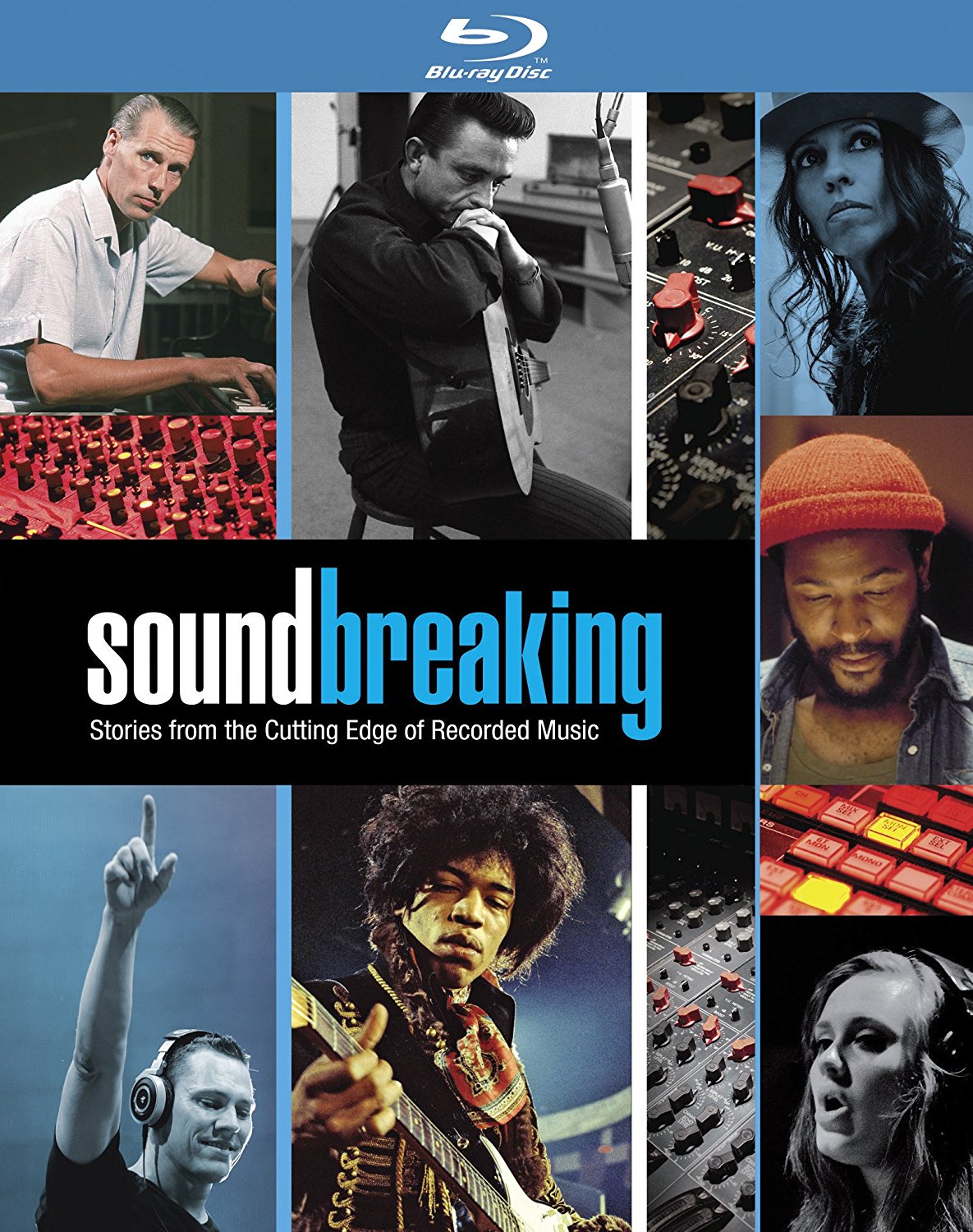
Soundbreaking
(RLJ/Athena)
Throughout its eight one-hour episodes, director Jeff Dupre and Maro Chermayeff’s series explores how recording, video and other technical innovations have changed the way music is created and how we absorb it. Even if such a format inevitably makes it more of a general overview than an in-depth examination, the historical performance clips and interviews with luminaries from George Martin and Paul McCartney to Rick Rubin and Tom Petty are something to see, especially in the first two (and best) parts, The Art of Recording and Painting with Sound. The Blu-ray looks fine; extras include even more interviews, including Ringo demonstrating rock’n’roll drumming.

Time After Time 
(Warner Archive)
In Nicholas Meyer’s sensationally entertaining 1979 time-travel adventure, Malcom McDowell makes a witty and sympathetic H.G. Wells, who lands in modern-day San Francisco in his own time machine—chasing Jack the Ripper (a perfectly creepy David Warner), who loves the chaotic 20th century. A terrifically clever premise and undeniable if offbeat chemistry between McDowell and Mary Steenburgen as the woman who aids Wells make this a grand diversion. There’s a superior hi-def transfer; lone extra is a Meyer and McDowell commentary.

DVDs of the Week
True New York
When Two Worlds Collide
(First Run)
Anthologies don’t come more absorbing than True New York, comprising five documentary shorts about some incredible characters living in a New York City not usually shown: teens cliff-jumping in the Harlem River; workers at a Queens yellow-cab depot; an artist who draws interiors of all of New York’s subway stations; a financial whiz who takes over his father’s halal slaughterhouse; and a Harlem street performer who regales drivers on the FDR Drive. In Heidi Brandenburg & Mathew Orzel’s astonishing documentary When Two Worlds Collide, Peruvian indigenous people and government forces clash over the destruction of valuable rainforest by companies that those in power have given the green light to. Angry rhetoric soon devolves into violent, fatal clashes—it’s a timely and depressing look at authoritarian control. True extras include filmmaker interviews.

CDs of the Week 
Gidon Kremer—Complete Concerto Recordings
(Deutsche Grammophon)
One of the great violinists of the late 20th—and early 21st—century, Gidon Kremer is best known as a remarkably agile and inspired interpreter of modernist composers like Alfred Schnittke and Sofia Gubaidulina (both of whom are generously represented here), but this 22-CD set—which collects all of Kremer’s concerto recordings for DG since his 1979 Beethoven/Schubert disc—shows Kremer’s versatility as well as his virtuosity. So we get his extraordinarily expressive readings of works by Bartok, Berg and Shostakovich as well as Bach, Mozart and Mendelssohn; Tchaikovsky, Bernstein and Rorem along with Vivaldi, Schumann and Paganini. Even in the occasional dud, like Philip Glass’s repetitious and unmusical concerto, Kremer gives a scalding performance that almost makes one believe it is worthy of his talent. 

Tuesday, November 22, 2016

November '16 Digital Week IV

Blu-rays of the Week 
Akira Kurosawa’s Dreams
(Criterion)
One of Japanese master Akira Kurosawa’s most vividly visual filmscapes, this episodic 1990 fantasy doesn’t connect in any way but its stories are heartfelt—if at times diffuse—reminders of how life on this planet is both precious and filled with man-made horrors. The best segments, at the beginning and end, present Kurosawa’s singular cinematic vision at its most colorful: the middle segment, on Vincent van Gogh (with Martin Scorsese miscast as the painter), gloriously bursts into dazzling primary colors. Criterion’s excellent release comprises an eye-poppingly beautiful hi-def transfer; Stephen prince commentary; Making of “Dreams,” a 150-minute on-set documentary; Kurosawa's Way (2011), a 50-minute feature with many filmmaking admirers discussing Kurosawa; and new interviews with assistant director Takashi Koizumi and production manager Teruyo Nogami round out this excellent set.

Carrington
J’accuse
(Olive Films)
In Christopher Hampton’s choppy 1995 biopic Carrington, Emma Thompson embracingly embodies the title character, whose love for avowed homosexual writer Lytton Stratchey (a powerful Jonathan Pryce) was forever unrequited; Hampton gets much right, but he meanders too often to no discernable point. Abel Gance’s J’accuse, a strong but strident 1938 anti-war tract, showcases several formidable actors (Victor Francen, Jean-Max, Line Noro, Paul Amiot) who point Gance’s polemic in the right direction. Both films have nicely restored transfers.

Hannie Caulder 
(Olive Signature)
This 1971 revenge western stars a comely but wooden Raquel Welch as a frontier woman who survives a rape by three outlaws, then tracks them down after they kill her husband in cold blood. Director Burt Kennedy is unsure whether he’s making an exploitation flick or a serious drama about a woman’s degradation and redemption, ending up in a no man’s (or woman’s) land uneasily poised between two extremes. Robert Culp is gamely appealing as the hired gun who helps Hannie, while Ernest Borgnine, Strother Martin and Jack Elam are an appropriately despicable bunch of hombres. The film looks quite good on Blu-ray; extras are a director Alex Cox (Walker, Repo Man) commentary and two featurettes.

Looking—Complete Series and Movie
(HBO)
This HBO series about a trio of gay men who are close friends explores their relationships, both platonic and intimate, over the course of two seasons and 16 episodes—along with a full-length film which reunited the friends a year later at a wedding. The five-disc Blu-ray set brings together all of the episodes and the film, all showcasing the rich, sensitive performances in the leads by Jonathan Groff, Frankie J. Alvarez and Murray Bartlett. The hi-def transfers are first-rate; the 16 episodes contain audio commentaries.

One-Eyed Jacks 
(Criterion)
Marlon Brando’s lone directing effort was this overambitious 1961 western in which he plays a gunslinger who, after going to prison because of his partner’s betrayal, spends the rest of the long movie getting his ultimate revenge. The always-charismatic Brando is never less than watchable, Karl Malden fine as his nemesis and Slim Pickens steals scenes as Malden’s lackey, but there’s a huge hole left by Pina Pellicer’s amateurishly stiff performance as the woman Brando loves. It’s undeniably gorgeous to look at, as Charles Lang’s splendid cinematography gains in color and detail in Criterion’s restored hi-def transfer. Extras include a Martin Scorsese intro, Brando voice-recording excerpts made during production and video essays on Jacks’ production history and Brando’s making a western.

DVDs of the Week
Capital
The Syndicate—All or Nothing
Wentworth
(Acorn)
The acting is the main thing is two new British television series, as well as one from Down Under. Capital is a clever drama tinged with mystery and paranoia, helped along by an ace cast led by Toby Jones, Rachael Stirling, Lesley Sharp and Gemma Jones; The Syndicate—which follows the servants at a ritzy mansion who win the lottery—features a stellar ensemble headed by Alice Krige, Polly Walker and Anthony Andrews. The intense Australian prison drama Wentworth—emphatically not a rip-off of Orange Is the New Black—also features a plethora of superb performers: Danielle Cormack, Nicole da Silva, Kris McQuade, Leeanna Walsman and Kate Atkinson. Wentworth extras include an hour of on-set featurettes and several interviews.

The Childhood of a Leader 
(IFC)
Actor Brady Corbet’s haunting directorial debut, a Fascist allegory for our time, is an absorbing tale of a rambunctiously wild child—son of an American ambassador in Europe—who quickly discovers that he can have his way at any cost, including the lives of his parents. Although the finale unsubtly depicts the adult leader beginning his reign in front of cheering crowds—the showy camerawork and blatant score are showy undercut the power of the images—overall, this is an unsettling and pertinent expose, which features a brilliant performance by Berenice Bejo as the boy’s mother.

Lo and Behold—Reveries of the Connected World
(Magnolia)
Another of German director Werner Herzog’s endlessly fascinating documentaries—as opposed to his trite and unconvincing fictions—is this playfully serious study of how the virtual world has encroached on the real one, most likely to our ultimate peril. As usual, Herzog seeks out the most interesting if unlikely people to talk with, all in his own, charmingly accented English; that inimitable voice also provides the alternately amused and bemused narration. Lone extra is a Herzog interview.

CD of the Week 
Arthur Honegger and Jacques Ibert—L’Aiglon
(Decca)
Two master French composers did that rare thing, joining forces to collaborate on an opera. The unsurprisingly tuneful but surprisingly coherent result (musically and dramatically) contains both charming and intense music, with a flavorful libretto based on Edmund Rostand’s play about Napoleon’s son. This recording—conducted by Kent Nagano, leading a lovely performance by the Montreal Symphony Orchestra—gets all the little details right and builds the opera to a taut finale; there’s exquisitely idiomatic singing by sopranos Anne-Catherine Gillet and Helene Guilmette and baritones Marc Barrard and Etiene Dupuis. Too bad this rarity—first performed in 1937 then infrequently done since—wasn’t given a staging that we could watch on DVD or Blu-ray.

Monday, November 21, 2016

Off-Broadway Review—“Terms of Endearment” with Molly Ringwald

Terms of Endearment
Adapted by Dan Gordon; directed by Michael Parva
Performances through December 11, 2016
59e59 Theatres, 59 East 59th Street, New York, NY
59e59.org

Molly Ringwald and Hannah Dunne in Terms of Endearment (photo: Carol Rosegg)
I’ve never read Larry McMurtry’s novel Terms of Endearment, so I don’t which parts playwright Dan Gordon used for his stage adaptation. But since I know James L. Brooks’ film of the book—which swept the 1983 Oscars—pretty well, it’s striking how many of the best lines in this alternately sardonic and sentimental comedy-cum-tragedy about the volatile relationship between a headstrong widow and her only daughter are taken directly from the screen version.

Of course, in the movie, writer-director Brooks had such acting luminaries as Shirley MacLaine, Jack Nicholson, Debra Winger and Jeff Daniels—all at their considerable best—at his disposal. Their long shadows unfortunately hang over the stage version of Terms, efficiently directed by Michael Parva and tidily if a bit too obviously adapted by Gordon.

This is not to blame the very capable actors: Molly Ringwald is, like MacLaine, a simultaneously appealing and exasperating matriarch Aurora Greenaway; Hannah Dunne gives feisty daughter Emma a tangy Texas twang a la Winger, but smartly never apes her outright; Jeb Brown treads lightly around the scene-stealing Nicholson performance as the aging but still womanizing astronaut Garrett Breedlove; and Denver Milord makes a likable Flap, Emma’s put-upon husband, who was so memorably played by Jeff Daniels.

But even with such solid acting, whenever the all-time classic dialogue tumbles out of the characters’ mouths—Aurora (“Why should I be happy about being a grandmother??!!”), Garrett (“If you wanted to get me on my back, all you had to do was ask”); and Emma (“I don't give a shit, mother, I'm sick”)—anyone with passing familiarity with the movie will miss the legendary spins put on it by MacLaine, Nicholson, Winger, et al. It earns the tears it gets at the end, but this Terms of Endearment sits uneasily between the screen and the stage.

Sunday, November 20, 2016

Off-Broadway Review—Anna Deavere Smith’s “Notes from the Field”

Notes from the Field
Written and performed by Anna Deavere Smith; directed by Leonard Foglia
Performances through December 11, 2016
Second Stage Theater, 305 West 43rd Street, New York, NY
2st.com

Anna Deavere Smith in Notes from the Field (photo: Joan Marcus)
We need Anna Deavere Smith more than ever. Her form of documentary theater—where she “plays” real-life individuals discussing whatever subject she has to hand, starting with Fires in the Mirror, about the Crown heights riots, and continuing with Twilight Los Angeles 1992, House Arrest and Let Me Down Easy—returns with Notes from the Field, another provocative and wide-ranging exploration of a peculiarly American problem: the uneasy relationship between education and the penal system.

The starting point for Smith is the police killing of Freddie Gray in Baltimore. But Smith is after something more substantial than simple racial politics: she charts a more systematic failure in how people who need help are treated, often being thrown them in prison instead. The words of the NAACP’s Sherrilyn Ifill—who bookends the show with remarkably clear-headed pronouncements on race, education and prison—puts it into perspective by saying “one of the huge investments that we made was in the criminal justice system. And that investment was made at the expense of other investments.” Namely, she elaborates, education and mental illness. And so it begins…

Smith introduces school officials like Philadelphia principal Linda Cliatt-Wayman and teacher Stephanie Williams, who continue fighting the good fight even while having little in the way of ammo to fight with, as Williams willingly admits: “It's like me running a jail without a gun…I can’t throw you in a closet, I can't do any of that. It's just like, I gotta keep you in order just by being me!”

There’s Pastor Jamal-Harrison Bryant, speaking to an emotionally charged audience at Gray’s memorial service, where he gives his own take on why Gray ended up dead in the back of a police van: “in a subtlety of revolutionary stance, (Gray) did something that black man were trained to—taught—know not to do. He looked police in the eye. I want to tell this grieving mother, you are not burying a boy, you are burying a grown man. Who knew that one of the principles of being a man is looking somebody in the eye.”

And, most poignant of all, there’s John Lewis, Congressman and former 1960s civil rights protestor, who was seriously injured marching with Martin Luther King. Lewis’s story about meeting ex-Klan members who apologize to his face for their viciously racist actions against him and them crying genuine tears over it is heartrending and hopeful.

As always, Smith’s chameleon-like ability—indeed, genius—to bring out the nuances in 19 very different people underlines the fact that this is a moral dilemma, not a partisan one, which is something we desperately need during this uncertain time in our country. Leonard Foglia’s astute direction shifts the visuals often enough to keep the performance from stagnating—particularly the use of a video camera to bring subjects into closer focus—and the appearance of Marcus Shelby occasionally playing an upright bass, which at times enters into a duet of sorts with Smith that makes the subject matter even more urgent.

Saturday, November 19, 2016

Off-Broadway Review—Classic Musical “Finian’s Rainbow” Returns

Finian’s Rainbow
Music by Burton Lane; book by E.Y. Harburg & Fred Saidy; lyrics by E.Y. Harburg
Adapted & directed by Charlotte Moore
Performances through December 31, 2016
Irish Rep, 132 West 22nd Street, New York, NY
irishrep.org

Ryan Silverman and Melisa Errico in Finian's Rainbow (photo: Carol Rosegg)
The Irish Rep’s revival of the 1947 musical, Finian’s Rainbow, is stripped-down musically (a four-piece ensemble led by piano and harp), but such a small-forces staging allows this charming show—with a smart, sassy book by E.Y. Harburg and Fred Saidy, clever lyrics by Harburg and sweetly beguiling music by Burton Lane—to inhabit such a tiny space so engagingly.

The story, a messy mix of the magical and mundane, has progressive racial attitudes for its day—and for our day too, it now appears. Irish immigrant Finian (the delightful Ken Jennings) and his marriageable daughter Sharon (the delightfully plucky Melissa Errico) arrive in America with a crock o’gold Finian stole from a leprechaun, which he hopes helps them become rich in their new country.

The pair settle in Rainbow Valley, Missitucky, where Sharon falls in love with handsome local yokel Woody (a nice turn by Ryan Silverman), leprechaun Og (a too campy Mark Evans) slowly turns human while searching for the lost gold, and racist Senator Rawkins (an amusingly blustery Dewey Caddell) gets his comeuppance when he’s transformed into a black man.

Combining standard ethnic jokes with standard romantic comedy, the show bubbles along nicely, spurred on by wonderful Lane-Harburg songs like “Old Devil Moon” and “Look to the Rainbow,” and spirited dance numbers choreographed by Barry McNabb, particularly “Dance of the Golden Crock,” performed with gusto by young dancer Lyrica Woodruff.

The whole shebang is wrapped up with a reprise of one of the score’s most soaring melodies, “How Are Things in Glocca Morra?” Director Charlotte Moore obviously loves Finian, and it shows: even in her scaled-down version, it’s an unalloyed pleasure.

Tuesday, November 15, 2016

November '16 Digital Week III

Blu-rays of the Week 
Citizen Kane—75th Anniversary
(Warner Brothers)
Rightly celebrated as The Great American Movie, Orson Welles’ towering debut remains a remarkable cinematic achievement, with an innovative narrative structure that still works its strange magic 75 years later. And the sterling Blu-ray transfer only enhances Gregg Toland’s lustrous B&W compositions, as well as throwing Welles’ youthful genius into sharp relief: he never topped himself in the next 40+ years of making (or trying to make) movies, although he came close with his follow-up, The Magnificent Ambersons. Warner Brothers’ latest Blu-ray release comes on the heels of its stacked 70th anniversary edition in 2011; there are fewer extras this time around: Roger Ebert and Peter Bogdanovich commentaries, still photography with Ebert commentary, interviews and world premiere footage.

Doc Savage
(Warner Archive)
In one of the laziest superhero movies ever made, Ron Ely (TV’s Tarzan) plays the “Man of Bronze” in Michael Anderson’s 1975 camp fest, which isn’t very amusing, exciting or entertaining throughout its turgid 112 minutes. Aside from a nice performance by Pamela Hensley in the sole female role (she’s of course just eye-candy), this remains an often cringe-worthy flick that probably won’t warrant repeat viewings even for camp fans. The film does have a sparkling transfer, so there’s at least that.

Finding Dory 
(Disney)
The latest animated Pixar juggernaut is this cute tale of a fish with short-term memory loss who gets by with a little (actually a lot) of help from her friends—including some voiced with aplomb by Albert Brooks and Ed O’Neill. Ellen DeGeneres provides the engaging voice of Dory, while the clever director Andrew Stanton (Finding Nemo) is back for more, which brightens up this sequel immensely. The hi-def transfer is spectacular; extras (spread out over two discs) include shorts, featurettes and deleted scenes.

The Goodbye Girl
(Warner Archive)
Richard Dreyfuss won the 1977 Best Actor Oscar for his fresh and ingratiating comic portrayal of a down-on-his-luck actor who befriends—and soon falls for—the dumped girlfriend of the guy who sublet a Manhattan apartment to him, along with her adorable little daughter. Neil Simon’s script is funny and tender in equal measure, Herbert Ross’s directing brings everything into comedic and romantic harmony, and Marsha Mason and 10-year-old Quinn Cummings are as terrifically irresistible as Dreyfuss. The hi-def transfer is solid and detailed.

Lone Wolf and Cub 
(Criterion)
Six films’ worth of a samurai and a stroller-bound toddler, filed with geysers of blood and stylized violence might seem a bit too much, but that’s what this boxed set brings together: the half-dozen Lone Wolf films, made in a creative spurt by four directors between 1972 and 1974. Although it’s overkill (pun intended), there’s great fun in watching our hero vanquish opponents with the greatest of ease, all with his kid watching the increasingly bloody proceedings. All of the films have stunning new transfers and are complemented by extras comprising Shogun Assassin, the American recut of the first two films, which was a hit over here; interviews; and featurettes.

The Rolling Stones—Havana Moon
(Eagle Rock)
Mick, Keith and what’s left of the boys performed in Havana last March in front of over a million fans, who responded ecstatically to a sharp and polished performance that’s highlighted by bulls-eye versions of “Angie” and “You Can’t Always Get What You Want” (complete with choir) among the handful of timeless tracks on the set list. The band sounds as tight as ever, and extras feature an additional five songs that were cut from the concert film for some reason, the best of which is a surprisingly funky “Miss You.” Both hi-def audio and video are outstanding.

DVDs of the Week 
Art21: Art in the Twenty-First Century—Season 8
(PBS)
The latest series of programs dealing with several cutting-edge artists from across the country and the world touches down in Chicago, Los Angeles, Mexico City and Vancouver to profile four artists in each city, all of whom are making their own mark and staking their own claim in an increasingly fractured and crowded art market in the age of the internet. The most interesting of these artists are both from L.A.: Edgar Arceneaux, whose investigation of history includes his reenactment of Ben Vereen’s discomfiting performance at President Reagan’s 1981 inaugural ball, and Liz Larner, whose remarkable sculptures play with time and space.


Okinawa—The Afterburn
(First Run)
The still unresolved status of the island of Okinawa—under the control of the United States, with its army bases, since the end of the Second World War—is encountered head on by director John Junkerman, who interviews survivors from both sides of the incredibly bloody and drawn-out battle, along with Americans and Japanese who either lived or were stationed on the island in the intervening decades. Although he is clearly on the side of those many who are still loudly protesting the presence of the U.S. military bases, Junkerman cuts to the heart of and illuminates a still polarizing subject for Americans and Japanese alike. Extras comprise additional interviews.

CD of the Week 
Lang Lang—New York Rhapsody
(Sony Classical)
Now that he’s reached classical super-stardom, pianist Lang Lang can make any kind of album he wants, including this pell-mell stew of pop and Broadway tunes, jumbled together and turned into ersatz light-jazz, which adversely afflicts Don Henley’s “New York Minute,” Alicia Keys’ “New York State of Mind,” and even Lou Reed’s “Boulevard,” mashed-up insipidly with “Summertime” by George Gershwin. These New York-inspired tunes are rounded out by a flashy version of Gershwin’s “Rhapsody in Blue.” Lang has always been an idiosyncratic player, but too often on this disc he sounds like a mere cocktail-bar ivory tickler.

Friday, November 11, 2016

Off-Broadway Review—Athol Fugard’s “’Master Harold’…and the Boys”

“Master Harold”…and the Boys
Written and directed by Athol Fugard
Performances through December 4, 2016
Signature Theatre, 480 West 42nd Street, New York, NY
signaturetheatre.org

Sahr Ngaujah, Leon Addison Brown and  Noah Robbins in "Master Harold"...and the Boys (photo: Joan Marcus)
Unfortunately, “Master Harold”…and the Boys, Athol Fugard’s 1982 play about apartheid—the South African racist system which crumbled in 1994 with the election of President Nelson Mandela—is not dated: the current off-Broadway revival, warmly directed by the author himself, shows that it’s as unnervingly relevant as ever.

It’s Port Elizabeth in 1950. “Master Harold” is Hally, a 17-year-old who drops into the tea room his parents own one rainy afternoon after school, where two 40-ish black employees, Sam and Willie, clean and ready the still-empty place. Fugard shrewdly explores the power dynamics of these relationships—Sam and Willie are equals but Sam, more worldly, is the wiser one, while Hally is friendly with both men, but especially so with Sam, who is a kind of father figure: a kite-flying episode when Hally was a small boy is recalled by both of them.

Gradually—amid discussions of Hally’s homework and the Sam and Willie’s love of ballroom dancing—Hally’s own messy family life (sickly father and put-upon mother weigh on him) rears its head, causing Hally to end up lashing out at his unseen parents and then at Sam after the older man asks him not to say something about them he might regret. In a fit of supreme pique and unmitigated rage, Hally spits in Sam’s face.

The tension in this quietly devastating drama is built slowly and skillfully by Fugard the writer and director to that precise moment when Hally, Sam and Willie realize that their friendship has been forever altered, both by these seemingly quotidian events and by the strictures already locked in place by apartheid.

It’s all shown in painful and penetrating detail through the powerhouse performances of Sahr Ngaujah as Willie and especially Leon Addison Brown as Sam—Noah Robbins’ Hally, though persuasive, is less formidable—which allow Fugard’s percolating drama to sear itself into our very souls, dramatizing a bygone era of racism that remains, most distressingly, in near-perfect alignment with our nation’s own current political predicament.

Thursday, November 10, 2016

Off-Broadway Review—Richard Nelson’s “Women of a Certain Age”

Women of a Certain Age
Written and directed by Richard Nelson
Performances through December 4, 2016
The Public Theater, 425 Lafayette Street, New York, NY
publictheater.org

Mary Ann Plunkett, Patricia Maxwell, Amy Warrren and Jay O. Sanders in Women of a Certain Age 
(photo: Joan Marcus)
Leave it to Richard Nelson to write so elegantly about the most inelegant era in our country’s recent history. The third play of Nelson’s Gabriel Family trilogy, Women of a Certain Age, finds the family (82-year-old matriarch Patricia; her daughter Joyce; her son George and his wife Hannah; and their dead brother Thomas’ wives, number one Karen and number three—and widow—Mary) gathered at the long-time Rhinebeck family home this past Election Night, November 8, which is when I saw it.

For 100 minutes, these six people discuss many things, including their sense of loss—Thomas’s death a year earlier, the family house going up for sale, Patricia in an assisted-living center—and their hope for the future—George and Hannah’s college-age son voting for the first time and the possibility of the first female president—all while preparing a meal that was the Gabriel kids’ favorite from an old Betty Crocker cookbook.

In my previous reviews of the Gabriel plays, I may have downplayed the importance of food in these seminal works: Nelson’s characters sit in the kitchen in all three plays, preparing and cooking an actual meal, which the actors do as believably and entertainingly as they embody these rational, relentlessly normal people. When the Shepherd’s pie comes out of the oven, piping hot, the actors leave the stage, one by one, as the family prepares to eat in the dining room and the play ends.

It all seems simple, even simplistic, in summary. But Nelson’s exquisitely detailed writing—his often funny and pointed dialogue takes mundanity to new heights of poetic realism—and deft directing are joined by the flawless performances of Roberta Maxwell (Patricia), Jay O. Sanders (George), Lynn Hawley (Hannah), Amy Warren (Joyce), Meg Gibson (Karin) and Mary Ann Plunkett (Mary) to make this intimate but expansive play help in the healing our divided nation will need on January 20, 2017.

Tuesday, November 8, 2016

November '16 Digital Week II

Blu-rays of the Week 
The Durrells in Corfu—Complete 1st Season
(PBS)
In this breezily entertaining Masterpiece series, a widow, Louisa, and her four unruly children decide to leave stuffy old England for the Greek island of Corfu: unsurprisingly, drama and romance ensue as the five of them adjust to a very different way of living. Despite its soap opera contrivances, Durrells is quite involving, thanks to glorious Mediterranean locations and persuasive acting, especially by Keeley Hawes, who invests Louisa with the three-dimensionality of a character in a great novel. The hi-def transfer is excellent; extras include making-of featurettes.

Einstein on the Beach
(Opus Arte)
I might be in the minority, but I find this 4-1/2 hour “opera” by Philip Glass and Robert Wilson to be one of the most enervating and sleep-inducing pieces of musical theater I’ve ever experienced: but if you’re on the Glass/Wilson wavelength, this 2014 Paris production will do very nicely—with the added bonus of pausing it whenever the many musical and dramatic repetitions rear their heads. The performers (both dancers and singers) are remarkable in their ability to sing and move in unison, so there is that. The hi-def video and audio are first-rate.

Indian Summers—Complete 2nd Season 
(PBS)
As the friction between the Indians and their British occupiers grows more tense by the moment, the second season of this conventional Masterpiece series creeps up and shakes viewers out of your complacency, as the violence becomes more common both politically and personally, with often fatal consequences. The splendid acting includes Julia Walters as a magnificently malevolent matron, and Jemima West, Amber Rose Revah and Fiona Glascott as women who, despite their second-class status, find that their own actions make for a kind of historic change. The Blu-ray transfer is stunning; extras include a 45-minute making-of featurette.

The Initiation
(Arrow)
Daphne Zuniga plays dual roles—a panicky college student with awful nightmares and her twin sister—in this moderately scary 1984 horror entry about a few sorority pledges and their boyfriends locked in a store at night with a murderous mental-hospital escapee around. Director Larry Stewart repeats his formula killings—bludgeonings with an axe or garden tools—but a game cast (which includes Vera Miles and vivacious Hunter Tylo, under the name Deborah Morehart) keeps things percolating for a watchable 95 minutes. The hi-def transfer is good and grainy; extras include interviews, commentary and extended scene.

Motley Crue—The End 
(Eagle Rock)
After three decades of playing schlocky cock-rock, Motley Crue said goodbye at a recent L.A. concert, pulling out all the visual stops that overpower their wan hard rock that, shockingly, many of their fans consider the crème de la crème of heavy music. Mainly it’s the elaborate drum setup for Tommy Lee, which during his solo moves him up, down, around and upside down (he was already doing it in 1987, when I saw them, only without cutting-edge technology); singer Vince Neil, guitarist Mick Mars and bassist Nikki Sixx are adequate, and familiar tunes like “Girls Girls Girls” and “Doctor Feelgood” keep thousands of fans sated. Hi-def video and audio are first-rate; extras comprise band interviews.

Private Property
(Cinelicious)
This tense low-budget 1960 thriller pits two psychotic criminals (Corey Allen and Warren Oates) against a young married woman who obliviously allows them into her Southern California mansion while her husband’s away. Shot on location at director Leslie Stevens’ own home, the terrorizing is forced at times, but Oates and Allen are especially effective villains and actress Kate Manx (Stevens’ wife) is full of a vivid aliveness that makes this creepy tale credible—tragically, she killed herself three years later. The film has been restored and the tangy B&W photography looks crisp in hi-def; lone extra is a new interview with technical consultant Alexander Singer.

DVDs of the Week 
Indian Point
Among the Believers
(First Run)
Ivy Meeropol’s documentary Indian Point is a sober and even-handed look at supporters and protestors of the Indian Point nuclear plant—only 35 miles from New York City—in the wake of Japan’s Fukishima disaster. Though both sides make their points (for the most part) non-hysterically, all evidence points to an ongoing danger for all of us living nearby. Hemal Trivedi and Mohammed Ali Nagvi's documentary Among the Believers trenchantly explores the never-ending War on Terror by showing the frightening indoctrination of children at the Red Mosque, a Pakistani fundamentalist organization; its matter-of-factness is its most chilling feature. Both discs’ extras comprise deleted scenes.

Saving Mes Aynak
(Icarus)
In Afghanistan, a priceless ancient place of archeological treasures—some 5,000 or more years old—is in danger of being destroyed by a Chinese company, who wants to harvest copper from directly underneath it. Director Brent E. Huffman urgently chronicles the efforts of a local archeologist as he races against time, the Chinese and—of course—the Taliban to try and save a huge chunk of Afghan and Buddhist history from being obliterated. Extras are deleted scenes.

CD of the Week 
Frank Martin—Ein Totentanz zu Basel im Jahre 1943
(CPO)
Swiss composer Frank Martin wrote this piece for choir, percussion and massive orchestral forces during World War II for a staged drama featuring Death as a sympathetic character; since it’s visual as well as musical, this CD provides only half the work. But thanks to a vivid, persuasive performance by the superb choristers, pummeling percussionists and first-rate orchestral musicians conducted by Bastiaan Blomhert, this recording gives of a flavor of the entire work, an interesting oddity from the most sophisticated of 20th century composers.