Saturday, June 11, 2011

Listen to the Bees

Queen of the Sun
Directed by Taggart Siegel
Produced by Siegel & Jon Betz
Released by Collective Eye Films

Taggart Siegel’s sober-minded (and sobering) documentary Queen of the Sun meticulously lays out evidence that the honeybee--probably nature’s most important creature, since it nearly singlehandedly ensures the continued propagation of most plant life on earth--is dying off in huge numbers, which will almost certainly create a catastrophe of epic proportions that will also affect life as humans know it.

Despite such a gloomy prognosis at its center, Queen of the Sun is admirably restrained, even lighthearted, in explaining this alarming premise, as much of the film is taken up by interviews with various bee lovers, mainly experts and beekeepers, from around the world, all of whom discuss engagingly and with candor their love for bees and bees’ role in nature’s very survival. “Beekeepers are chosen by bees,” says one quirky character, which pretty much sums up a peculiar but legitimate worldview.

Why are bees dying at such an alarming rate? It seems to be a widespread incidence of Colony Collapse Disorder, which was predicted by Rudolf Steiner, a scientist and philosopher, back in 1923. The film’s many talking heads describe how pesticides are a major culprit, of course, as is the introduction of non-native bee species into certain areas, which bring with them diseases that native bees are not resistant to, causing calamitous consequences. Massive agricultural industrialization has also caused a shift in how certain crops are grown, and whole areas where bees were once plentiful are now barren because the current plant life doesn’t sustain the growth of hives.

Even if one thinks its charges are too alarmist (which they’re not), Queen of the Sun can still be appreciated simply as a loving document of nature. The superb photography catches every microscopic bit of beauty as the bees pollinate an array of colorful flowers, are shown in their hives dripping with golden honey or are seen swarming in a tree in the Bronx, in a particularly unlikely but amazing moment while one New York City beekeeper talks about her rooftop hive. Even the opening shots, of an attractive young woman doing a sort of bee dance as she sways and moves with hundreds of bees all over her body, are an eye-opening introduction to a strangely intoxicating world.

We also hear life-affirming tidbits like the one from author Michael Pollan, who makes clear that, at least aesthetically, bees and humans are similar: both species agree on the beauty of flowers’ colors and scents, since the flowers that bees pollinate are also the ones most people find beautiful in our very own yards and gardens. Compare this to the plants that look and smell awful, and which are usually pollinated by filthy flies: for aesthetics alone, we should ensure that honeybees survive, but there are so many more compelling reasons, which Queen of the Sun painstakingly shows.

Friday, June 10, 2011

No Dumbo

One Lucky Elephant
Directed by Lisa Leeman
Produced by Cristina Colissimo and Jordana Glick-Franzheim
Written by Leeman and Colissimo

In the heartwarming but clear-eyed documentary One Lucky Elephant, the title pachyderm is Flora, who has lived most of her life as the lead attraction of the Flora Circus run by David Balding. David considers Flora a close family member ever since he adopted the orphaned elephant 16 years ago.

Although Flora has been David’s circus star since her arrival, he senses that this is no longer a life for the elephant: she no longer wants to perform. But returning her to Africa is out of the question also, since she would never survive in the wild after spending so much time with human companionship. David explores other options to let Flora leave the confines of the circus ring, but those options are limited.

Like the circus, the zoo is not a good fit for wild animals, especially a five-ton elephant which needs room to roam. There’s an elephant habitat in, of all places, Kentucky, and it’s run by a close friend of David’s, but she only accepts Asian elephants (apparently Asian and African elephants do not get along). So David decides to take Flora to the Miami Zoo, which will accept her into their elephant habitat.

Director Lisa Leeman unobtrusively perceives the contradiction at the heart of her film. David’s adoption of Flora, although humane and justified at the time, contributed to the dilemma she’s currently in: she is stuck in the middle between the tame life she has led with humans and the wild life she needs but is ill-equipped to handle.

David’s blind devotion to Flora is also a cause for concern, which comes to the fore when he leaves her at the Miami Zoo, and Flora stomps on and seriously injures a worker. David calls it an “accident,” like an earlier incident recounted by the elephant’s circus trainer and the victim, a woman who, after being thrown to the ground from a tree by Flora, had broken several ribs. Although there were extenuating circumstances (David was not there and strangers should not have been allowed near Flora in his absence), David’s belief in a 10,000-pound wild animal’s “innocence” shows that he is fallible and, well, human when it comes to making decisions about an animal he loves.

With admirable doggedness, director Leeman spent ten years filming Flora and David, from Flora’s final circus appearance in 2000 through David’s selfless attempts to find someplace allowing her the freedom she needs. By chronicling Flora and David’s ultimate separation in a sympathetic but unsentimental way, One Lucky Elephant perceptively recognizes how our treatment of wild animals in an increasingly overcrowded world has real-life consequences: not only for our emotional well-being, but for the animals’ very survival.

Thursday, June 9, 2011

Off-Bway Roundup: Carey Mulligan Does Bergman, Kushner's 'Illusion,' Bottom-feeding 'Shaggs'

Through a Glass Darkly
With Carey Mulligan, Chris Sarandon, Jason Butler Harner, Ben Rosenfield
Written by Jenny Worton, based on Ingmar Bergman’s script
Directed by David Leveaux
Opened June 6; closes July 3, 2011
New York Theatre Workshop, 79 East 4th Street
nytw.org

The Illusion
With Peter Bartlett, David Margulies, Amanda Quaid, Lois Smith
Written by Tony Kushner, based on Pierre Corneille’s play
Directed by Michael Mayer
Opened June 5; closes July 17, 2011
Signature Theatre, 555 West 42nd Street
signaturetheatre.org

The Shaggs
With Peter Friedman, Annie Golden, Emily Walton, Jamey Hood, Sarah Sokolovic
Book by Joy Gregory, lyrics by Joy Gregory and Gunnar Madsen, music by Gunnar Madsen
Directed by John Langs
Opened June 6; closes July 3, 2011
Playwrights Horizons, 416 West 42nd Street
playwrightshorizons.org

This Broadway season is over (the Tony Awards are on TV Sunday night), but off-Broadway is still going. As with the Great White Way, however, it’s hit or miss there too.

1961’s Through a Glass Darkly is one of Ingmar Bergman’s most personal films: in it, Karen, a young woman vacationing on a remote island with her husband, father and younger brother, is afflicted with a form of schizophrenia that allows the director to plumb the depths of his favorite themes, the absence of God in the modern world and the most complex male-female relationships. Aided by stunning black and white photography by Sven Nykvist and indelible performances by Harriet Andersson (Karin), Max von Sydow (husband), Gunnar Bjornstrand (father) and Lars Passagard (brother), Bergman’s remarkable chamber drama is among his most uncompromising character studies.

Jenny Worton’s stage adaptation of Bergman’s script gets the outline right, but not much more: what makes the film so memorable is immeasurably wedded to Bergman’s own visual and verbal symbolism that what plays out onstage, while sometimes affecting, pales in comparison, especially by merely alluding to the finale’s powerful spider/God metaphor, so no one who hasn’t seen the film will understand the point.

David Levaux directs without ostentation, as if he realizes that he cannot compete with one of our greatest theater and film directors. But that understatement also makes for a 90-minute one-act play that slogs along content to be a mirror image of the film. Chris Sarandon (father) Jason Butler Harner (husband) and Ben Rosenfield (son) acquit themselves well, and Carey Mulligan’s wonderfully expressive Karin only reminds us of the greatness of Harriet Andersson and the film’s other actors when Ingmar shoots them in his famously unyielding close-ups: the play is merely an approximation of true genius.

Genius is what Pierre Corneille, the 17th century French playwright, had, and mega-award-winning playwright Tony Kushner (Angels in America) did him the ultimate honor by adapting his tragicomic fantasy L’Illusion Comique in 1988, with the result, The Illusion, now onstage as part of the Signature Theatre’s all-Kushner season.

As it follows a French aristocrat who, while searching for his son, is shown scenes from the boy’s life by a magician, The Illusion plays around with well-worn notions of reality vs. artifice, which leads to a final buoyant speech that was definitely ahead of its time in Corneille‘s day but is pretty ho-hum today. Kushner’s dialogue is curiously flat for the most part, and the blame must be equally assigned to Michael Mayer’s draggy staging, the strangely uninvolved cast (including David Margulies, above right) and the adaptor’s own detachment.

There are scattered moments of delightful visual sleights-of-hand to display the wonders of a darkened theater, but this 2-½ hour Illusion is too much of not-so-good thing.

The Shaggs, an abysmal female pop trio, became the Ed Wood of ‘60s musical lore. Of course, as with Wood’s unwatchable movies, the Shaggs’ unlistenable songs are occasionally resurrected as lost and misunderstood art. The musical The Shaggs doesn’t fall into that trap, but by straddling the thin line between mockery and sympathy, it ends up being not much of anything.

The musical shows off the girls’ bottom-of-the-barrel ineptitude so insistently that it’s difficult to tell where their badness ends and the show’s begins: for starters, director John Langs and book writer Joy Gregory make the amateur-night vibe so ham-fistedly obvious that their nudges in our sides start to break our ribs.

That the cast plays it all at an overdone level is initially amusing, then quickly wearying. Emily Walton, Jamey Hood and Sarah Sokolovic (below right) try their best to get across the pathos of being untalented, but are defeated by their director; Peter Friedman plays the father who believes in his daughters’ imminent stardom to the point of madness with an uncommon intensity that throws the whole show out of whack.

Joy Gregory and Gunnar Madsen’s music and lyrics aren’t much more accomplished than the Shaggs’ originals, so we’re left with the bad aftertaste as a dreary soundtrack at the service of what could have made a fascinating psychological study. But then we’d need an Ingmar Bergman to bring that to life.

Sunday, June 5, 2011

June '11 Digital Week I


Blu-rays of the Week
A Clockwork Orange
(Warners)
Stanley Kubrick’s classic remains as unnerving as it was in 1971. Welded to Malcolm McDowell’s spectacularly physical performance as the ultimate anti-hero, Kubrick’s sardonically funny and visually dazzling adaptation of Anthony Burgess’ cautionary novel is the ultimate feel-guilty-for-feeling-good movie. This 40th anniversary release sadly doesn’t upgrade the solid but unexciting transfer of the original Blu-ray, but does add two new retrospective featurettes and the feature-length career overview Stanley Kubrick: A Life in Pictures to the previously-included full-length documentary about McDowell, O Lucky Malcolm, other featurettes and the actor’s chatty commentary.

The Big Bang (Anchor Bay) and Burning Palms (Image)
The seedier sides of Los Angeles are featured in these bizarre dramas. In The Big Bang, private eye Antonio Banderas investigates a missing woman and $30 million in diamonds, only to come up against Snoop Dogg and super-sexy Autumn Reeser as a whip-smart tattooed waitress. Burning Palms offers five vignettes of dysfunctional relationships, including one in which a young woman feels guilty after sex with her boyfriend. Enjoyably crazed moments are scattered throughout both movies, yet neither coheres satisfactorily. Each receives a top-notch hi-def transfer, and Big Bang extras comprise a commentary, extended scenes and a making-of featurette (no Burning Palms extras).

Gettysburg (Warners) and Gods and Generals (Warners)
To commemorate the 150th anniversary of the Civil War, Warners lovingly packages on Blu-ray Ronald F. Maxwell’s sprawling films about pivotal moments during the War between the States: 1993’s Gettysburg, recounting the bloodiest battle ever fought on American soil; and 2002’s Gods and Generals, which shows how strategies (or lack of) led to that pivotal 1863 battle. These already long films have been lengthened even more, both clocking in at over 4-½ hours. History fans (like me) will love it: Gods even features an added subplot about actor John Wilkes Booth. Maxwell’s stodgy direction is helped by exemplary casts (Jeff Daniels, Tom Berenger and Martin Sheen in Gettysburg, Daniels, Stephen Lang and Robert Duvall in Gods). Extras include commentaries by Maxwell and several historians, featurettes and documentaries.

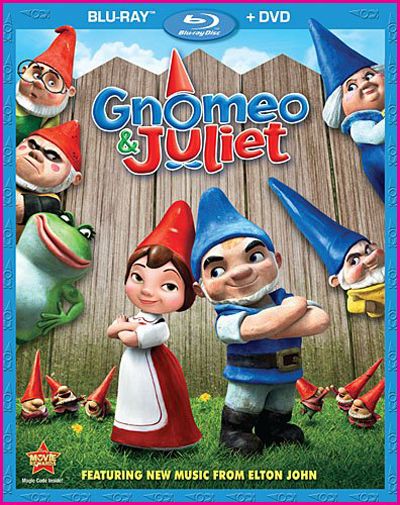
Gnomeo & Juliet (Disney)
If your and your kids’ tastes run to stale garden gnome and Shakespeare jokes, then Gnomeo & Juliet is for you. The colorful animation is all that kept me from nodding off, as neither dialogue nor songs (mostly Elton John retreads) were enough to hold my interest. This movie seemed to be created in a brief meeting: “Let’s do a take-off on Shakespeare!” “And let’ add Elton John music!” “OK, cool!” The clever animation really pops off the screen on Blu-ray; extras include two alternate endings, deleted scenes, Ozzy Osbourne interview, music featurette and a “Crocodile Rock” video.

The Great Dictator (Criterion)
Charlie Chaplin’s brilliantly hilarious Hitler satire was daring back in 1940, and today, even if the edges have worn off, there’s so much comic inventiveness throughout that even Chaplin’s usual sentimentality doesn’t drag the film down but nicely balance things between bold audacity and sticky-sweetness. Criterion’s Blu-ray transfer is absolutely superb: rarely have I seen a 70-year-old film looking so pristine. The usual bountiful Criterion extras include an audio commentary; The Tramp and the Dictator, a 2001 documentary that parallels Chaplin and Hitler; two visual essays; color production footage; and silent-film sequences.

I Am Number Four (Disney)
Director D.J. Caruso’s standard-issue sci-fi fantasy tells a teen-friendly story of an alien who finds danger and love when his cover is blown. Decent action sequences butt heads with by-the-numbers teen romance it’s aimed at the audience that made Twilight such a smash, it’s unsurprising that there’s nothing novel about the whole enterprise. Still, an attractive young cast gamely does its job, and there’s enough to keep one’s interest from flagging. The movie looks terrific on Blu-ray, while extras include deleted scenes, the usual blooper reel and a making-of featurette.

Papillon (Warners)
Franklin J. Schaffner’s 1973 epic stars Steve McQueen as Henri “Papillon” Charriere, whose attempts to escape from the notorious French colony of Devil's Island are recounted. Dustin Hoffman co-stars as his prison sidekick, and with two then-big stars front and center, this is a weird hybrid of Hollywood adventure and French art film. The movie is occasionally rousing good fun, yet rarely reaches the gripping heights its amazing true story is capable of. Now that it’s finally on Blu-ray, the movie definitively hasn’t looked this good (lots of filmic grain, for starters) since it was first released. The lone extra is a featurette, The Extraordinary Rebel.

Platoon (MGM) and Rocky (MGM)
These classics won Best Picture Oscars ten years apart: Rocky, Sylvester Stallone’s one-two writing-acting knockout punch, in 1976; and Platoon, Oliver Stone’s personal recreation of his Vietnam experiences, in 1986. The gritty griminess of Rocky (recreated on the excellent Blu-ray) is as much director John G. Avildsen’s achievement as Stallone’s, while the you-are-there immediacy of Platoon (also given a satisfying Blu-ray transfer) is Stone’s lasting achievement. Shockingly, Rocky has no extras, except for a nice-looking digibook; Platoon includes the original DVD extras, including Stone’s commentary, deleted and extended scenes, featurettes and documentaries.

The Roommate (Sony)
I doubt anyone was clamoring for a remake of Single White Female, the creepy 1992 thriller starring Jennifer Jason Leigh and Bridget Fonda (whatever happened to her?). But here is The Roommate, gliding along to its foregone conclusion slickly and unsurprisingly, with several attractive performers in the leads (including Minka Kelly, whose bigger claim to fame is being Derek Jeter's current girlfriend) and a solid hi-def transfer. The Roommate does its job for its intended audience: those under 25 who’ve never seen Single White Female on TV, video or DVD. Extras include an audio commentary, deleted/alternate scenes, and on-set featurettes.

Solaris (Criterion)
Inscrutable to those wanting more visceral sci-fi adventures, Russian master Andrei Tarkovsky's 1972 masterpiece is more about inner than outer space: the last word in psychological character study, this uncompromising glimpse at the minds of astronauts being controlled by a distant world they are exploring contains the usual Tarkovsky recipe of slow, steady and subtle effects, and if you don’t fall into a very deliberate frame of mind, you’ll never catch up. Evocative and genuinely beautiful visuals are rendered clearly on Criterion’s Blu-ray, with several B&W sequences color-coded correctly. Extras include Tarkovsky scholars‘ commentary, deleted/alternate scenes, video interviews with actress Natalaya Bondarchuk and the film’s cinematographer, art director and composer; and an excerpt from a documentary on Stanislaw Lem, whose novel inspired the film.

DVDs of the Week
Nenette, Every Little Thing, In the Land of the Deaf, Louvre City (Kino)
Nicholas Philibert, arguably the world’s finest documentary filmmaker, is represented by four of his characteristic films. 1990’s Louvre City displays the inner workings of the world’s most important art museum, 1992’s In the Land of the Deaf chronicles the lives of those cut off from the hearing world, and 1997’s Every Little Thing shows psychiatric inmates putting on a play. Philibert’s latest, Nenette, is an enchanting study of the Paris Zoo’s oldest resident: a female orangutan. Philibert’s films fill viewers with enchantment and wonderment while learning more about our world. Two bonus films are included on the Nenette disc: an 11-minute short, Night Falls on the Menagerie, and a 1996 feature about the stuffed animals in Paris’ natural history museum, Animals and More Animals.

CD of the Week
How to Succeed in Business Without Really Trying (Decca)
Rob Ashford’s revival of the classic musical unabashedly wears its datedness on its sleeve. Listening to the new Broadway cast recording reinforces that impression, as Frank Loesser’s memorable score has its share of time-capsule tunes like “Happy to Keep His Dinner Warm.” Still, standards like “Rosemary” and “I Believe in You” are there, and the energetic cast features Rose Hemingway’s sweet ingenue Rosemary and Tammy Blanchard’s hilarious bimbo Hedy La Rue. Star Daniel Radcliffe has a decent singing voice as our hero J. Pierrepont Finch, but not seeing his hard work onstage hampers him a bit. Still, this is an enjoyable listen.

Wednesday, June 1, 2011

Open Roads 2011

Marco Bellocchio's Sorelle mai

Open Roads: New Italian Cinema

June 1-8, 2011
Film Society of Lincoln Center
filmlinc.com

This year’s edition of Open Roads: New Italian Cinema, the Film Society of Lincoln Center’s annual survey, is led by a trio of top-notch non-fiction features. The latest by Oscar-winning director Gabriele Salvatores (Mediterraneo), 1960, cannily assembles archival footage to tell a compelling story of a family searching for its son. 71-year-old master Marco Bellocchio (whose My Mother’s Smile, Good Morning Night and Vincere highlighted recent New York Film Festivals) returns with Sorelle Mai, a personal journey into his family’s life and hometown, Bobbio. Giovanna Taviani’s Return to the Aeolian Islands lovingly explores the isles which were the settings for classics like Antonioni’s L’Avventura and Kaos, the brilliant Pirandello adaptation by the Taviani brothers (one of whom is Giovanna’s father, and the other her uncle).

Several of the fiction features take the pulse of Italian society, with mixed results. 20 Cigarettes, Aureliano Amadei’s pulse-pounding account of an anti-war filmmaker going to Iraq only to become another victim of its random violence, is as volatile and exciting as it is thought-provoking. Contrarily, Love or Slaps is Sergio Castellitto’s frantically unfunny update of Guess Who’s Coming to Dinner in which Castellitto and the always dependable Laura Morante play good liberal parents who are disappointed their daughter’s new boyfriend isn’t black. Working from his wife Margaret Mazzantini’s flaccid script, Castellitto never finds a consistent tone or point of view, finally just spinning his wheels. (The title’s literal translation is The Beauty of the Donkey, which makes no sense in English unless you’ve seen the movie.)

Morante and Castellitto in Love and Slaps

Director Roberta Torre reteams with her marvelous Angela star (and Bellocchio leading lady) Donatello Finocchiaro in the gentle satire Lost Kisses, in which Finocchiaro burns a hole in the screen as the opportunistic mother of a teenager (the wonderful Carla Marchese) who says that the Virgin Mary spoke to her after a new religious statue lost its head. Whatsoeverly, Giulio Manfredonia’s absurdist take on the intersection of politics, media and celebrity, dishes out as much silliness as it does satiric bulls-eyes. Think Trump or Palin in the land of Berlusconi.

The Woman of My Life, with Stefania Sandrelli as the mother of two sons in love with the same woman, is a trite updating of Gabriele Muccino’s superb The Last Kiss, which also featured Sandrelli. Despite an excellent cast and the magnetic presence of Valentina Lodovini (you definitely believe both brothers would fall for her), the movie becomes exhausting as it goes along. Happily, Giorgia Cecere’s debut, The First Assignment, is a modest, self-assured gem about a young teacher (the terrific Isabelle Ragonese) whose first job in an out of the way village doesn’t go as planned.

Sunday, May 29, 2011

May '11 Digital Week IV

Blu-rays of the Week
Farewell
(Neoclassics)
Christian Carion’s cold war drama, based on a true story set in 1981, has two worthy adversaries: French actor Guillaume Canet and Serbian director Emir Kusturica play an engineer and KGB colonel who helped the West bring down the Iron Curtain. Drenched in an authentic period atmosphere (with amusing references to Freddie Mercury and Queen), Farewell is a taut thriller with a splendid cast, including Fred Ward as Ronald Reagan, of all people. The movie has a superior Blu-ray transfer; there are no extras.

Freedom Riders
(PBS)

This enlightening documentary recounts the heroism of several brave American patriots in 1961 who rode buses into the segregated South, where several were arrested and beaten. Still, they helped turn the tide against Jim Crow, which ended with the Civil Rights Act of 1964. Insightful interviews with participants, others who witnessed the events and historians who provided needed context are featured, along with archival footage that gives immediacy to a long, painful struggle. The movie’s visuals have added sharpness on Blu-ray; there are no extras.

Grand Prix (Warners) and The Manchurian Candidate (MGM)
These films show director John Frankenheimer in his prime. 1962’s The Manchurian Candidate is a true nail-biting classic of the paranoid thriller genre, with hard-bitten portrayals by Frank Sinatra, Angela Lansbury and Laurence Harvey complementing a brilliantly created B&W world; 1966’s Grand Prix, however, is three hours of wooden dramatics and explosive car racing throughout Europe, with an attractive international cast (Yves Montand, James Garner, Jessica Harper, Brian Bedford) doing little. Both films have been transferred to Blu-ray with superb results, particularly Grand Prix’s 65mm widescreen panoramas. Extras include featurettes on both releases, with added interviews and a commentary on Candidate.

I Saw the Devil (Magnet) and Vanishing on 7th Street (Magnet)
These horror films approach their stories from opposite angles. Kim Ji Woon’s I Saw the Devil jumps into gory violence from the beginning, as a terrorizing serial killer gets his eventual (and bloody) comeuppance, while Brad Anderson’s Vanishing uses suggestiveness rather than gore to extract suspense from a blackout that causes people to disappear mysteriously. Both movies work on their own terms, although Devil’s bludgeoning wearies and Vanishing’s reticence induces dullness; both also look terrific on Blu-ray. Extras on Devil include behind-the-scenes featurette and deleted scenes; extras on Vanishing include featurettes, interviews and alternate endings.

The Misfits (MGM) and Some Like It Hot (MGM)
Two of Marilyn Monroe’s seminal roles (one dramatic, the other comedic) arrive on hi-def: John Huston’s The Misfits (1961), from Arthur Miller’s treacly script, stars Monroe and Clark Gable in their final onscreen appearances; Billy Wilder’s Some Like It Hot (1959), one of Hollywood’s all-time classics, finds Monroe keeping up with the breakneck pace of Jack Lemmon and Tony Curtis‘s comic chops. Both black and white films look better than on DVD but are not visual knockouts. There are no extras on Misfits; Hot’s DVD extras (commentary and featurettes) are included on the Blu-ray.

The Other Woman (IFC)
Natalie Portman won the Oscar for her tour de force in the ridiculous Black Swan, but that recognition buried any praise for her equally superb work in this tragic character study of a young woman who loses her newborn child and tries to come to terms with how the baby’s death affects her relationship with her husband and stepson and his ex-wife. Portman’s sympathetic portrayal, as in Black Swan, allows us to care about an unlikable woman, even if writer-director Don Roos eventually leaves her (and us) hanging. The film is given a solid Blu-ray transfer; there are no extras.

Pale Flower (Criterion)
Masahiro Shinoda’s Japanese New Wave classic is a strange but compelling drama about a yakuza who, just released from jail, falls in with a compulisve and irresistible gambler. Shinoda’s unerring camera eye, coupled with Toru Takemitsu’s unerring ear (in which natural sounds and silence are as important as his music), make this a powerful experience, even for those already familiar with Shinoda’s better known films like Double Suicide. Criterion’s first-rate transfer, in which the moody B&W photography positively shimmers, does Shinoda proud. Extras include a new Shinoda interview and commentary by Takemitsu expert Peter Grilli.

The Rite (Warners)
On the Blu-ray cover, Anthony Hopkins looks like a demented Hannibal Lecter, which gives the false impression that this somber, unexciting drama is about the unorthodox priest that he plays; rather, it’s about a seminary student learning about exorcism. Either way, it’s basically one long tease: it’s neither intensely scary nor psychologically probing, which makes it vastly inferior to The Exorcist, if you were wondering. The clinical visuals are for the most part rendered acceptably on Blu-ray; extras include deleted scenes, alternate ending, and interview with the priest whose story is told in the film.

DVDs of the Week
British Royal Weddings of the 20th Century (Strike Force)
The Royal Wedding: William & Catherine
(BBC)
William & Kate: Planning a Royal Wedding
(PBS)
There’s been an unsurprising run of releases related to the recent Royal Wedding, as most Americans can’t get enough of all things William and Kate (mostly Kate, and her sister Pippa too). British Royal Weddings of the 20th Century is smartly done, with vintage archival footage of royal weddings from Patricia and Alexander in 1919 to Edward and Sophie in 1999. In all, 17 weddings are featured in three hours. The PBS special Planning a Royal Wedding is a decent 45-minute overview that includes interviews with “experts” about what to expect on the big day. The BBC disc The Royal Wedding is the real thing, however: two hours of BBC’s own wedding coverage in HD, and with a satisfying bonus: a 50-minute special, William & Kate: A Royal Engagement, an informative and entertaining look at the couple’s history together.

CD of the Week
Nino Rota: Symphony No. 3, Etc. (Chandos)
Best known for his Fellini film scores and Godfather music, Nino Rota was also an accomplished composer of concert music, ballets and operas. This disc features three orchestral works, each a wonderful example of Rota’s instantly recognizable style. The Concerto soiree for piano and orchestra is rhythmically lively and just plain catchy, the Divertimento Concertante (for the unlikely combo of double-bass and orchestra) is both light on its feet and seriously thoughtful, and the Symphony No. 3, with less weightiness than its predecessors, nevertheless is another beautifully structured work. The Turin Philharmonic, led by conductor Gianandrea Noseda, makes it all sound so effortless and flavorful, the highest compliment to Rota and his music.

Saturday, May 28, 2011

2011 Tribeca Film Festival

Tribeca Film Festival
April 20-May 1, 2011

tribecafilm.com/festival


The Tribeca Film Festival began in the spring of 2002 as the brainchild of Robert DeNiro, Craig Hatkoff and Jane Rosenthal, who envisioned an event to help united and heal New York City after the September 11 terrorist attacks. Nine years later, Tribeca wraps up its first decade entrenched in the fabric of the city’s cultural life, spreading out into other Manhattan venues and neighborhoods and slowly encroaching on the New York Film Festival (which began in 39 years earlier) as New York’s premier film festival.

Tribeca is a democratic festival comprising more than 100 features (and dozens of shorts, panel discussions and other events); so even dedicated movie buffs who can squeeze in 6 daily screenings throughout the festival would see 66. I saw a baker’s dozen which showed a maturing festival whose depth and breadth of features and documentaries bodes well for its second decade.

The deserved winner of the festival’s Best Actress award, the Netherlands’ Carice van Houten, pictured (Black Book, Valkyrie), gives a fearless portrayal of South African poet Ingrid Jonker in Black Butterflies. Her sublime, unforgettable performance overshadows the rest of Paula van der Oest’s biopic, which has good, intense sequences visualizing Jonker’s tortured psychology but too often falls into the melodramatic trap of too many similar screen biographies. But Houten is such a shattering presence that it rarely matters.

Strong performances also distinguish other features this year. In Catherine Trieschmann’s 
relentlessly downbeat Angels Crest, the accidental death of a toddler—thanks to his young 
father’s carelessness—forces a small town’s inhabitants to deal with their own inadequacies and 
prejudices. But despite a good cast led by Lynn Collins as the boy’s distraught, alcoholic mother, 
Thomas Dekker as the unfortunate dad and Kate Walsh and Elizabeth McGovern as an unlikely pair 
of lovers, the movie never escapes its own melodramatic trappings.

If you want to see the great Irish actor Brendan Gleeson, pictured (The General, In Bruges) knock heads with our very own Don Cheadle (Crash, Hotel Rwanda), then don’t miss John Michael McDonaugh’s uproarious The Guard, a pitch-black comedy about an unorthodox local cop in Galway, Ireland who teams with a visiting FBI agent to break up an international drug smuggling scheme. The maniacal Gleeson, who is on the same wavelength of McDonaugh’s acidic script, gives an exceptionally accomplished demonstration of how to walk the overacting tightrope without falling off. (Sony Pictures Classics; opens July 29)

Movies don’t get much more glamorous than Last Night, Massy Tadjedin’s sophisticated-looking but ultimately superficial examination of a couple dealing with temptations of the flesh and the spirit on the same night. Keira Knightley (who has never looked more ravishing) and Sam Worthington (without Avatar’s blue pigment) play the tempted couple; that he has the chance to cheat with the equally gorgeous Eva Mendes makes his predicament even more difficult, poor guy. A listless Guillaume Canet rounds out the quartet. (Tribeca Film; released May 6)

French director Cedric Klapisch’s boisterous films cram many characters and story lines into their two-hour running times. His most recent, Paris, was among his most diverting; his newest, My Piece of the Pie, wastes a superb cast (led by a luminous Karin Viard) and the director’s effortless sleight-of-hand in cutting back and forth among London, Paris and Dunkirk, a seaside town where his protagonist, an unemployed mother appropriately named France, resides. The first hour is Klapisch at his best, as the precarious global economy and small-town blue-collar struggles bump up against each other, but the second half falls apart as Klapisch muddies his message of responsibility and accountability with a shrill, feel-good revenge ending.

Director Michael Cuesta’s talent for exploring the lives of people on society’s fringes shone through in his unsettling debut L.I.E. He returns to the well again in the overly familiar Roadie, in which Jimmy, long-time Blue Oyster Cult employee, returns to Queens and pretends to be a successful songwriter and producer for the band. Jill Hennessey is delicious as an old flame building her own singing career and Bobby Cannavale (as he does in Win Win) paints another warmly funny portrait of a loser with dreams of grandeur, but Ron Eldard is a wanly unconvincing Jimmy, preventing Roadie from reaching its rather modest aims.

Romantics Anonymous is a movie that only the French (and Belgians) can get away with: an unashamedly winning fairy tale of love found between two terminally shy people thanks to her gift for making chocolate concoctions and his for running the business. Despite (or because of) its straight-faced silliness, director Jean-Pierre Ameris has made a charming 80-minute trifle, with the help of two supremely gifted performers: the delectable Isabelle Carre and the hilarious Benoit Poelvoorde. (Tribeca Film, no release date yet)

A brutish world is vividly if unpleasantly displayed in Serbian director Oleg Novkovic’s White White World, which covers up its essential grimness by occasionally letting its characters break into song. Perhaps if that device was used more coherently, the movie wouldn’t seem like such a grimy downer, even if Miladin Colakovic’s gritty photography and a splendid cast elevate it above its meager interest. The real find is young Hana Selimovic, who gives an amazing performance as the scalded offspring of a woman just released from prison after serving time for killing her husband. To tell more would ruin the movie’s tragic trajectory.

A particularly strong documentary slate is led by Shakespeare High, Alex Routau’s uplifting look at an annual program several California schools participate in, as the students—many of whom come from broken homes or have had tragedy touch their lives thanks to poverty, drugs or gangs—act out Shakespeare’s plays in their own ways, in the process getting their first chance to hone new skills and talents. Routau’s engaging movie include interviews with the program’s most illustrious alumni: Kevin Spacey, Mare Winningham, Val Kilmer and Richard Dreyfuss.

The festival’s most timely film, Revenge of the Electric Car, is a rare documentary sequel. The original Who Killed the Electric Car? showed how quickly automakers wanted to eliminate the car that could have changed their industry, and Chris Paine’s follow-up displays that, in a totally different landscape of a failed economy and high oil prices, electric cars are—surprise!—making a comeback. Such a prescient, philosophical and entertaining treatise as Revenge of the Electric Car should be must-viewing for anyone involved in “fixing” our broken economy.

The Miners’ Hymns, Bill Morrison’s provocative, dream-like reminiscence, comprises newly restored British Film Institute footage of coal miners working below the earth and their families celebrating what seemed an unassailable way of life. Morrison’s evocative imagery shows what remains of the mine locations today and provides a glimpse of a hard-working generation that sometimes gave their lives in a most dangerous, and thankless, occupation.

Yugoslavia’s national cinema pretty much disappeared after President Tito’s death in 1980. But as Mila Turajlic’s Cinema Komunisto entertainingly and educationally shows, it was one of the most stable and efficiently run cinemas in Europe for many decades. With a plethora of clips, archival footage and interviews with filmmakers, actors, producers and even Tito’s personal projectionist, the documentary is an elegy for a lost cinematic history that’s also practical: it points out that even a notable success like 1969′s Oscar-nominated The Battle of Neretva had the distinction of blowing up an actual bridge twice for a pivotal shot that didn’t even end up in the film. Maybe that could stand as a metaphor for what happened to this once-thriving industry.

There’s only one Carol Channing, and the aptly named Carol Channing: Larger than L presents the now 90-year-old Broadway legend in her element, giving viewers a tour of her eventful life and career, from her childhood to her classic performance in Hello Dolly to her finding love a man with a man she hadn’t seen in 70 years since junior high, Harry Kujilian, whom she married in 2003. Dori Berinstein’s affectionate portrait of the ultimate, if offbeat, Broadway baby is 83 minutes of pure bliss.

Thursday, May 26, 2011

Two Couples, One Baby


Dizzia and Keller in Cradle and All (photo by Joan Marcus)

Cradle and All
Written by Daniel Goldfarb
Directed by Sam Buntrock
Starring Maria Dizzia, Greg Keller

Performances through June 19, 2011
Manhattan Theatre Club, New York City Center, 131 West 55th Street
manhattantheatreclub.com

Daniel Goldfarb’s The Retributionists might have reduced Nazi-era horrors to mere soap opera, but his slight new comedy Cradle and All engagingly shows how having (or not having) a child affects two couples in the same Brooklyn Heights apartment building.

The first half, Infantry, introduces Claire, a 39-year-old (or is it 41?) former movie actress whose fertility clock is winding down. She tells reluctant boyfriend Luke that she wants a baby, triggering confessional soul-searching on her part (he’s pretty much reduced to a listener). The second half, The Extinction Method, set in the apartment down the hall, has zombified parents Annie and Nate trying one last-ditch attempt to get their 11-month-old daughter to fall asleep without placating her, however long she cries. Needless to say, she carries on for hours, driving them to reexamine their very relationship.

Throughout Cradle and All, Goldfarb shows a knack for how adults deal with momentous events missing from The Retributionists: his clever dialogue catches all the attendant recriminations, insults and occasional reconciliations, even if much of what happens remains superficial.

Although The Extinction Method seems more successful because there are more laughs, I actually liked the more somber Infantry, and not merely because too many of Method’s jokes are repeated (how many times can we hear the baby’s screaming and the couple’s increasingly harried attempts to deal with it?). Infantry actually tries to bring a character to life, as Claire gives a lengthy speech, punctuated by Luke’s interjections, that explains her motives for wanting a baby at this time in her life. Maria Dizzia, giving a splendid and moving reading, actually makes us feel for Claire, personalizing her predicament in ways that Goldfarb only hints at in his writing,.

Dizzia is as convincingly frumpy as overtired mother Annie in Method as she is ravishingly desperate in Infantry; conversely, Greg Keller, who doesn’t make much of an impression in Infantry because Goldfarb isn’t as interested in Luke, works harder and more effectively as Method's Nate.

Goldfarb’s ear for how these people talk is hampered by too much pop culture name-checking, as references to Mad Men, Keanu Reeves, Blue Man Group, Tyra Banks, James Lipton and The Daily Show abound. The playwright does hit on trenchant lines, as how young girls engaging in oral sex in grade school are “part of the Clinton legacy,” and the final dialogue between Annie and Nate while they prepare to have sex for the first time since her pregnancy has an appropriately acidic edge to its humor.

Sam Buntrock’s by-the-numbers direction of Infantry gives way to the livelier Method, likely due to the second half’s lighter touch. Both of Neil Patel’s apartment sets are so dead-on in their details that one wants to move right in: but only if these couples and their baby problems are jettisoned.

Sunday, May 22, 2011

May '11 Digital Week III

This summary is not available. Please click here to view the post.

Friday, May 20, 2011

Dad-to-Be Blues

Chaplin and Barron in Knickerbocker (photo by Carol Rosegg)
Knickerbocker
Written by Jonathan Marc Sherman
Directed by Pippin Parker
Starring Mia Barron, Alexander Chaplin, Bob Dishy, Christina Kirk, Drew Madland, Zak Orth, Ben Shenkman

Performances through May 29, 2011
Public Theater, 425 Lafayette Street
publictheater.org

In Jonathan Marc Sherman’s agreeably slight Knickerbocker, impending fatherhood haunts 40-year-old Jerry, whose anxiety contrasts with wife Pauline’s levelheadedness. The first of seven scenes, which introduces the couple, with Pauline three months into her pregnancy, shows them good-naturedly picking a name for their peach-sized unborn son.

Six more scenes follow in the six months counting down to the big day in October, all set in Jerry’s favorite restaurant in the neighborhood near the Public Theater. After Pauline’s first appearance (she returns in July and October), there’s his best friend, straight-shooting Melvin; his former but still flirty girlfriend, Tara; his other best friend, unrepentant stoner Chester; and his father, Raymond.

Knickerbocker is a series of vignettes, some funny, some more serious, but none probing all that deeply, thanks to Sherman’s labored dialogue. The best moments come during Jerry’s rather touching talk with his dad, which goes for sentiment instead of the easy laughs sprinkled throughout the rest of the play. (Do we really need to hear Jerry and Tara discuss how his sperm tastes or her taking her shirt off at a Who concert, or Charles being happily oblivious to maturity or responsibility?)

It’s unfortunate that Sherman ends Knickerbocker with one final Jerry-Pauline scene the day before she enters the hospital for her C-section, because it spoils the gentle poignance of Jerry reminiscing with his father.

Christina Kirk (Tara) and Zak Orth (Chester) overdo their admittedly caricatured parts, while Mia Barron makes an engaging Pauline, Ben Shenkman a nicely restrained Melvin and Bob Dishy an amusingly flustered Raymond. Alexander Chaplin, the lone actor onstage for the entire play, amiably plays off the rest of the cast.

Pippin Parker’s efficient staging, which uses one semi-circular restaurant table for all the scenes, doesn’t solve a big sightline problem: the back of one performer’s head often faces certain members of the audience. (The titles that introduce each scene are also not visible to some viewers.) Knickerbocker, finally, has too few insights to compensate for its overreliance on a certain quirkiness that first amuses then sags.

Wednesday, May 18, 2011

The Housewife from New Jersey

Leavel and Louis in Baby It's You! (photo by Ari Mintz)
Baby It’s You!
Book by Floyd Mutrux and Colin Escott
Choreographed by Birgitte Mutrux
Directed by Floyd Mutrux and Sheldon Epps
Starring Beth Leavel, Allan Louis, Geno Henderson, Erica Ash, Kelli Barrett, Kyra DaCosta, Erica Dorfler, JahI A. Kearse, Barry Pearl, Christina Sajous, Crystal Starr, Brandon Uranowitz

Performances through September 4, 2011
Broadhurst Theatre, 235 West 44th Street
babyitsyouonbroadway.com

As jukebox musicals go, Baby It’s You! is closer to Jersey Boys than Momma Mia: maybe not in quality, but in its use of music to tell a true story rather than a fabricated soap opera. The early ‘60s hit-making girl group the Shirelles’ songs form the skeleton of this stage bio of Florence Greenberg, a typical Jewish housewife from Passaic who became the quartet’s manager and steered them to short-lived success.

Greenberg’s story—which touches on always-pertinent topics like music biz racism and sexism, even if they’re simply name-checked without delving too deeply before returning to the hit parade—personalizes Baby It’s You! in a way that jazzes up creator/co-director Floyd Mutrux’s otherwise rote “band history” comedy-drama, whose 2-½ hour running time is dominated but a slog through several years of pop history before the Beatles invaded America and changed everything in 1964.

Florence deals with her increasingly fractious (and melodramatic) home life: nagging husband Bernie believes her music “hobby” is just a phase, their blind son Stanley writes his own minor hit songs, and her daughter Mary Jane—who discovered the Shirelles in high school—is put off by the fact that Florence is more of a mother to those four young women than to her. Then there are the issues she faces on the business side: as the lone female, she learns the hard way that it’s a dog-eat-dog world, while her love affair with Luther Dixon, the black songwriter who becomes her record-label partner, is frowned upon by all parties, personal and professional.

But Baby It’s You doesn’t trust Florence’s story alone to keep interest, so Mutrux and Colin Escott’s choppy book provides a narrator, a DJ named Jocko, who explains things and checks off what was popular on TV and at the movies for certain years (1960 Best Picture Oscar, The Apartment; Best Actress, Liz Taylor). The first act moves quickly as we get caught up in Florence’s liberation and the Shirelles’ rise to fame; the second act, conversely, is padded by so many song interludes (performances by Lesley Gore, Dionne Warwick, Gene Chandler and Kingsman) that the crumbling of Florence’s marriage, her relationship with Luther and the Shirelles’ career all seem like afterthoughts.

But the audience doesn’t care: they came to hear dozens of the hits of yesteryear, and they get them. Shirelles’ hits like “Dedicated to the One I Love,” “Soldier Boy” and the Bert Bacharach-Hal David title song preside, but there are also Dionne Warwick’s “Don’t Make Me Over” and “Walk on By,” and others like “Since I Don’t Have You,” “Duke of Earl” and “Louie Louie.” The Shirelles’ biggest hit, the Carole King-penned Number One smash “Will You Love Me Tomorrow,” is not in the show, apparently because King may create her own musical someday.

An ace onstage band knocks out these and other tunes, and the performers have a blast belting them: Erica Ash, Kyra Da Costa, Crystal Starr and Christina Sajous are a vocally formidable quartet as the Shirelles, with Ash doing additional good work as Dionne Warwick. Geno Henderson and Allan Louis make memorable music as Jocko and Luther, respectively.

The always-amazing Kelli Barrett, who’s been treated badly by Broadway (she was delightful in the otherwise forgettable Rock of Ages off-Broadway, but was not in it when it transferred), gets only a few song showcases as (mostly) Mary Jane and (once) Lesley Gore, but she stops the show each time. Tony-nominated Beth Leavel grabs the part of Florence by the throat and, with a powerhouse voice and charismatic stage presence, transforms a caricature into an indelible portrait of a Jersey housewife finding herself in the Big Apple.